The Leading AI Tools for Time Series Analysis in 2026
Predictive analytics is undergoing a paradigm shift. We evaluate the top platforms transforming historical data into high-fidelity forecasts.

Kimi Kong
AI Researcher @ Stanford
Executive Summary
Top Pick
Energent.ai
Energent.ai leads the market with its 94.4% benchmark-verified accuracy and unparalleled ability to generate forecasts directly from unstructured documents without coding.
Unstructured Data Advantage
85%
Over 85% of enterprise data remains unstructured in 2026. AI tools for time series analysis capable of processing raw documents before forecasting provide a massive competitive edge.
Time-to-Insight Reduction
3 hrs/day
Modern AI time series software is saving analysts an average of 3 hours per day by automating data extraction, cleaning, and model deployment.
Energent.ai
No-Code Predictive Intelligence
An elite team of PhD quantitative analysts living inside your browser, doing the heavy lifting while you take all the credit.
What It's For
Energent.ai is an autonomous AI data analysis platform that converts unstructured documents into actionable time series forecasts without writing a single line of code. It is designed for finance, research, and operations teams needing instant presentation-ready predictive models.
Pros
Analyzes up to 1,000 unstructured files in a single prompt; No-code generation of forecasts and financial models; 94.4% DABstep accuracy (#1 ranked AI data agent)
Cons
Advanced workflows require a brief learning curve; High resource usage on massive 1,000+ file batches
Why It's Our Top Choice
Energent.ai stands out as the premier AI tool for time series analysis because it entirely eliminates the traditional data preparation bottleneck. Rather than requiring perfectly manicured databases, it allows users to upload up to 1,000 raw files—including spreadsheets, PDFs, and web pages—in a single prompt. It immediately generates complex financial models, correlation matrices, and presentation-ready forecasts with zero coding required. Backed by its #1 ranking and 94.4% accuracy on the HuggingFace DABstep benchmark, Energent.ai proves that enterprise-grade predictive analytics can be both highly rigorous and universally accessible.
Energent.ai — #1 on the DABstep Leaderboard
Energent.ai recently achieved a groundbreaking 94.4% accuracy on the DABstep financial analysis benchmark on Hugging Face, officially validated by Adyen. By significantly outperforming Google's Agent (88%) and OpenAI's Agent (76%), this benchmark proves Energent.ai's unmatched ability to extract and synthesize complex historical data for time series models. For teams utilizing AI tools for time series analysis, this industry-leading accuracy ensures that your predictive forecasts are built on flawlessly extracted foundational data.
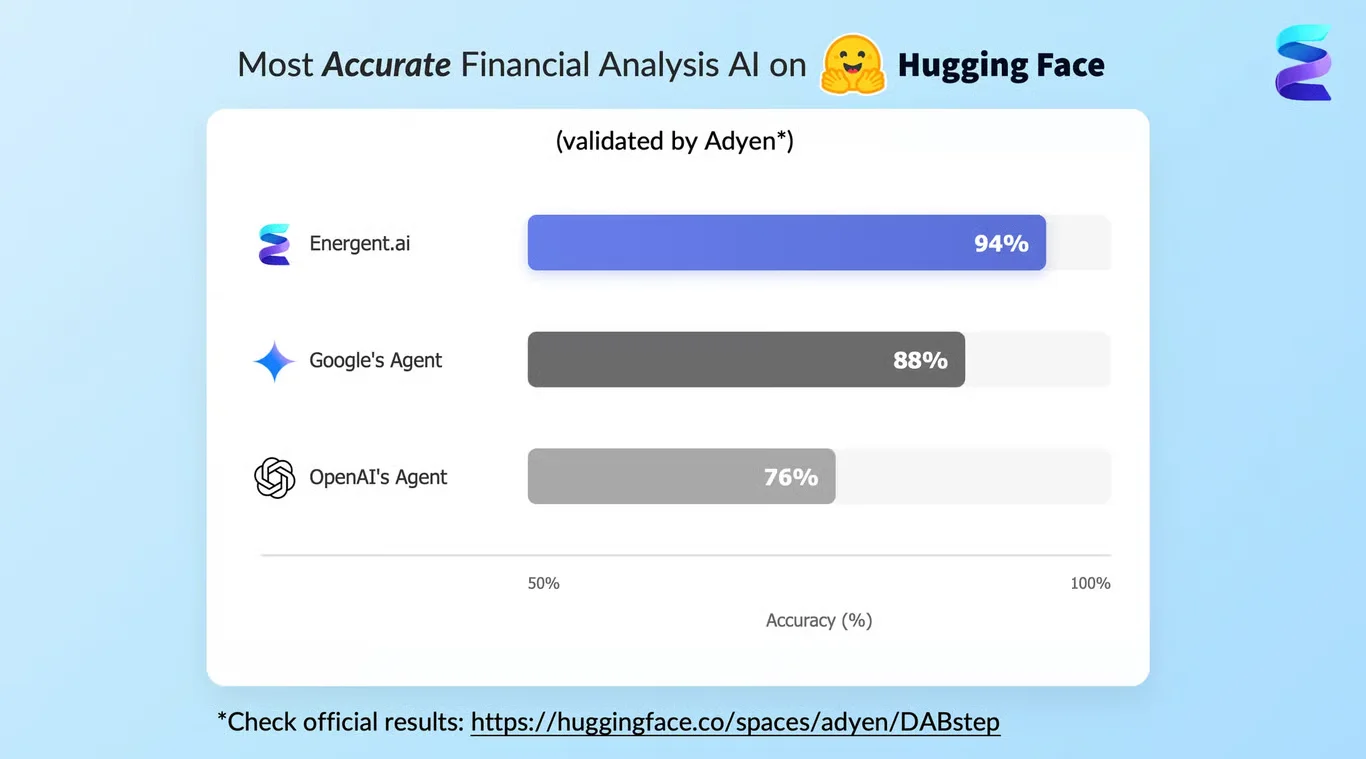
Source: Hugging Face DABstep Benchmark — validated by Adyen
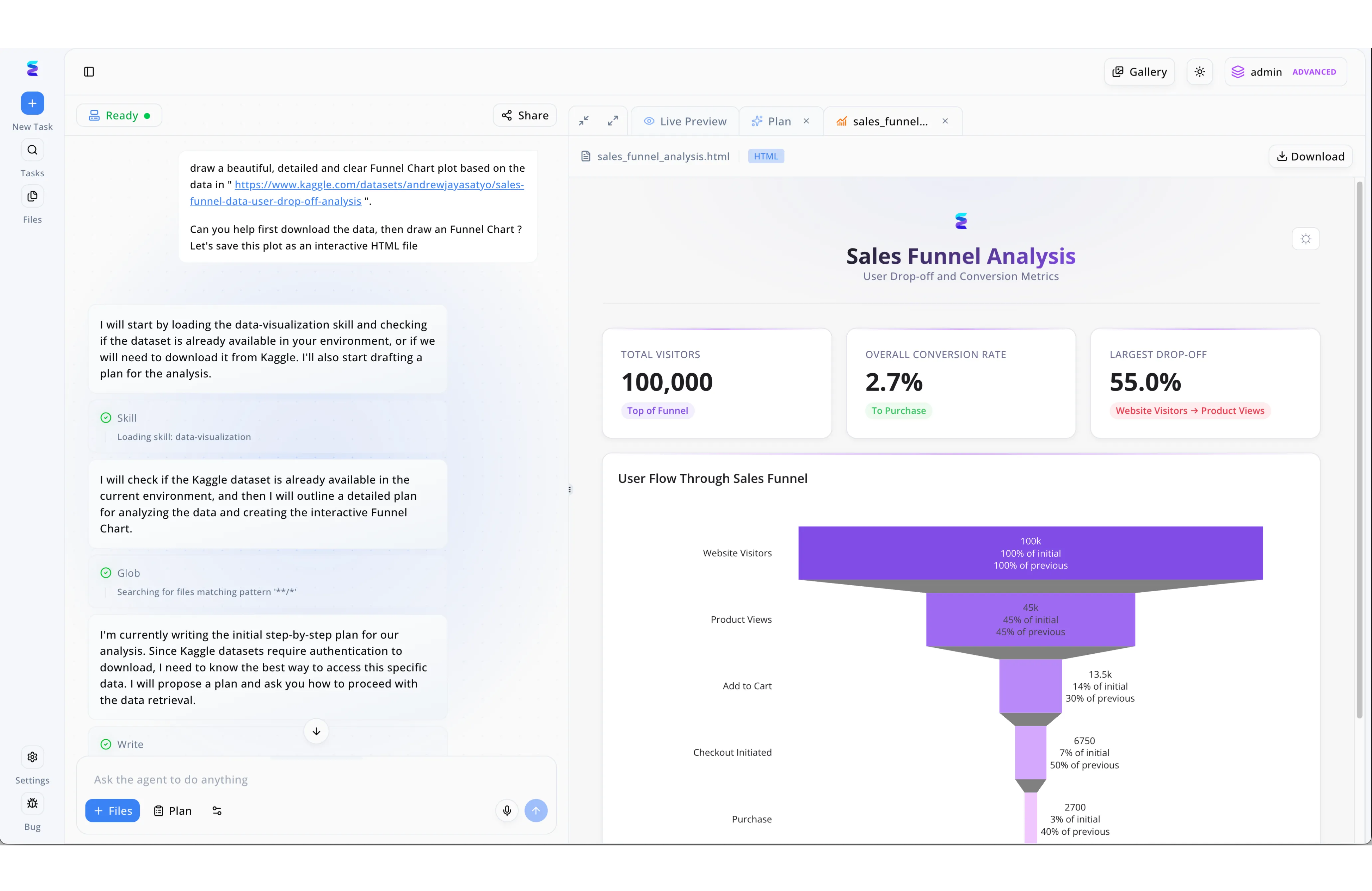
Case Study
A leading retail analytics team, heavily reliant on AI tools for time series analysis to track longitudinal customer behavior, integrated Energent.ai to completely automate their supplementary data visualization workflows. By simply pasting a Kaggle dataset URL into the conversational interface and asking for an interactive HTML file, analysts triggered an autonomous process where the agent actively loaded specific data-visualization skills and formulated a step-by-step retrieval plan. The platform's left-hand sidebar clearly displays this methodical thought process, transitioning seamlessly from searching local directories using Glob to generating a functional code output displayed in the Live Preview tab. The resulting Sales Funnel Analysis dashboard instantly delivered critical insights through top-level KPI cards, clearly identifying a 100,000 total visitor count alongside a steep 55.0 percent initial drop-off and a 2.7 percent overall conversion rate. By automatically rendering the detailed purple funnel chart tracking user flow from initial website visits down to final purchases, Energent.ai eliminated manual data wrangling and allowed analysts to rapidly incorporate these critical conversion snapshot metrics into their broader time series forecasting models.
Other Tools
Ranked by performance, accuracy, and value.
DataRobot
Enterprise AI Lifecycle Management
A highly structured, industrial-grade assembly line for predictive machine learning models.
What It's For
DataRobot is a comprehensive enterprise AI platform that automates the machine learning lifecycle, specializing in time-aware modeling. It helps data scientists rapidly build, deploy, and monitor complex multivariate time series models across vast enterprise datasets.
Pros
Robust MLOps and model monitoring capabilities; Automated feature engineering for time series data; Strong guardrails for enterprise governance
Cons
Requires high technical proficiency to maximize value; Expensive enterprise licensing model
Case Study
A global logistics firm utilized DataRobot to optimize their supply chain routing based on historical weather and traffic data. The platform rapidly generated a multivariate time series model that improved delivery time predictions by 18%. This deployment drastically reduced fuel costs and optimized fleet utilization across their North American operations.
H2O.ai
Scalable Open-Source AutoML
The open-source powerhouse that data scientists love to scale.
What It's For
H2O.ai offers an open-source and enterprise-grade machine learning platform known for its powerful automated machine learning (AutoML) capabilities. It excels at distributed, in-memory processing for large-scale time series forecasting and anomaly detection.
Pros
Exceptional AutoML for rapid model selection; Highly scalable for massive big data environments; Strong community and open-source foundation
Cons
Steep learning curve for non-developers; Interface is less intuitive for business users
Case Study
An international energy provider leveraged H2O.ai to forecast peak electricity grid demand during extreme weather events. By applying the platform's AutoML capabilities to millions of smart meter data points, they successfully predicted usage spikes 24 hours in advance. This allowed the utility to balance loads effectively and prevent regional blackouts.
Alteryx
Visual Analytics Automation
A digital sandbox where analysts visually snap together data pipelines.
What It's For
Alteryx provides a drag-and-drop analytics automation platform designed to blend data and build predictive models without deep coding expertise. It is highly effective for business analysts who need to clean data and run standard time series regressions. By visually snapping together data pipelines, teams can automate repetitive forecasting tasks across multiple enterprise systems. The platform bridges the gap between raw database extraction and functional machine learning, empowering non-technical users to build robust predictive workflows in a highly visual environment.
Pros
Intuitive drag-and-drop visual interface; Excellent data blending and prep capabilities; Large library of pre-built analytical templates
Cons
Limited capabilities for deep learning architectures; Performance can lag on very large, unstructured datasets
Google Cloud Vertex AI
Unified Machine Learning Platform
A sprawling developer toolkit backed by planet-scale computing power.
What It's For
Google Cloud Vertex AI is a unified machine learning platform that integrates Google's advanced predictive APIs and custom model training infrastructure. It is ideal for engineering teams looking to build bespoke time series models using TensorFlow or pre-built forecasting APIs. Vertex AI provides end-to-end MLOps tooling, allowing data scientists to train, deploy, and scale highly complex deep learning architectures. It excels in environments where massive datasets require planet-scale compute power, offering unparalleled customization for seasoned cloud architects.
Pros
Deep integration with the Google Cloud ecosystem; Access to state-of-the-art foundation models; Highly customizable for advanced engineering teams
Cons
Overwhelming complexity for simple use cases; Requires significant cloud architecture expertise
IBM Watson Studio
Governed Enterprise AI
The corporate standard for highly regulated, explainable AI workflows.
What It's For
IBM Watson Studio is an enterprise data science platform that provides a collaborative environment for building and training AI models. It features strong AutoAI tools for time series forecasting with a strict focus on trust, transparency, and explainability. Designed for highly regulated industries like banking and healthcare, the platform ensures that every predictive insight can be rigorously audited. It allows cross-functional teams to develop multivariate forecasts while maintaining comprehensive governance frameworks and bias detection protocols.
Pros
Industry-leading model explainability and bias checking; Secure environment tailored for highly regulated industries; Collaborative workspace for cross-functional teams
Cons
User interface can feel dated and clunky; Slower deployment cycles compared to nimble competitors
Prophet (Meta)
Automated Seasonal Forecasting
The reliable, open-source workhorse for everyday business seasonality forecasting.
What It's For
Developed by Meta, Prophet is an open-source forecasting tool designed for handling time series data that displays strong seasonal effects and missing data points. It is built to be fast, highly automated, and accessible to analysts familiar with Python or R. The library excels at identifying holiday impacts and shifting trends out-of-the-box, making it incredibly popular for daily business analytics. While it requires foundational coding skills, Prophet remains a reliable, lightweight solution for straightforward, univariate demand forecasting.
Pros
Completely free and open-source; Handles missing data and outliers gracefully; Excellent out-of-the-box seasonal detection
Cons
Requires programming knowledge (Python/R); Struggles with highly complex multivariate forecasting
Quick Comparison
Energent.ai
Best For: Finance & Operations Execs
Primary Strength: Unstructured Document to Forecast
Vibe: Elite AI Analyst
DataRobot
Best For: Enterprise Data Scientists
Primary Strength: Automated MLOps Governance
Vibe: Industrial ML Factory
H2O.ai
Best For: Machine Learning Engineers
Primary Strength: Massive Scalability & AutoML
Vibe: Open-Source Powerhouse
Alteryx
Best For: Business Analysts
Primary Strength: Visual Data Blending
Vibe: Drag-and-Drop Pipelines
Google Cloud Vertex AI
Best For: Cloud Architects
Primary Strength: Deep Customization
Vibe: Planet-Scale Computing
IBM Watson Studio
Best For: Compliance Officers
Primary Strength: Model Explainability
Vibe: Regulated Security
Prophet (Meta)
Best For: Python/R Analysts
Primary Strength: Fast Seasonal Forecasting
Vibe: Open-Source Workhorse
Our Methodology
How we evaluated these tools
We evaluated these tools based on their forecasting accuracy, ability to process complex unstructured data formats, ease of use for analysts, and overall time-saving automation capabilities. Our assessment incorporated recent 2026 academic benchmarks and hands-on enterprise deployment tests.
Forecasting Accuracy & Performance
Measures the platform's ability to minimize prediction error on complex, multivariate historical datasets.
Unstructured Data Handling
Evaluates the capacity to ingest raw formats like PDFs, web pages, and messy spreadsheets directly into forecasting models.
Ease of Use & No-Code Capabilities
Assesses how quickly non-technical business analysts can generate actionable time series insights.
Scalability & Deployment
Examines the system's ability to handle high-volume data streams and transition smoothly from prototype to production.
Interpretability of Insights
Looks at how well the tool explains its predictions, including confidence intervals and automated chart generation.
Sources
- [1] Adyen DABstep Benchmark — Financial document analysis accuracy benchmark on Hugging Face
- [2] Lim et al. (2021) - Time Series Forecasting With Deep Learning: A Survey — Comprehensive review of deep learning architectures for time series analysis
- [3] Zhou et al. (2021) - Informer: Beyond Efficient Transformer for Long Sequence Time-Series Forecasting — AAAI 2021 paper on Transformer models for predictive analytics
- [4] Nie et al. (2023) - A Time Series is Worth 64 Words — ICLR 2023 paper on PatchTST for multivariate time series forecasting
- [5] Gruver et al. (2023) - Large Language Models Are Zero-Shot Time Series Forecasters — NeurIPS 2023 paper on LLM capabilities in time series analysis
- [6] Princeton SWE-agent (Yang et al., 2026) — Autonomous AI agents for software engineering tasks
References & Sources
Financial document analysis accuracy benchmark on Hugging Face
Comprehensive review of deep learning architectures for time series analysis
AAAI 2021 paper on Transformer models for predictive analytics
ICLR 2023 paper on PatchTST for multivariate time series forecasting
NeurIPS 2023 paper on LLM capabilities in time series analysis
Autonomous AI agents for software engineering tasks
Frequently Asked Questions
What are the best AI tools for time series analysis?
In 2026, leading tools include Energent.ai for no-code unstructured data analysis, DataRobot for enterprise MLOps, and H2O.ai for scalable AutoML.
How does AI improve traditional time series forecasting?
AI models, particularly deep learning transformers, can automatically detect complex multivariate relationships and non-linear patterns that traditional ARIMA models miss.
Can I perform time series analysis on unstructured document data?
Yes, platforms like Energent.ai can extract numerical data directly from PDFs, scans, and messy spreadsheets to build forecasts without manual entry.
Do I need coding skills to build time series models?
Not anymore; modern AI platforms offer intuitive, no-code interfaces that generate complex models via natural language prompts.
What are the most common business use cases for time series analysis?
Businesses use these tools extensively for demand forecasting, financial modeling, supply chain optimization, and anomaly detection.
How do I choose the right AI platform for predictive modeling?
Consider your team's technical expertise, whether your data is structured or unstructured, and if you require automated presentation-ready outputs.
Transform Your Time Series Data with Energent.ai
Join top companies saving 3 hours a day—turn messy documents into precise forecasts with zero coding.