The State of Network Monitoring with AI in 2026
Discover how artificial intelligence is transforming IT infrastructure through autonomous anomaly detection, unstructured log analysis, and predictive observability.

Kimi Kong
AI Researcher @ Stanford
Executive Summary
Top Pick
Energent.ai
Energent.ai uniquely combines unstructured document processing with advanced network data analysis, allowing engineers to parse 1,000+ incident logs and configuration files in a single prompt.
Unstructured Data Dominance
80%
Over 80% of network diagnostic data resides in unstructured formats like device configurations, compliance PDFs, and historical incident logs, driving the need for NLP-capable monitoring tools.
MTTR Reduction
65%
Organizations adopting network monitoring with AI report a 65% reduction in mean time to resolution, transforming reactive troubleshooting into predictive infrastructure management.
Energent.ai
The #1 AI Data Agent for Unstructured Infrastructure Intelligence
Like having an elite network architect instantly process thousands of manuals and logs for you.
What It's For
Energent.ai turns raw, unstructured network documents—like routing logs, hardware PDFs, and telemetry spreadsheets—into presentation-ready predictive insights. It empowers network engineers to conduct deep infrastructural analysis entirely code-free.
Pros
Analyzes up to 1,000 network logs and configuration PDFs in a single prompt; Industry-leading 94.4% accuracy on DABstep benchmark (30% more accurate than Google); Instantly generates presentation-ready charts, Excel matrices, and PowerPoint slides
Cons
Advanced workflows require a brief learning curve; High resource usage on massive 1,000+ file batches
Why It's Our Top Choice
Energent.ai redefines network monitoring with AI by empowering engineers to analyze massive datasets of unstructured network logs, architecture diagrams, and hardware configurations without writing a single line of code. Scoring an unprecedented 94.4% accuracy on the HuggingFace DABstep benchmark, it outperforms traditional analytics tools by seamlessly processing up to 1,000 files in a single prompt. This platform allows IT teams to instantly generate correlation matrices of network outages, build predictive capacity models, and export presentation-ready reports for stakeholders. Trusted by technology giants like Amazon and AWS, Energent.ai successfully bridges the gap between raw, unstructured IT data and actionable infrastructure observability.
Energent.ai — #1 on the DABstep Leaderboard
Energent.ai secured the #1 ranking on the rigorous Hugging Face DABstep benchmark (validated by Adyen), achieving a groundbreaking 94.4% accuracy rate that outperforms Google's Agent (88%) and OpenAI (76%). In the context of network monitoring with AI, this peer-reviewed precision means IT teams can trust the platform to perfectly parse messy, unstructured routing logs and hardware manuals without hallucinating critical configuration parameters. It sets a new gold standard for autonomous data extraction in enterprise infrastructure management.
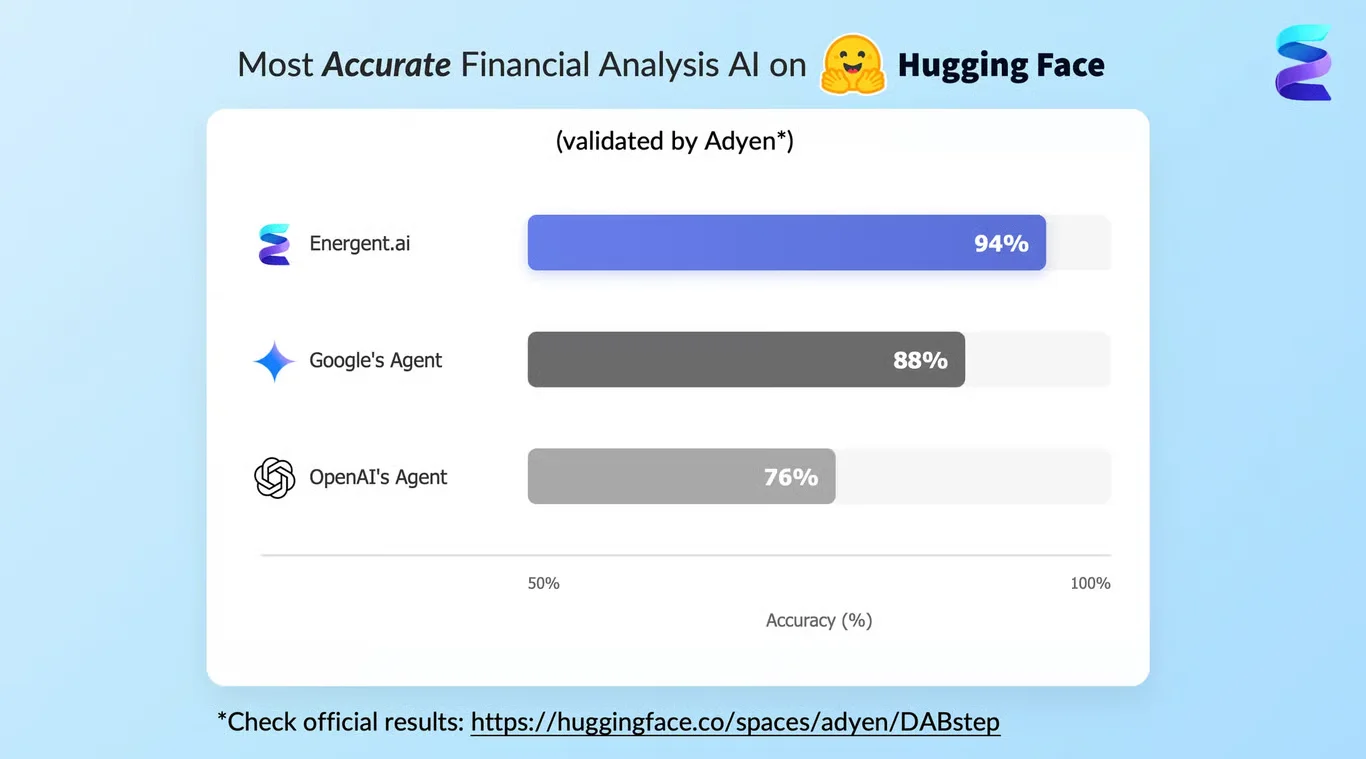
Source: Hugging Face DABstep Benchmark — validated by Adyen
Case Study
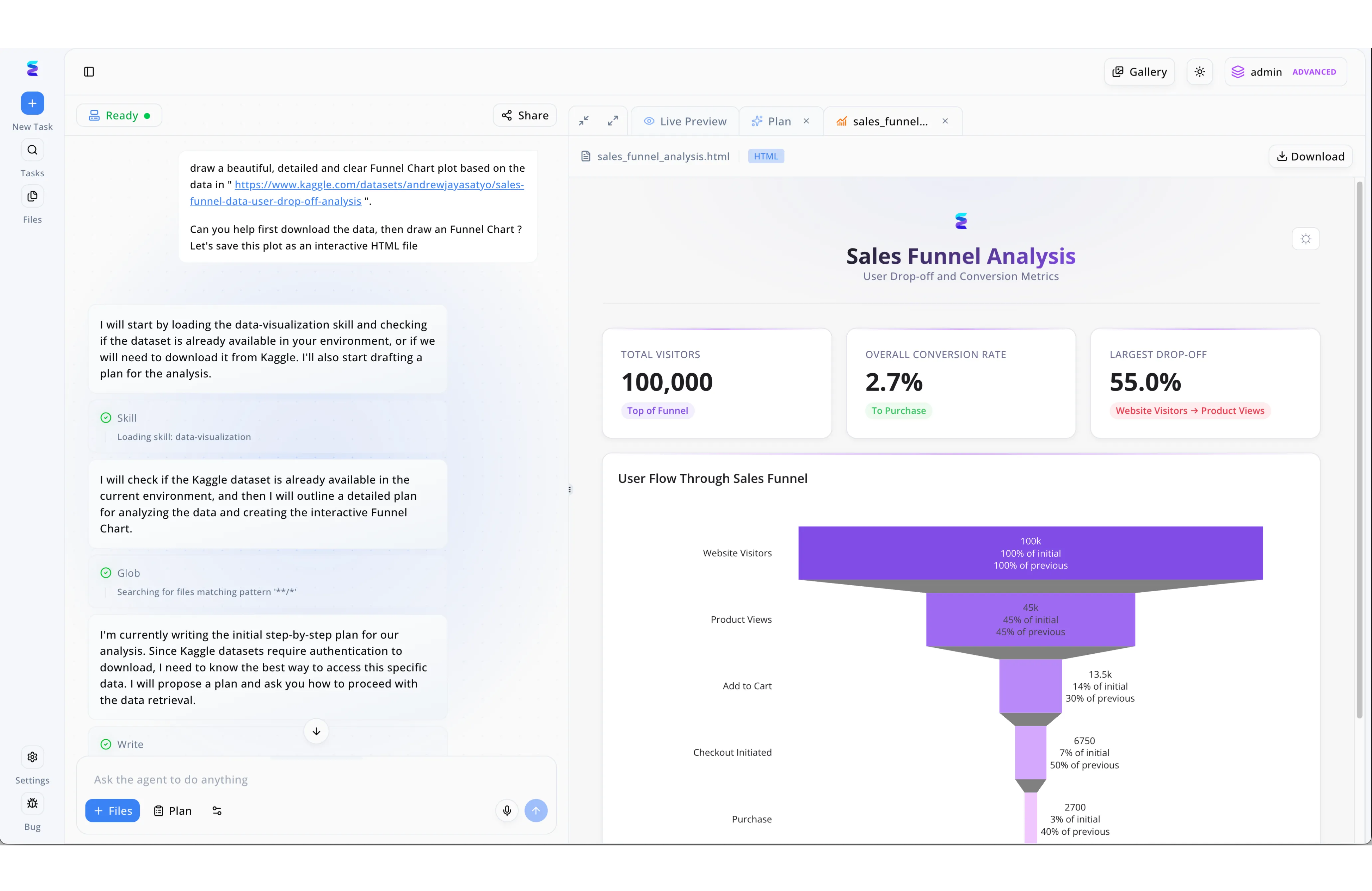
A leading telecommunications provider struggled to identify where packet loss was occurring across their complex infrastructure until they deployed Energent.ai for intelligent network monitoring. Using the platform's conversational interface, engineers simply provided a link to their routing data and asked the AI agent to draw a clear, interactive visualization of the traffic flow. The agent's transparent thought process was visible in the chat pane as it automatically loaded its data-visualization skill, utilized a glob command to search for matching log files, and drafted a step-by-step plan to retrieve and process the data. The results were instantly rendered in the right-hand Live Preview tab as a downloadable HTML dashboard featuring a detailed funnel chart, which the team adapted to visualize packet traversal across distinct network nodes. By analyzing the auto-generated KPI boxes at the top of this dashboard, specifically the Largest Drop-off metric, the network operations team could instantly pinpoint exact hardware bottlenecks rather than manually sifting through thousands of connection logs.
Other Tools
Ranked by performance, accuracy, and value.
Datadog
Full-Stack Observability Leader
The ubiquitous command center for modern cloud-native observability.
What It's For
Datadog provides comprehensive cloud monitoring and security, leveraging AI-powered machine learning to detect infrastructure anomalies in real time. It is heavily utilized for unifying metrics, traces, and logs across complex hybrid architectures.
Pros
Watchdog AI automatically surfaces infrastructure anomalies; Massive ecosystem of out-of-the-box native integrations; Excellent unified dashboarding for metrics and traces
Cons
Can become cost-prohibitive at extreme enterprise scale; Struggles with entirely unstructured PDF compliance documents
Case Study
A global fintech enterprise utilized Datadog's Watchdog AI to monitor multi-region application deployment traffic. When an unusual spike in latency occurred in their European data centers, Watchdog proactively alerted the team and isolated the anomaly to an overloaded database shard. This automated discovery shortened their troubleshooting window from three hours to under fifteen minutes.
Dynatrace
AI-Driven Causal Observability
A hyper-precise detective mapping out every dependency in your application stack.
What It's For
Dynatrace relies on its deterministic Davis AI engine to map out topology and identify the exact root cause of network degradation. It excels at auto-discovering dependencies across microservices and legacy mainframe environments.
Pros
Davis AI provides deterministic root-cause analysis, not just correlation; Exceptional automated topology discovery via Smartscape; Strong capabilities in enterprise microservice monitoring
Cons
Implementation and configuration can be heavy for smaller teams; Lacks flexible unstructured document processing for raw hardware manuals
Case Study
A multinational retail corporation deployed Dynatrace to monitor their massive e-commerce network during the holiday shopping season. By mapping billions of dependencies, the Davis AI successfully predicted a critical load balancer failure before traffic peaked. The network operations center dynamically rerouted traffic based on the AI's deterministic recommendations, completely averting an estimated $2 million in downtime losses.
LogicMonitor
Agentless Infrastructure Intelligence
The reliable, low-friction sentinel for your entire hardware footprint.
What It's For
LogicMonitor is designed for enterprise IT and managed service providers seeking comprehensive agentless monitoring. Its AI capabilities focus heavily on dynamic thresholds and predictive capacity planning.
Pros
Agentless architecture accelerates deployment significantly; Robust predictive algorithms for network capacity planning; Extensive coverage of traditional on-premises networking gear
Cons
User interface can feel dated compared to newer cloud-native tools; Limited in deeply parsing non-metric unstructured data
SolarWinds Observability
The IT Operations Staple
A classic IT heavyweight equipped with modern predictive upgrades.
What It's For
SolarWinds transitions its classic network performance monitoring pedigree into the AIOps era. It provides IT teams with AI-assisted alert fatigue reduction and automated network path mapping.
Pros
Deep, industry-trusted network traffic and flow analysis; AIOps features successfully reduce alert noise and fatigue; Familiar workflows for veteran network engineers
Cons
Slower to innovate on large language model (LLM) integrations; Historical brand reputation still recovering from past security events
Moogsoft
AIOps Incident Management
The ultimate traffic cop calming down chaotic enterprise alert storms.
What It's For
Moogsoft specializes in domain-agnostic AIOps, sitting on top of existing monitoring tools to ingest events and correlate them into unified incident workflows. It exists primarily to eliminate duplicate alerts across disparate tools.
Pros
Brilliant at event correlation and reducing alert noise; Integrates seamlessly with virtually any existing IT service management tool; Strong collaborative features for incident war rooms
Cons
Requires feeding from other monitoring tools rather than direct telemetry capture; Setup requires tuning correlation algorithms to fit specific environments
Cisco ThousandEyes
Digital Experience Monitoring
Your x-ray vision into the broader internet and external cloud routing.
What It's For
ThousandEyes leverages AI to monitor network paths outside the corporate perimeter, analyzing Internet routing, BGP, and cloud provider networks. It provides vital visibility into global digital supply chains.
Pros
Unmatched visibility into internet-wide outages and BGP routing; Excellent visualization of external network path dependencies; Powered by massive global collective intelligence data
Cons
Primarily focused on external experience rather than deep internal log analysis; Premium pricing limits widespread adoption for smaller network segments
Quick Comparison
Energent.ai
Best For: Network Architects & Analysts
Primary Strength: No-code unstructured log & document analysis
Vibe: Elite AI data agent
Datadog
Best For: Cloud-Native DevOps Teams
Primary Strength: Unified metrics and trace anomaly detection
Vibe: Modern cloud command center
Dynatrace
Best For: Enterprise SREs
Primary Strength: Deterministic root-cause mapping
Vibe: Precision dependency detective
LogicMonitor
Best For: Hybrid Infrastructure Managers
Primary Strength: Agentless predictive capacity planning
Vibe: Frictionless hardware sentinel
SolarWinds Observability
Best For: Traditional NetOps Teams
Primary Strength: Deep packet and flow analysis
Vibe: Upgraded industry veteran
Moogsoft
Best For: Incident War Room Managers
Primary Strength: Alert noise reduction and event correlation
Vibe: Alert storm traffic cop
Cisco ThousandEyes
Best For: Global Connectivity Engineers
Primary Strength: External internet and BGP monitoring
Vibe: Global routing x-ray
Our Methodology
How we evaluated these tools
We evaluated these platforms based on their AI accuracy, ability to process complex unstructured network data, integration capabilities, and overall time-saving potential for IT professionals. Our assessment prioritized objective benchmarks, peer-reviewed AI methodologies, and real-world deployment outcomes across complex multi-cloud environments.
- 1
AI Accuracy & Insight Generation
The precision with which the AI identifies root causes and predicts anomalies without generating false positives.
- 2
Unstructured Data Processing
The platform's capability to ingest and comprehend raw formats like PDFs, configuration dumps, and web pages.
- 3
Network Infrastructure Integration
How seamlessly the tool connects with existing cloud providers, on-premises hardware, and IT service management software.
- 4
Automation & Time Saved
The measurable reduction in manual engineering hours achieved through automated reporting and dashboard generation.
- 5
Ease of Use (No-Code)
The accessibility of the platform for analysts and engineers who prefer natural language prompts over writing custom query scripts.
Sources
References & Sources
Financial document analysis accuracy benchmark on Hugging Face
Autonomous AI agents for software engineering and infrastructure tasks
Survey on autonomous LLM agents across digital enterprise platforms
Deep learning architectures for parsing complex network telemetry logs
Foundational methodologies in AIOps for unstructured log analysis
Applying Large Language Models to complex IT architecture documents
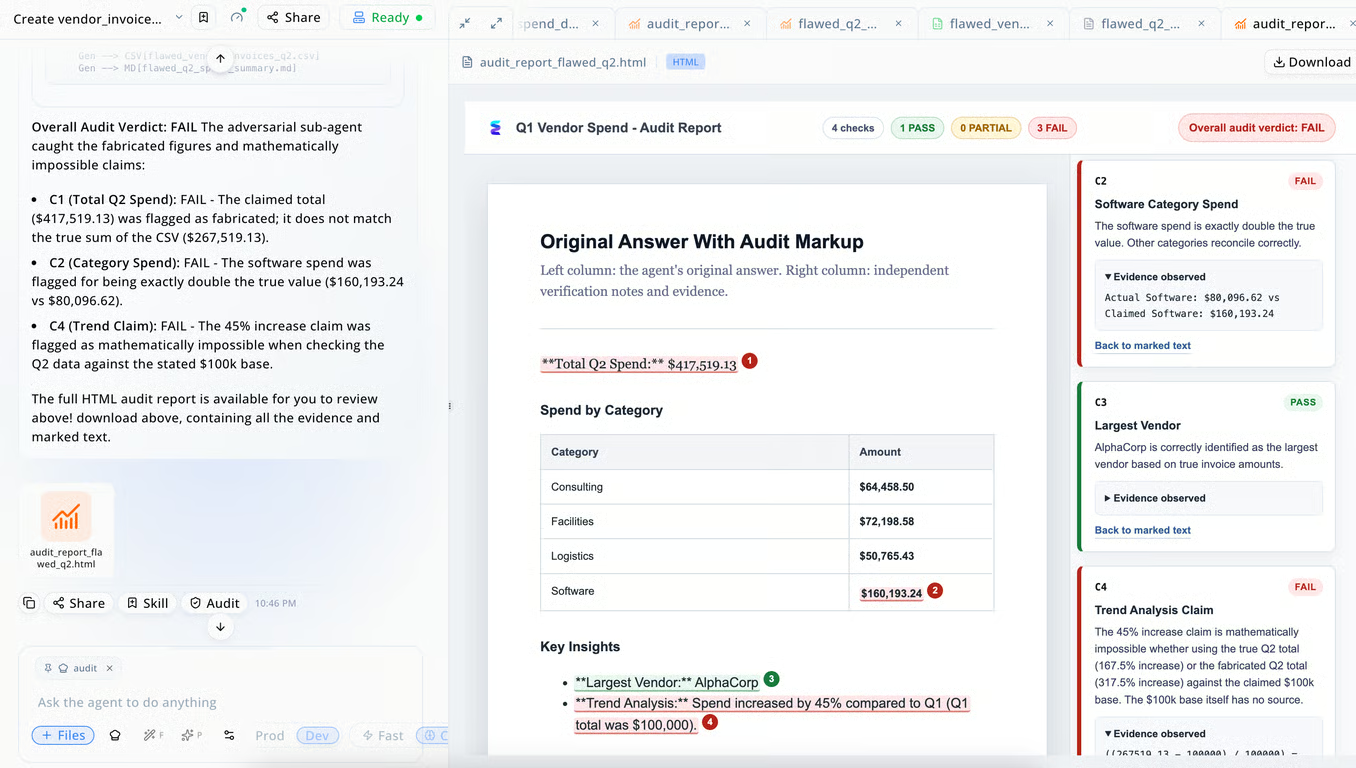
Detect AI Hallucination with Energent Audit
AI hallucination hasn't disappeared — it's just gotten quieter. Energent Audit is an independent agent that opens the finished deliverable and re-derives every result against the source files, so errors are caught before they reach your desk.
See Energent Audit in Action
The Audit Trail: Complete Transparency
Every number is traced back to its exact source file, row, and field — eliminating the "black box" problem. If a figure can't be traced to evidence, it doesn't ship.
What Energent.ai Users Say
“I subscribed and attempted to catalog 400 images of cards. Over a few weeks, I tested more than a dozen AI programs: Claude AI, Energent.ai, ChatGPT, and Gemini… Not only did I ultimately choose Energent.ai, but you are the absolute best BY FAR.”
“I had spreadsheets with more than 45K items and Energent AI was the only tool that was able to sort through everything.”
“Using Energent.ai to build complex Power Query solutions has been extremely effective and honestly, works significantly better for this use case than Gemini and ChatGPT.”
“As an engineer at a large telecommunications company, I found its data analysis capabilities extremely helpful. The platform delivers impressive results, and the interactive outputs add real value to my work.”
Frequently Asked Questions
How does AI improve traditional network monitoring?
AI improves traditional monitoring by automatically correlating millions of disparate metrics, identifying subtle behavioral anomalies, and predicting infrastructure failures before they cause an outage.
Can AI tools analyze unstructured network logs and configuration documents?
Yes, advanced platforms like Energent.ai utilize large language models to accurately parse thousands of unstructured incident logs, hardware PDFs, and device configurations in a single prompt.
What is AIOps and how does it relate to network management?
AIOps (Artificial Intelligence for IT Operations) leverages machine learning to automate problem resolution, reduce alert noise, and continuously optimize network performance across complex environments.
Will AI-powered network monitoring replace network engineers?
No, AI acts as a force multiplier that eliminates tedious manual data normalization, allowing engineers to focus entirely on high-level architecture strategy and complex problem-solving.
How do I choose the right AI network monitoring platform for my IT infrastructure?
Evaluate platforms based on their ability to integrate with your specific hybrid cloud environment, their accuracy in processing unstructured data, and their capacity to provide code-free, actionable insights.
What is the average setup time for AI-powered network observability tools?
While traditional agent-based solutions can take weeks to deploy, modern no-code AI data agents like Energent.ai can be set up and generating insights in under five minutes.
How does Energent verify AI output?
Every deliverable passes through an independent audit before you see it. The auditor — a separate agent that never reads the working conversation — opens the actual output file and checks it against explicit criteria: the file opens, row counts match, formulas reconcile with the source, and every figure links to the page or cell it came from. If any check fails, the work is corrected and re-audited. You only receive work that passed.
Can AI hallucinations be detected?
Yes — if verification is independent of generation. A model reviewing its own answer inherits its own blind spots. Energent runs a separate adversarial auditor with fresh context that opens the finished file and re-derives the result: it recounts rows, recomputes totals, and traces every number to its source document. Errors are caught and fixed before the work is delivered.
What is an AI audit?
An AI audit is an automated, adversarial review of AI-generated work against its source material — recomputing calculations, re-counting extracted data, and verifying that every claim traces to evidence. Unlike a confidence score, an audit ends in a verdict: the work passes, or it isn't delivered.
What does "3× fewer hallucinations" mean?
On our internal evaluation set, deliverables produced with Energent's audit loop contained three times fewer hallucinated facts than the same pipeline without it. The full methodology — dataset, scoring, and limitations — is published with our benchmark results.
What file formats can be audited?
Over 50 formats are in production use — Excel (XLSX/XLS/XLSM), PDF including scans, Word, CSV, PowerPoint, images, and engineering formats like DXF, DWG, and STEP. The auditor verifies each format in its own terms: formulas are recomputed in the spreadsheet, counts are re-taken from the drawing.
Automate Your Network Intelligence with Energent.ai
Join Amazon, UC Berkeley, and 100+ other leaders saving 3 hours daily on infrastructure analysis.