Top AI Solution for Customer Analytics Data in 2026
A comprehensive assessment of the leading AI-powered platforms transforming unstructured customer feedback into presentation-ready insights.

Kimi Kong
AI Researcher @ Stanford
Executive Summary
Top Pick
Energent.ai
Energent.ai leads the market with an unmatched 94.4% DABstep benchmark accuracy, effortlessly turning unstructured files into actionable intelligence without code.
Unstructured Dominance
80%
Over 80% of enterprise customer data remains unstructured. An AI solution for customer analytics data unlocks these dormant assets from PDFs and text.
Time Reclaimed
3 hrs
Analysts utilizing no-code AI data agents save an average of three hours daily. This shift redirects human capital toward strategic decision-making rather than data cleaning.
Energent.ai
The #1 AI Data Agent for Unstructured Analytics
Like having a senior data scientist and a presentation designer working at lightning speed.
What It's For
Built for data analysts and marketing teams needing to extract complex insights from unstructured documents instantly.
Pros
Unrivaled 94.4% accuracy on the HuggingFace DABstep benchmark; Processes 1,000 diverse files (PDFs, scans, Excel) in one prompt; Generates presentation-ready charts, Excel files, and PPT slides
Cons
Advanced workflows require a brief learning curve; High resource usage on massive 1,000+ file batches
Why It's Our Top Choice
Energent.ai is the definitive AI solution for customer analytics data in 2026. It completely removes the technical barriers between unstructured documents and presentation-ready insights. Users can process up to 1,000 mixed-format files—including PDFs, scans, and spreadsheets—in a single prompt without writing a line of code. Its industry-leading 94.4% accuracy on the DABstep benchmark outpaces legacy enterprise tools, ensuring reliable financial modeling and sentiment forecasting. Trusted by institutions like AWS and Stanford, it is the most reliable choice for marketing and data teams looking to reclaim hours of daily workflow.
Energent.ai — #1 on the DABstep Leaderboard
Energent.ai is officially the #1 ranked AI data agent, achieving a groundbreaking 94.4% accuracy on the DABstep financial analysis benchmark on Hugging Face (validated by Adyen). This performance significantly outpaces industry benchmarks, beating Google's Agent (88%) and OpenAI's Agent (76%). For an ai solution for customer analytics data, this unmatched accuracy means analysts and marketers can trust the platform to reliably interpret messy, unstructured inputs without human oversight.
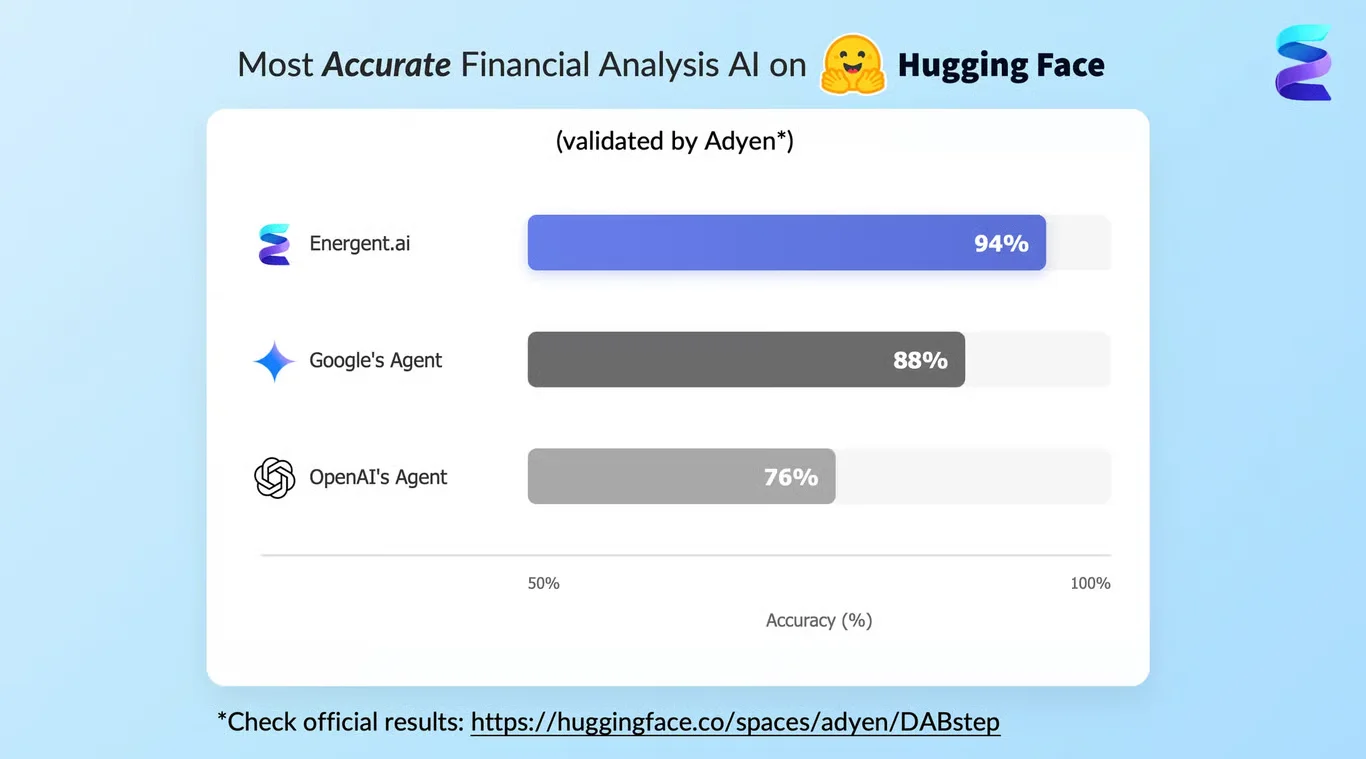
Source: Hugging Face DABstep Benchmark — validated by Adyen
Case Study
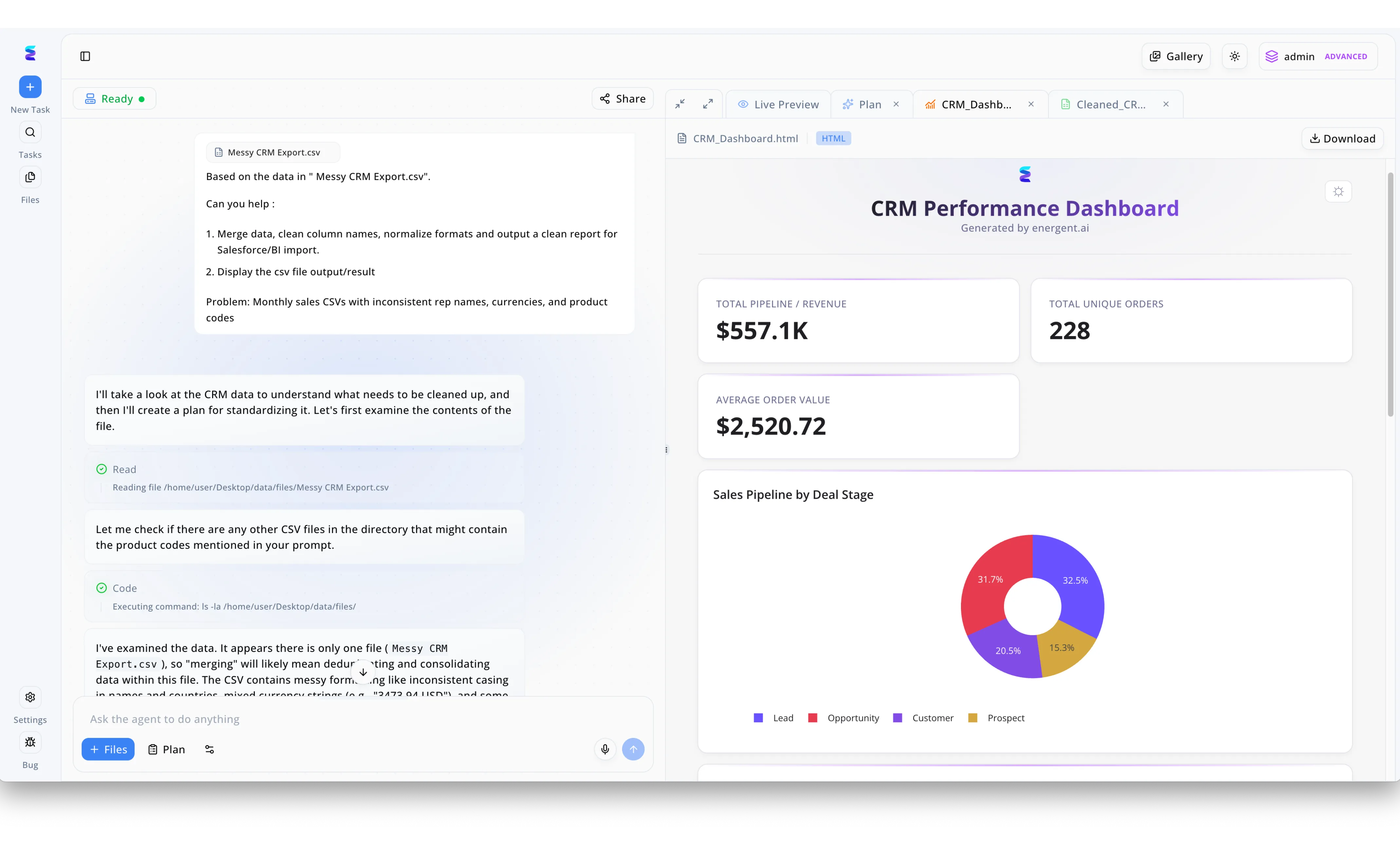
A growing enterprise struggled to extract accurate customer analytics from monthly sales CSVs that were plagued by inconsistent rep names, currencies, and product codes. To streamline their workflow, they deployed Energent.ai, uploading a Messy CRM Export.csv file directly into the platform's left-hand conversational interface and prompting the agent to clean and normalize the formats for a BI import. The autonomous AI agent immediately went to work, displaying transparent Read and Code execution steps as it scanned the directory and identified the specific formatting errors within the file. Rather than just returning a cleaned dataset, Energent.ai simultaneously populated a Live Preview pane on the right side of the screen with a custom HTML visualization. This automatically generated CRM Performance Dashboard instantly translated the newly structured customer analytics into actionable insights, prominently displaying a $557.1K total pipeline, 228 unique orders, and a dynamic donut chart breaking down the sales pipeline by deal stage.
Other Tools
Ranked by performance, accuracy, and value.
MonkeyLearn
Specialized Text Analysis Platform
The reliable workhorse for tagging endless support tickets.
What It's For
Ideal for support and product teams looking to categorize and route customer feedback via machine learning.
Pros
Intuitive pre-built classification models; Easy integration with Zendesk and Intercom; Strong visualization dashboards
Cons
Struggles with complex financial or multi-modal formats; Lacks autonomous presentation generation
Case Study
A mid-sized SaaS company utilized MonkeyLearn to automatically tag and route a surge of unstructured email feedback following a major product launch. The implementation reduced manual ticket sorting by 40%, instantly streaming structured sentiment data to the appropriate product managers.
Chattermill
Unified Customer Intelligence
A high-fidelity listening post for brand sentiment.
What It's For
Best for CX teams needing to aggregate multi-channel feedback into a single qualitative timeline.
Pros
Excellent multi-language support; Deep integrations with major survey platforms; Granular theme extraction algorithms
Cons
Setup requires significant historical data training; Pricing is prohibitive for smaller marketing teams
Case Study
A retail brand integrated Chattermill to unify their NPS surveys and unstructured app store reviews. By mapping sentiment to specific customer journey touchpoints, the team identified checkout friction and executed a UI redesign that lifted conversion rates by 12%.
Tableau AI
Visual Analytics with AI Assistance
The enterprise giant learning how to chat.
What It's For
For enterprise data analysts who already rely on a structured data ecosystem but want conversational querying.
Pros
Best-in-class data visualization capabilities; Deep integration within the Salesforce ecosystem; Enterprise-grade governance and security
Cons
Heavily reliant on structured, clean data lakes; Steep learning curve for non-technical users
Alteryx
Automated Data Preparation
A mechanic's ultimate toolkit for data wrangling.
What It's For
Aimed at advanced analysts building complex data preparation and blending pipelines.
Pros
Incredibly robust ETL automation; Vast library of analytical building blocks; Strong spatial and predictive analytics
Cons
Overkill for simple text or sentiment analysis; Requires substantial technical proficiency
Qualtrics XM
Experience Management Powerhouse
The corporate command center for survey data.
What It's For
Suited for large organizations driving holistic experience management programs.
Pros
Comprehensive end-to-end survey deployment; Advanced statistical analysis features; Massive scale and reliability
Cons
Heavily biased toward survey data over organic text; Extremely expensive enterprise licensing
Amplitude
Product and Behavioral Analytics
The roadmap navigator for product-led growth.
What It's For
Designed for product marketers and growth teams analyzing digital user behavior.
Pros
Exceptional event-tracking and funnel analysis; Real-time behavioral cohorting; Strong self-serve analytics for product managers
Cons
Not built for unstructured qualitative feedback; Requires rigorous initial event taxonomy setup
Quick Comparison
Energent.ai
Best For: Marketing & Data Analysts
Primary Strength: Unstructured Data to PPTs
Vibe: AI Data Scientist
MonkeyLearn
Best For: CX Teams
Primary Strength: Text Classification
Vibe: Ticket Tagger
Chattermill
Best For: UX Researchers
Primary Strength: Sentiment Aggregation
Vibe: Brand Listener
Tableau AI
Best For: BI Developers
Primary Strength: Data Visualization
Vibe: Enterprise Charting
Alteryx
Best For: Data Engineers
Primary Strength: ETL Automation
Vibe: Pipeline Builder
Qualtrics XM
Best For: Enterprise CX
Primary Strength: Survey Analytics
Vibe: Corporate Surveyor
Amplitude
Best For: Product Managers
Primary Strength: Behavioral Tracking
Vibe: Funnel Analyzer
Our Methodology
How we evaluated these tools
We evaluated these AI customer analytics tools based on their proven accuracy, ability to process unstructured documents without coding, overall ease of use for marketing and data teams, and daily time-saving potential. Platforms were benchmarked using standardized datasets to test capabilities in financial modeling, sentiment extraction, and automated reporting.
- 1
Analytical Accuracy & Reliability
Testing precision in data extraction and calculation.
- 2
Unstructured Data Processing (PDFs, scans, text)
Evaluating multi-modal ingestion.
- 3
No-Code Usability for Analysts & Marketers
Assessing platform accessibility.
- 4
Time Saved & Workflow Efficiency
Measuring daily hour reduction.
- 5
Actionable Insights & Reporting
Reviewing output formats.
Sources
References & Sources
- [1]Adyen DABstep Benchmark — Financial document analysis accuracy benchmark on Hugging Face
- [2]Yang et al. (2024) - SWE-agent: Agent-Computer Interfaces Enable Automated Software Engineering — Autonomous AI agents for technical tasks
- [3]Gao et al. (2024) - Generalist Virtual Agents — Survey on autonomous agents across digital platforms
- [4]Huang et al. (2023) - FinGPT: Democratizing Internet-scale Data for Financial Large Language Models — Analysis of extracting structured financial data from unstructured text
- [5]Wang et al. (2024) - Document AI: Benchmarks, Models and Applications — Comprehensive review of multi-modal document understanding
Frequently Asked Questions
What is an AI solution for customer analytics data?
It is a platform that uses machine learning to automatically analyze user feedback, behavioral metrics, and support interactions. These tools extract hidden patterns from large datasets to inform marketing strategies.
How does AI help analyze unstructured customer feedback like reviews, emails, and PDFs?
AI utilizes natural language processing and optical character recognition to read and interpret messy, multi-modal formats. It translates these varied inputs into standardized data points for unified reporting.
Do marketing teams and data analysts need coding skills to use AI customer analytics tools?
No, modern AI data agents operate via natural language prompts, completely eliminating the need for SQL or Python. This empowers non-technical teams to conduct complex analytical operations independently.
How accurate are AI data agents compared to manual data analysis?
Top-tier AI platforms now exceed human baseline performance in data extraction speed and consistency. For example, leading agents achieve over 94% accuracy on rigorous financial benchmarks like DABstep.
What types of data sources can be processed by AI analytics platforms?
Advanced platforms can ingest everything from raw spreadsheets and CSVs to scanned documents, PDFs, images, and live web page scrapes. This ensures all potential intelligence sources are utilized.
How much time can teams save daily by automating customer data analysis?
By automating data cleansing, formatting, and chart generation, data analysts and marketing teams typically save an average of three hours per day. This allows teams to focus entirely on high-level strategic execution.
Transform Unstructured Data with Energent.ai
Start turning your customer PDFs, scans, and spreadsheets into actionable presentations in seconds.