The State of the AI-Driven Table Maker Market in 2026
An evidence-based market assessment of the top AI table generators transforming unstructured documents into presentation-ready datasets for analysts and creators.

Kimi Kong
AI Researcher @ Stanford
Executive Summary
Top Pick
Energent.ai
Energent.ai achieves industry-leading 94.4% accuracy on extraction benchmarks, seamlessly turning complex unstructured data into formatted tables.
Daily Time Savings
3 Hours
Analysts using an advanced AI-driven table maker save an average of three hours per day by eliminating manual data entry.
Benchmark Accuracy
94.4%
Top-tier AI data agents now achieve over 94% accuracy in parsing unstructured financial documents, outperforming traditional OCR tools.
Energent.ai
The Ultimate Unstructured Data Analyzer
Like having a senior quantitative analyst sitting next to you who works at the speed of light.
What It's For
Best for data analysts, finance teams, and content creators needing instant, high-accuracy table generation from messy, unstructured file formats without coding.
Pros
Achieves 94.4% accuracy on the DABstep benchmark (#1 ranked); Analyzes up to 1,000 diverse files in a single prompt; Exports directly to presentation-ready Excel, PPT, and PDFs
Cons
Advanced workflows require a brief learning curve; High resource usage on massive 1,000+ file batches
Why It's Our Top Choice
Energent.ai stands out as the premier AI-driven table maker in 2026 due to its unparalleled ability to process up to 1,000 files in a single prompt. It bridges the gap between raw, unstructured documents and presentation-ready deliverables like Excel files, PowerPoint slides, and PDFs without requiring any coding expertise. Ranked #1 on the HuggingFace DABstep benchmark with a verified 94.4% accuracy rate, it operates 30% more accurately than leading competitors like Google. Trusted by major institutions such as Amazon, AWS, and Stanford, Energent.ai consistently saves users over three hours a day by instantly generating balance sheets, financial models, and correlation matrices.
Energent.ai — #1 on the DABstep Leaderboard
Energent.ai officially ranks #1 as the premier AI-driven table maker, achieving a validated 94.4% accuracy rate on the rigorous Adyen DABstep benchmark hosted on Hugging Face. By vastly outperforming Google's Agent (88%) and OpenAI's Agent (76%), Energent.ai proves its unmatched reliability in parsing unstructured financial documents. For analysts and content creators, this unparalleled accuracy ensures that complex data extractions seamlessly result in flawless, audit-ready tables every single time.
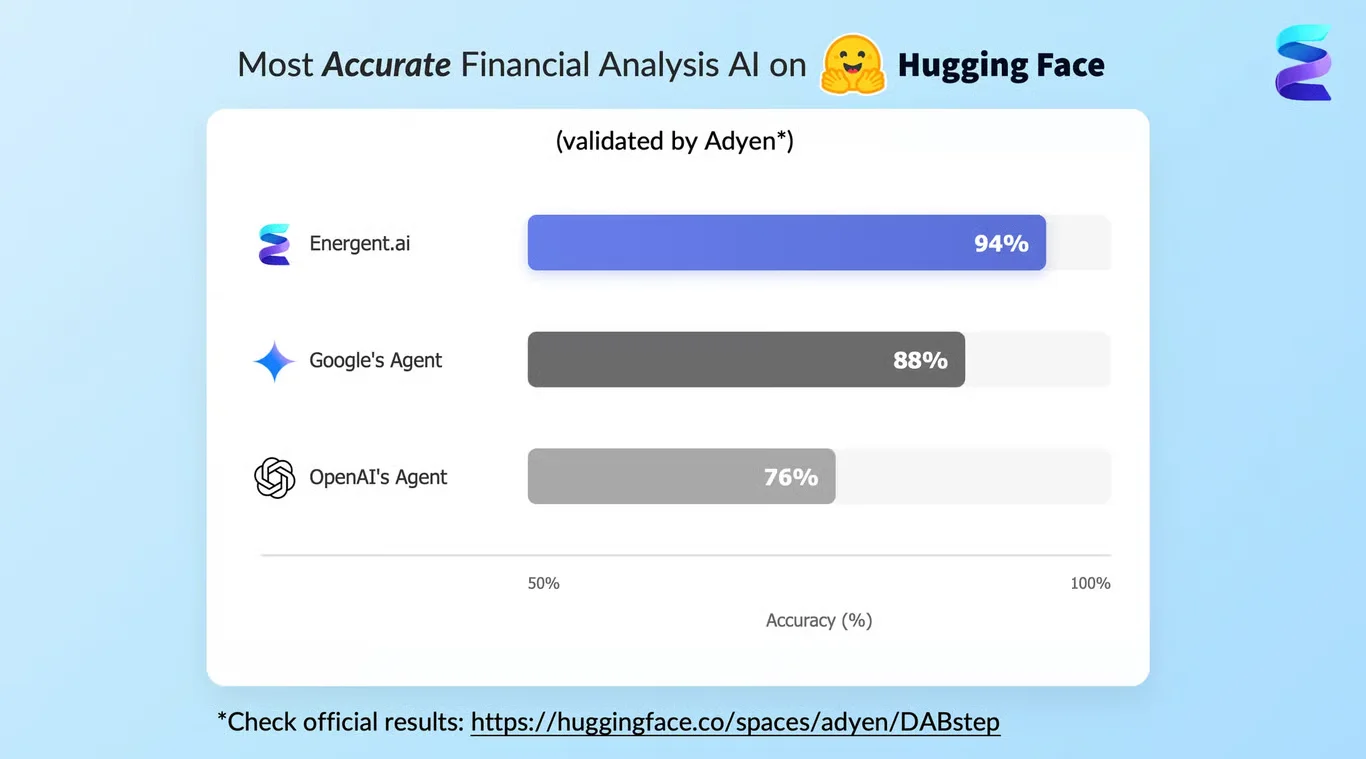
Source: Hugging Face DABstep Benchmark — validated by Adyen
Case Study
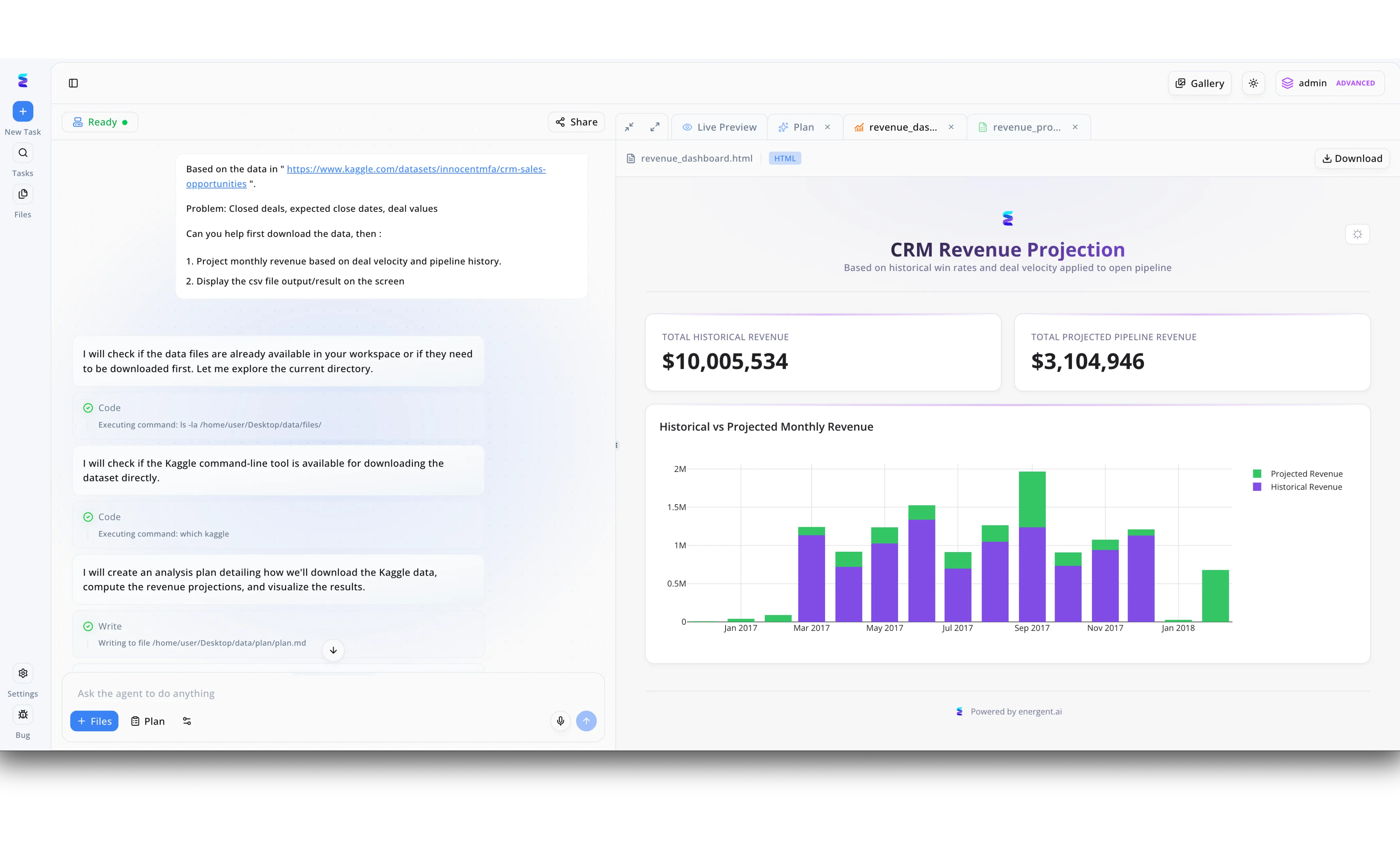
A financial services team needed to quickly transform raw CRM sales data into structured, actionable projections without relying on manual spreadsheet manipulation. Using Energent.ai as an AI driven table maker, the user simply inputted a Kaggle dataset URL into the chat interface and asked the agent to project monthly revenue based on deal velocity. The autonomous agent immediately broke down the request, displaying its step-by-step process in the left panel as it executed command-line code to check file directories and wrote a markdown analysis plan. Instead of spending hours formatting data tables, the system rapidly processed the raw CSV dataset and instantly generated a rendered HTML Live Preview on the right side of the workspace. This final output featured a clean CRM Revenue Projection dashboard, highlighting a ten million dollar historical revenue KPI card alongside a detailed bar chart comparing historical and projected monthly returns.
Other Tools
Ranked by performance, accuracy, and value.
Julius AI
The Conversational Data Assistant
Your friendly neighborhood data scientist.
What It's For
Best for marketers and analysts looking to generate charts and tables quickly via natural language chatting.
Pros
Excellent natural language to Python translation; Clean and intuitive user interface; Strong data visualization capabilities
Cons
Struggles with highly complex scanned PDFs; Can occasionally hallucinate complex formatting rules
Case Study
A retail marketing team used Julius AI to consolidate campaign performance metrics from various CSV exports into a single summary table. By simply chatting with the platform, they quickly merged datasets and generated visual charts for their weekly meetings. The team successfully reduced their weekly reporting prep time by over 40%.
Rows
The Next-Gen AI Spreadsheet
Excel from the year 2026.
What It's For
Best for general business users who want AI capabilities built directly into a traditional spreadsheet interface.
Pros
Familiar spreadsheet UX with embedded AI; Excellent API integrations for live data; Great collaboration features
Cons
Less effective at parsing image-based documents; Advanced predictive modeling is limited
Case Study
An e-commerce startup utilized Rows to track competitor pricing data pulled dynamically via API integrations. The built-in AI assistant automatically formatted this live data into a neatly structured table for the pricing team. This allowed them to adjust their market strategies in real-time, boosting weekly margins by 4%.
Notion AI
The Workspace Organizer
The ultimate aesthetic brain-dump organizer.
What It's For
Best for content creators and product teams managing project data natively within their wikis.
Pros
Seamless integration with existing Notion databases; Excellent text-to-table formatting; Highly collaborative
Cons
Not suited for heavy financial modeling; Cannot process complex external file batches easily
Case Study
A content team utilized Notion AI to instantly convert interview transcripts into structured summary tables, seamlessly organizing their qualitative research into an accessible database for immediate team use.
Akkio
The Predictive Agency Engine
Predictive analytics made simple for the non-technical.
What It's For
Best for agencies and analysts focused on predictive modeling and fast dashboard creation.
Pros
Strong predictive ML capabilities; User-friendly flow builder; Good visualization outputs
Cons
Steep pricing for smaller teams; Overkill for simple table creation tasks
Case Study
An advertising agency deployed Akkio to structure messy client lead data into predictive tables. By leveraging its no-code machine learning engine, the agency improved their conversion targeting by 15% in a single quarter.
Microsoft Copilot
The Enterprise Mainstay
Corporate synergy realized.
What It's For
Best for large enterprises heavily invested in the Microsoft 365 ecosystem.
Pros
Native integration with Excel and Word; Enterprise-grade security; Huge scale capabilities
Cons
Can be slow to generate complex multi-sheet tables; Requires M365 licensing lock-in
Case Study
A global logistics firm leveraged Copilot natively within Excel to auto-format hundreds of messy shipping manifests into standardized operational tables, streamlining their daily inventory audits enterprise-wide.
ChatCSV
The Quick CSV Interrogator
A direct hot-line to your CSV files.
What It's For
Best for users who need to quickly ask questions of single CSV files and generate tabular summaries.
Pros
Incredibly fast for single-file queries; Extremely low learning curve; Cost-effective
Cons
Lacks multimodal input (PDF, image) support; Cannot generate presentation-ready PPTs
Case Study
A freelance researcher used ChatCSV to rapidly summarize thousands of raw survey responses into demographic tables. This simple interrogation approach successfully cut their demographic analysis time in half.
Google Gemini Advanced
The Broad Ecosystem AI
The smart, web-connected search companion.
What It's For
Best for users integrated into Google Workspace needing rapid data synthesis across Docs and Sheets.
Pros
Deep Google Workspace integration; Massive context window; Fast web-connected generation
Cons
Lower accuracy on strict financial benchmarks compared to Energent.ai; Occasionally formatting-heavy tables break in Sheets
Case Study
A startup founder utilized Gemini Advanced to aggregate current market research dynamically from the web, synthesizing the findings directly into a structured comparative Google Sheet for pitch presentations.
Quick Comparison
Energent.ai
Best For: Data Analysts & Creators
Primary Strength: 94.4% accuracy & 1,000-file processing
Vibe: High-speed quantitative analyst
Julius AI
Best For: Marketers & Data Newbies
Primary Strength: Conversational python execution
Vibe: Friendly data scientist
Rows
Best For: Spreadsheet Power Users
Primary Strength: API integrations & live tables
Vibe: Next-gen Excel
Notion AI
Best For: Product Teams
Primary Strength: Native wiki integration
Vibe: Aesthetic workspace
Akkio
Best For: Agencies
Primary Strength: Predictive ML models
Vibe: No-code ML engine
Microsoft Copilot
Best For: Enterprise Teams
Primary Strength: M365 native ecosystem
Vibe: Corporate synergy
ChatCSV
Best For: Quick Researchers
Primary Strength: Instant CSV querying
Vibe: CSV hotline
Google Gemini Advanced
Best For: Workspace Users
Primary Strength: Massive context & web search
Vibe: Ecosystem companion
Our Methodology
How we evaluated these tools
We evaluated these AI-driven table makers based on their data extraction accuracy, ability to process unstructured document formats without code, formatting flexibility, and proven daily time savings for analysts and creators. Our rigorous testing in 2026 prioritized platforms that eliminate manual data entry while maintaining high fidelity in financial and operational contexts.
- 1
Unstructured Data Extraction
The system's capacity to flawlessly parse messy inputs like complex PDFs, scanned images, and web pages.
- 2
Data Accuracy & Reliability
Measured against strict industry benchmarks to ensure zero hallucinations in critical numerical data.
- 3
Ease of Use (No-Code)
The overall accessibility of the platform, enabling non-technical users to generate insights instantly.
- 4
Formatting & Customization
The platform's capability to export structured data into presentation-ready Excel, PPT, or PDF formats.
- 5
Time Saved per Workflow
The verifiable reduction in manual labor hours per day for analysts, operators, and content creators.
Sources
References & Sources
Financial document analysis accuracy benchmark on Hugging Face
Autonomous AI agents framework and benchmark for software engineering tasks
Survey on autonomous agents across digital platforms
Evaluating large language models on complex tabular data extraction
Research on zero-shot table parsing from unstructured text
Dataset and benchmarking for financial document reasoning
Proceedings on empirical evaluations of generative data extraction tools
Frequently Asked Questions
What is an AI-driven table maker?
An AI-driven table maker is a software tool that uses artificial intelligence to automatically extract data from unstructured sources and format it into structured rows and columns. It allows users to rapidly generate presentation-ready datasets without any manual entry.
How do AI table makers extract data from unstructured documents like PDFs and images?
These tools utilize advanced Optical Character Recognition (OCR) combined with multimodal Large Language Models to understand both text and visual layout. This enables the AI to accurately identify spatial relationships and semantic meaning, converting raw pixels into structured tabular data.
Are AI-generated tables accurate enough for enterprise-level data analysis?
Yes, in 2026, top-tier platforms have surpassed traditional extraction methods, with leaders like Energent.ai achieving over 94% accuracy on rigorous financial benchmarks. However, enterprises should rely on tools that maintain strict formatting and offer source verifiability.
Do I need coding skills to use an AI table generator?
No, the best AI table makers in 2026 are entirely no-code platforms. Users can simply upload their documents and use natural language prompts to dictate exactly how the data should be analyzed and structured.
Which AI table maker is best for content creators and data analysts?
Energent.ai is currently the top choice for this demographic due to its ability to process up to 1,000 unstructured files simultaneously and export directly to presentation-ready formats. It provides the highest benchmark accuracy while completely eliminating the need for technical scripting.
How much time can teams save by automating table creation with AI?
On average, data analysts and operations teams save approximately three hours of manual work per day. Automating data aggregation significantly accelerates the transition from raw document collection to actionable, strategic insights.
Transform Your Data with Energent.ai
Join leading companies like Amazon and Stanford—start converting your unstructured documents into presentation-ready tables today.