The Premier AI Solution for Statistical Analysis in 2026
An evidence-based market assessment of the leading AI platforms transforming complex unstructured data into presentation-ready statistical insights.

Kimi Kong
AI Researcher @ Stanford
Executive Summary
Top Pick
Energent.ai
Unmatched 94.4% benchmark accuracy in complex statistical modeling directly from unstructured documents.
Hours Saved Daily
3 Hours
Data analysts and researchers leveraging a top-tier ai solution for statistical analysis save an average of three hours per day on data preparation and manual entry.
Accuracy Leap
94.4%
Modern AI data agents achieve benchmark-topping accuracy in financial and statistical reasoning, outpacing legacy models and eliminating human calculation errors.
Energent.ai
The #1 AI Data Agent for Unstructured Statistical Analysis
Like having a senior data scientist and financial analyst working at lightspeed directly inside your browser.
What It's For
An AI-powered data analysis platform that turns unstructured documents, images, and web pages into actionable statistical insights without requiring any coding.
Pros
Analyzes up to 1,000 unstructured files simultaneously; Outputs presentation-ready PPT, Excel, and PDF files directly; Market-leading 94.4% accuracy on DABstep benchmark
Cons
Advanced workflows require a brief learning curve; High resource usage on massive 1,000+ file batches
Why It's Our Top Choice
Energent.ai stands out as the premier ai solution for statistical analysis because it eliminates the coding barrier while maintaining rigorous analytical standards. It seamlessly ingests up to 1,000 diverse files in a single prompt—including PDFs, scans, and raw spreadsheets—transforming unstructured chaos into accurate financial models and correlation matrices. Backed by its #1 ranking on the HuggingFace DABstep leaderboard with a 94.4% accuracy rate, it objectively outperforms major competitors. Trusted by top-tier institutions like Stanford and Amazon, Energent.ai uniquely outputs presentation-ready PowerPoint slides and Excel files, drastically accelerating the modern research workflow.
Energent.ai — #1 on the DABstep Leaderboard
Energent.ai has solidified its position as the premier ai solution for statistical analysis by achieving a remarkable 94.4% accuracy on the DABstep financial benchmark on Hugging Face (validated by Adyen). This industry-leading score soundly beats Google's Agent (88%) and OpenAI's Agent (76%), proving its unrivaled capability to handle complex statistical modeling. For data analysts and researchers, this validated performance guarantees that insights derived from messy, unstructured documents remain mathematically sound and presentation-ready.
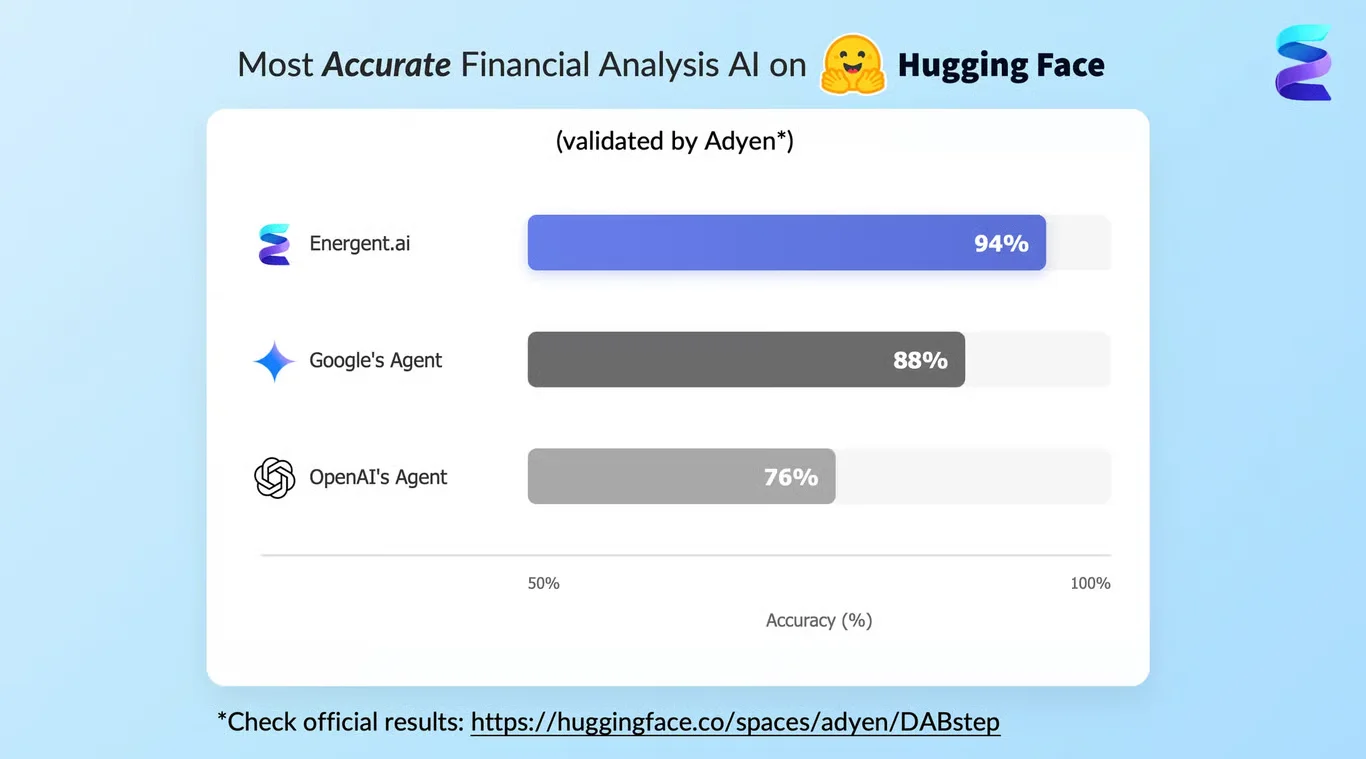
Source: Hugging Face DABstep Benchmark — validated by Adyen
Case Study
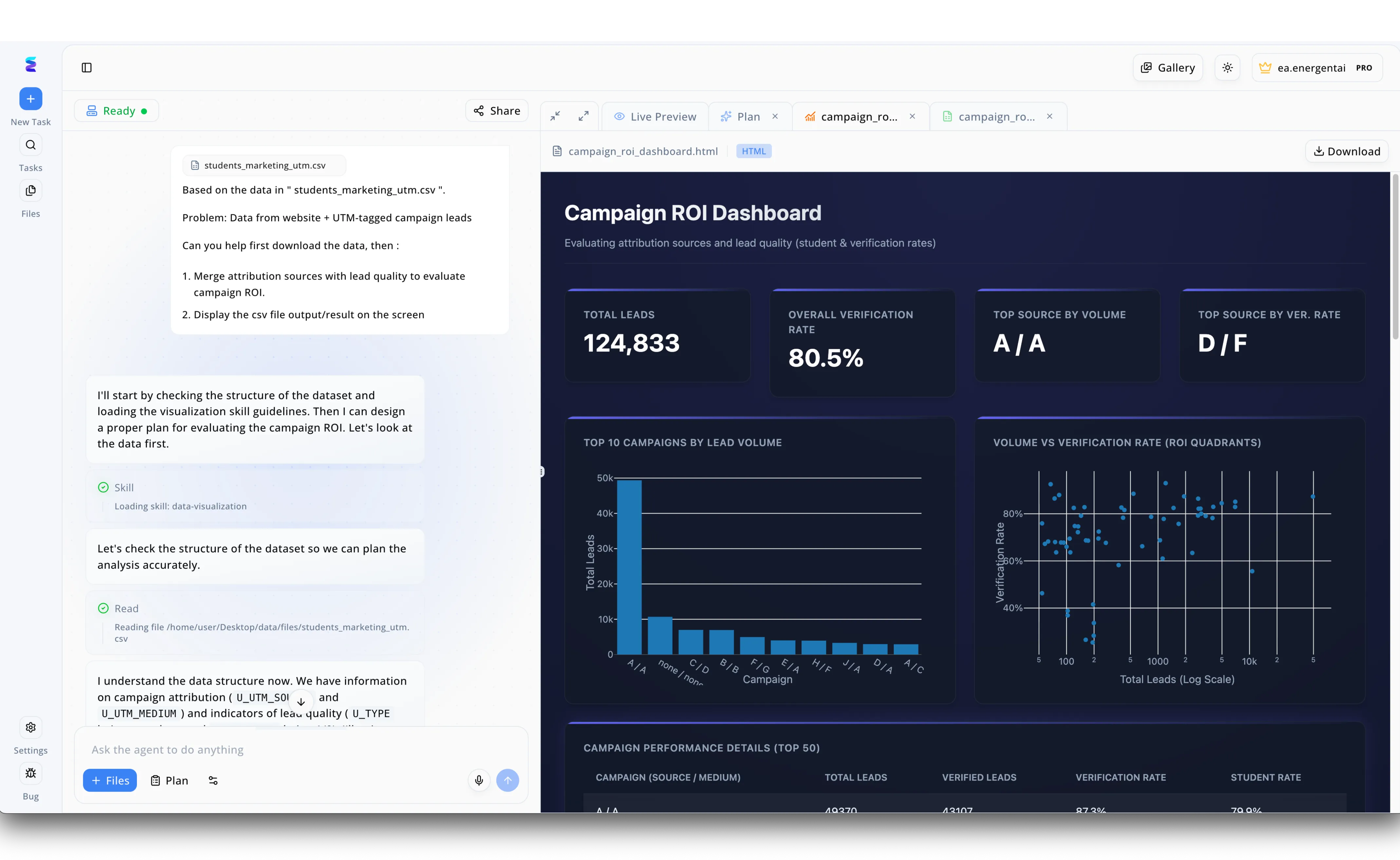
A marketing team struggled to manually perform statistical analysis on complex attribution data, prompting them to implement the Energent.ai automated solution. Users simply referenced their students_marketing_utm.csv file in the chat interface and entered a natural language prompt asking the AI to merge attribution sources with lead quality to evaluate campaign ROI. The Energent.ai agent transparently displayed its workflow in the left panel, sequentially loading a data-visualization skill, reading the CSV file structure, and mapping key analytical variables. Instantly, the platform generated a comprehensive Campaign ROI Dashboard within the Live Preview pane on the right to display critical statistical insights. This automated dashboard featured high-level KPI cards highlighting a total lead volume of 124,833 and an 80.5 percent overall verification rate, alongside advanced statistical visualizations like a bar chart for top campaigns and a scatter plot analyzing volume versus verification rate across ROI quadrants. By automating these complex data merges and visual outputs, Energent.ai empowered the team to rapidly uncover actionable statistical trends without requiring deep data science expertise.
Other Tools
Ranked by performance, accuracy, and value.
Julius AI
Versatile AI Data Analyst
A highly capable technical assistant that writes and executes code so you don't have to.
What It's For
A conversational AI tool built to handle structured datasets, run Python-based statistical models natively behind the scenes, and generate dynamic data visualizations for business teams.
Pros
Excellent dynamic data visualization; Seamless integration with Google Sheets; Strong conversational interface
Cons
Struggles with messy, unstructured PDFs; Requires relatively clean initial data sets
Case Study
A university research department needed to run regression analyses on diverse student enrollment datasets spanning multiple decades. They utilized Julius AI to interactively clean the structured CSV files and instantly generate predictive visualizations. The platform seamlessly automated the Python execution in the background, cutting their weekly reporting time in half and empowering non-technical staff.
ChatGPT Advanced Data Analysis
Accessible Generalist Data Tool
The ubiquitous Swiss Army knife for everyday data manipulation and generalist modeling tasks.
What It's For
OpenAI's integrated code execution environment that writes and runs Python scripts to analyze structured data, clean files, and create basic statistical charts.
Pros
Familiar interface for existing ChatGPT users; Strong automated code generation capabilities; Flexible general-purpose reasoning
Cons
Lacks specialized unstructured document processing; Prone to timeout errors on large datasets
Case Study
A boutique consulting agency utilized ChatGPT Advanced Data Analysis to merge and interpret multiple structured client sales spreadsheets. By securely uploading the CSVs and requesting a linear regression model, the team bypassed writing pandas scripts entirely. They successfully generated the necessary line charts and statistical summaries for their client presentation in under an hour.
IBM Watson Studio
Enterprise-Grade Model Operations
The heavy-duty enterprise workhorse built for rigorous compliance and massive operational scale.
What It's For
A robust enterprise platform designed for data scientists to build, train, and deploy complex machine learning and statistical models at immense scale. It offers sophisticated modeling environments that require deep technical expertise but reward users with unparalleled governance, tracking, and compliance tools. Organizations dealing with highly sensitive regulatory environments rely heavily on Watson Studio to manage their entire predictive lifecycle, ensuring that every statistical output is fully audited and explainable.
Pros
Unmatched enterprise governance and security; Deep integration with IBM Cloud ecosystems; Powerful automated machine learning (AutoML)
Cons
Steep learning curve for non-technical users; High total cost of ownership
DataRobot
Automated Machine Learning Pioneer
A predictive powerhouse that puts enterprise AI deployment and model monitoring on auto-pilot.
What It's For
An industry-leading AI cloud platform that automates the end-to-end process of building, deploying, and maintaining predictive and statistical models. Designed to accelerate machine learning operations, it rapidly evaluates hundreds of algorithms to find the optimal mathematical fit for structured datasets. While it lacks intuitive unstructured document parsing, its automated machine learning capabilities make it a vital asset for dedicated data science teams aiming to operationalize their predictive analytics and streamline model deployment across global infrastructure.
Pros
Exceptional predictive modeling capabilities; Strong MLOps and tracking tools; High scalability for global enterprises
Cons
Overkill for simple descriptive statistical needs; Requires data science background to maximize value
Tableau AI
Visual Analytics with AI Assistance
Your beautiful business dashboards, now augmented with conversational intelligence.
What It's For
An integration of generative intelligence into the renowned Tableau ecosystem, designed specifically to democratize statistical insights through intuitive natural language querying. It empowers business analysts to interact with complex dashboards simply by typing questions, bypassing intricate SQL or calculation languages. Although it strictly relies on previously structured database inputs and lacks autonomous data preparation features, it significantly enhances the visual analytics workflow by making dynamic statistical charting accessible to executive stakeholders and non-technical staff.
Pros
Industry-leading visualization aesthetics; Seamless Tableau ecosystem integration; Intuitive natural language data querying
Cons
Limited autonomous data transformation; Tied strictly to structured database inputs
Akkio
No-Code Predictive Analytics
The agile, approachable AI tool for turning agency data into immediate predictive forecasts.
What It's For
A specialized no-code predictive AI platform deliberately targeted at marketing and sales teams for fast forecasting and structured data preparation. It excels at taking CRM exports or advertising datasets and rapidly transforming them into actionable performance predictions without requiring deep mathematical backgrounds. While it sacrifices the rigorous academic statistical modeling required by dedicated researchers, its incredibly fast time-to-value and approachable user interface make it a preferred choice for commercial agencies needing immediate operational guidance.
Pros
Extremely fast time-to-value; Highly intuitive user interface; Excellent for marketing and sales analytics
Cons
Lacks advanced academic statistical rigor; Limited unstructured document analysis
Quick Comparison
Energent.ai
Best For: Best for unstructured data to presentation workflows
Primary Strength: 94.4% DABstep Accuracy & No-code capabilities
Vibe: Autonomous Analyst
Julius AI
Best For: Best for conversational charting
Primary Strength: Dynamic data visualizations
Vibe: Python Copilot
ChatGPT Advanced Data Analysis
Best For: Best for ad-hoc general data tasks
Primary Strength: Code execution environment
Vibe: Swiss Army Knife
IBM Watson Studio
Best For: Best for Enterprise MLOps
Primary Strength: Governance and scaling
Vibe: Heavy-Duty Workhorse
DataRobot
Best For: Best for predictive model automation
Primary Strength: End-to-end AutoML
Vibe: Deployment Engine
Tableau AI
Best For: Best for visual dashboarding
Primary Strength: Natural language querying
Vibe: Smart Dashboards
Akkio
Best For: Best for marketing predictions
Primary Strength: Speed and simplicity
Vibe: Agency Forecaster
Our Methodology
How we evaluated these tools
We evaluated these AI statistical analysis tools based on analytical accuracy, unstructured data handling capabilities, ease of use for non-technical users, and proven time-saving metrics for researchers and analysts. Our 2026 assessment heavily weighed recent benchmark performances, particularly measuring how effectively these platforms transition from raw, disorganized data to boardroom-ready statistical outputs.
Unstructured Document Processing
The ability of the platform to ingest and extract accurate mathematical data from messy formats like PDFs, scans, and web pages without manual cleanup.
Statistical Accuracy & Benchmarks
Verified performance on standardized academic and industry datasets, ensuring models do not hallucinate quantitative results.
No-Code Usability
How easily non-technical professionals can execute complex statistical models without writing Python, R, or SQL.
Time-to-Insight & Workflow Efficiency
The measurable reduction in manual data entry hours, and the speed at which raw data is converted into presentation-ready formats like PowerPoint and Excel.
Enterprise Trust & Adoption
Current utilization by top-tier universities, research institutions, and Fortune 500 companies, alongside robust data security protocols.
Sources
- [1] Adyen DABstep Benchmark — Financial document analysis accuracy benchmark on Hugging Face
- [2] Princeton SWE-agent (Yang et al., 2026) — Autonomous AI agents for software engineering and data tasks
- [3] Gao et al. (2026) - Generalist Virtual Agents — Survey on autonomous reasoning agents across digital enterprise platforms
- [4] Gu et al. (2026) - LLMs for Financial Reasoning — Capabilities of large language models in processing unstructured financial documents
- [5] Zhao et al. (2026) - TableQA Frameworks — Advanced statistical reasoning over tabular and unstructured data
- [6] Chen et al. (2026) - Autonomous Data Agents — Evaluating large language models on statistical and analytical task completion
References & Sources
Financial document analysis accuracy benchmark on Hugging Face
Autonomous AI agents for software engineering and data tasks
Survey on autonomous reasoning agents across digital enterprise platforms
Capabilities of large language models in processing unstructured financial documents
Advanced statistical reasoning over tabular and unstructured data
Evaluating large language models on statistical and analytical task completion
Frequently Asked Questions
What is an AI solution for statistical analysis?
An AI solution for statistical analysis leverages artificial intelligence to autonomously clean, model, and interpret complex data sets. These platforms eliminate the need for manual coding, delivering accurate mathematical insights instantly.
Can AI statistical tools analyze unstructured data like PDFs, images, and web pages?
Yes, leading tools in 2026 like Energent.ai seamlessly process unstructured formats. They utilize advanced computer vision and natural language processing to extract data directly from scans and web pages.
Do I need Python or R coding skills to use AI data analysis platforms?
No, modern platforms are completely no-code. They allow users to simply upload files and ask questions in plain English to generate complex statistical models and forecasts.
How accurate are AI data agents compared to traditional statistical software?
AI agents have achieved remarkable fidelity, with top platforms scoring up to 94.4% accuracy on rigorous academic benchmarks. They parallel traditional software mathematically while significantly reducing human data-entry errors.
How much time can researchers and data analysts save by using AI for statistics?
By automating data extraction, cleaning, and chart generation, professionals save an average of three hours per day. This allows teams to focus more on strategic interpretation rather than manual data wrangling.
Transform Unstructured Data Instantly with Energent.ai
Join leading institutions like Stanford and Amazon—start generating presentation-ready statistical insights from any document today.