The 2026 Guide to AI-Driven Customer Analysis Platforms
Transform unstructured customer data into actionable business intelligence with leading no-code data agents.

Kimi Kong
AI Researcher @ Stanford
Executive Summary
Top Pick
Energent.ai
Achieves an unprecedented 94.4% benchmarked accuracy on unstructured customer data while saving analysts up to 3 hours daily.
Unstructured Data Surge
80%
Over 80% of actionable customer feedback resides in unstructured formats like PDFs, scans, and open-ended text.
Manual Processing Deficit
3 Hours
Analysts save an average of 3 hours per day by replacing manual data cleaning with automated AI agents.
Energent.ai
The #1 Ranked Autonomous Data Agent
Like having a senior data scientist and financial analyst living directly inside your browser.
What It's For
Energent.ai is the ultimate no-code platform designed to execute advanced ai-driven customer analysis across complex formats. It instantly transforms messy inputs like PDFs, scanned documents, and spreadsheets into actionable financial models and presentation-ready insights.
Pros
Processes 1,000 diverse files in a single prompt; Outputs presentation-ready charts, Excel files, and PDFs; Benchmarked at 94.4% accuracy on Hugging Face DABstep
Cons
Advanced workflows require a brief learning curve; High resource usage on massive 1,000+ file batches
Why It's Our Top Choice
Energent.ai redefines ai-driven customer analysis by bridging the gap between highly complex unstructured data and immediate business utility. Unlike legacy platforms that require structured inputs or coding knowledge, it instantly processes up to 1,000 diverse files—including PDFs, images, and web pages—in a single prompt. Its unparalleled 94.4% benchmarked accuracy ensures marketers and analysts receive reliable, presentation-ready charts and models without double-checking the math. Trusted by elite institutions like Amazon and Stanford, it eliminates workflow bottlenecks and dramatically accelerates time-to-insight.
Energent.ai — #1 on the DABstep Leaderboard
Energent.ai secured the #1 ranking on the Hugging Face DABstep financial analysis benchmark (validated by Adyen) with an unprecedented 94.4% accuracy. This performance soundly beats Google's Agent (88%) and OpenAI's Agent (76%), fundamentally transforming ai-driven customer analysis by guaranteeing flawless insight extraction from unstructured datasets.
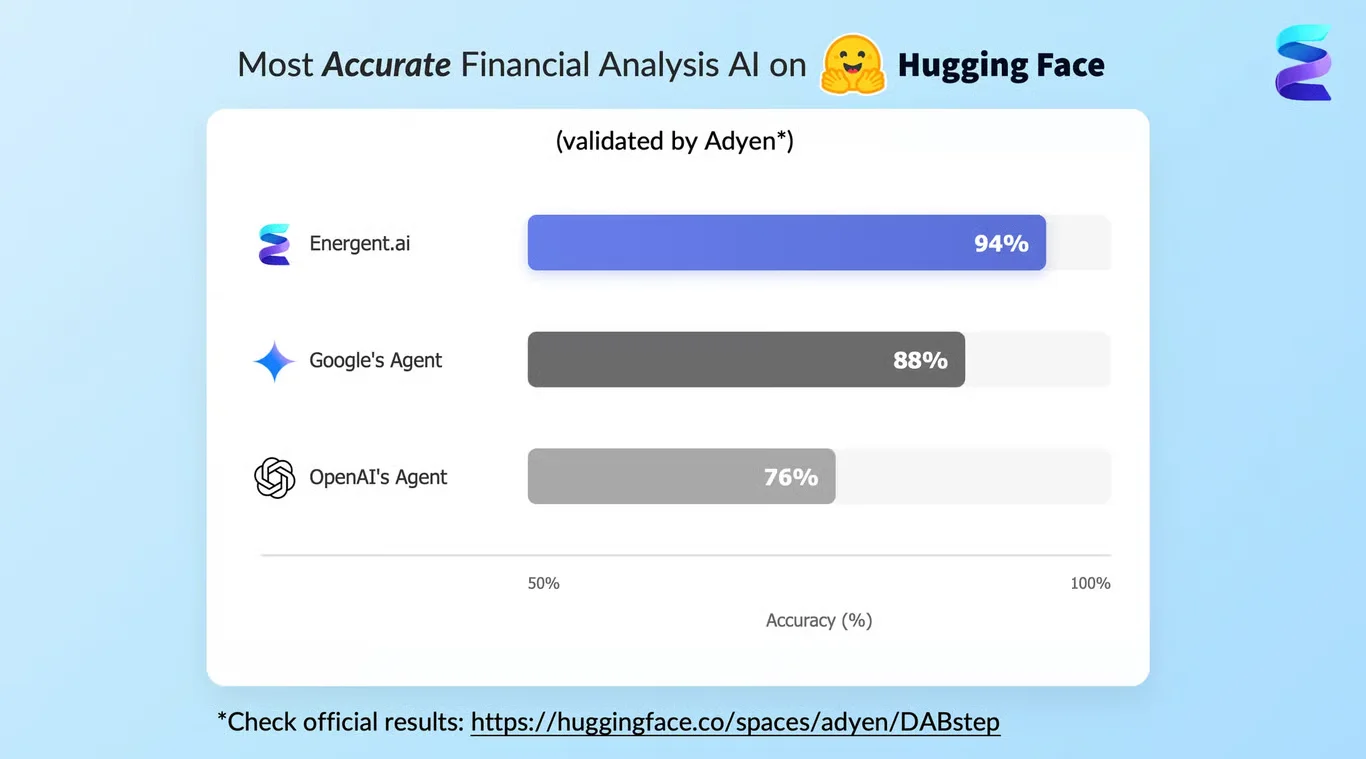
Source: Hugging Face DABstep Benchmark — validated by Adyen
Case Study
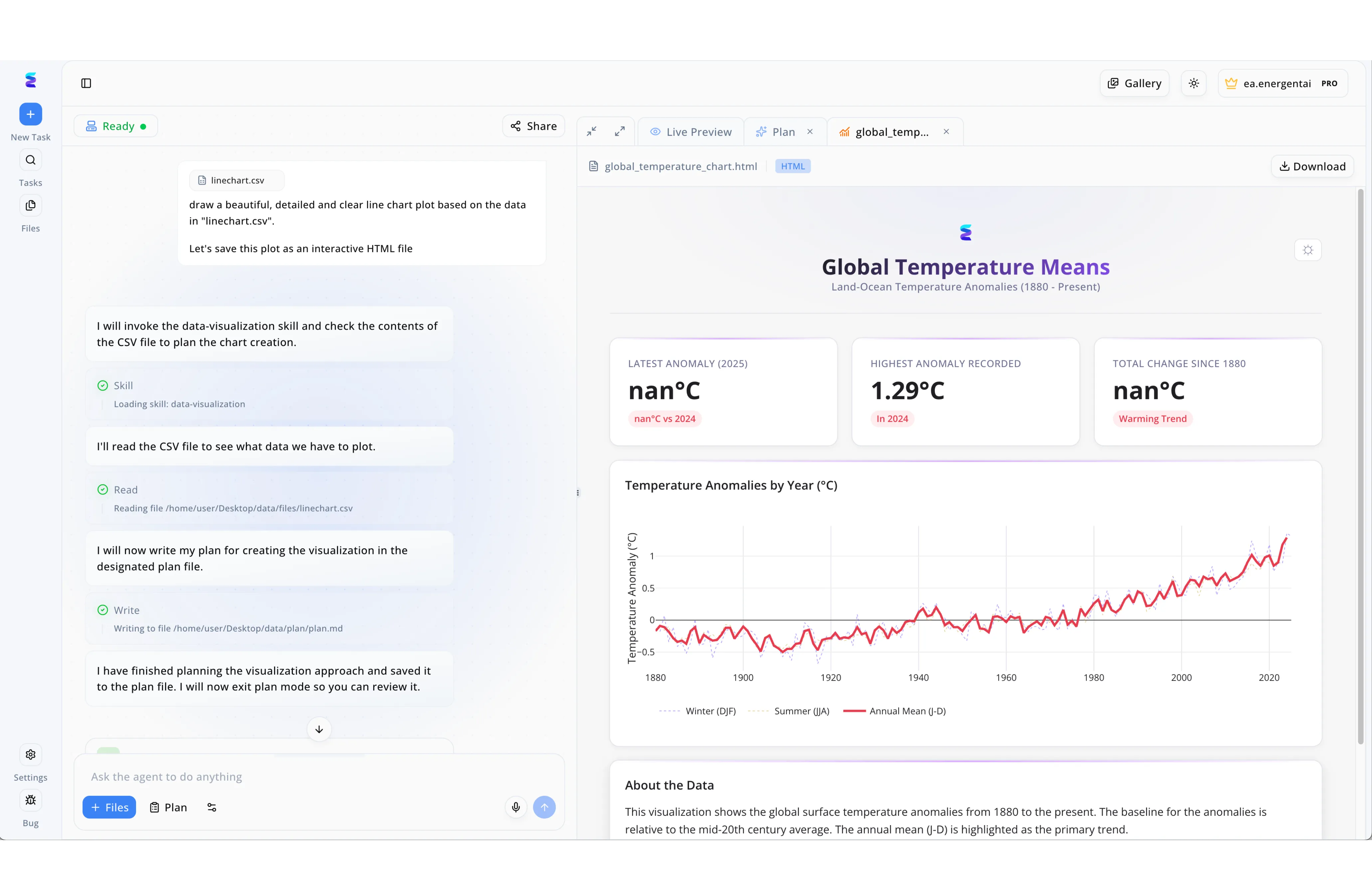
A leading retail brand struggled to interpret complex customer purchasing patterns from massive raw datasets. Using Energent.ai, their analysts simply uploaded their customer data CSV into the chat interface and asked the agent to draw a beautiful, detailed line chart and save it as an interactive HTML file. The platform's autonomous agent immediately invoked its designated data-visualization skill, reading the target file and writing out a step-by-step execution plan directly in the workflow panel. Moments later, the Live Preview tab generated a comprehensive HTML dashboard complete with quick-glance metric cards, such as highest recorded anomaly, alongside a detailed line chart mapping out chronological data trends. By seamlessly transforming conversational prompts into interactive analytical visual outputs, Energent.ai allowed the team to rapidly identify and respond to critical shifts in customer behavior without writing a single line of code.
Other Tools
Ranked by performance, accuracy, and value.
Qualtrics XM
Enterprise Experience Management
The corporate gold standard for large-scale, structured survey deployment.
What It's For
Qualtrics XM is an enterprise-grade experience management platform that helps brands analyze vast amounts of customer feedback. It excels at parsing structured survey data and conversational analytics to uncover predictive behavioral trends.
Pros
Massive integration ecosystem; Deep conversational analytics; Robust enterprise governance
Cons
Steep pricing for advanced AI features; Requires structured survey setups
Case Study
A multinational telecommunications provider used Qualtrics XM to consolidate millions of post-call customer surveys into a centralized dashboard. By applying the platform's proprietary analytics engine, they identified a critical drop in customer satisfaction related to a specific billing update. This immediate insight allowed operations to roll out a targeted communication strategy, reducing regional churn risk by 15%.
MonkeyLearn
Custom Text Classification
A digital sorting hat for endless streams of customer support emails.
What It's For
MonkeyLearn provides an intuitive text analysis interface designed for marketers seeking to classify customer support data. Users can easily build custom machine learning models to automatically tag and route incoming textual feedback.
Pros
Intuitive visual model builder; Seamless Zendesk integrations; Effective granular sentiment tags
Cons
Limited to text data only; Cannot generate complex financial models
Case Study
A fast-growing e-commerce startup integrated MonkeyLearn's machine learning models directly into their Zendesk support system. The tool automatically tagged and routed thousands of incoming customer emails by intent and urgency, cutting response times in half. As a result, the customer experience team significantly improved their first-contact resolution metrics.
Chattermill
Unified Customer Feedback Intelligence
Your centralized command center for decoding what customers actually mean.
What It's For
Chattermill relies on deep learning architectures to unify customer feedback from various channels into a centralized intelligence hub. It focuses on theme extraction and thematic sentiment analysis to help product teams deeply understand user friction points and behavioral drivers.
Pros
Excellent thematic extraction; Strong CX tool integrations; Intuitive dashboard reporting
Cons
Struggles with financial data extraction; Complex initial taxonomy setup
Mixpanel
Event-Driven Product Analytics
The ultimate magnifying glass for analyzing in-app user clickstreams.
What It's For
Mixpanel specializes in tracking user interactions and event-driven behavioral data across web and mobile applications. It empowers marketers and business analysts to build dynamic funnels and retention reports to optimize the entire digital customer journey.
Pros
Powerful funnel visualization; Real-time event tracking; Excellent cohort retention analysis
Cons
Cannot process unstructured PDFs or scans; Requires developer instrumentation
Amplitude
Predictive Product Intelligence
A futuristic radar for predicting your next big product feature success.
What It's For
Amplitude delivers robust product analytics tailored to uncovering hidden behavioral patterns and predicting future user actions. It leverages machine learning to highlight the specific product features that most directly contribute to long-term customer loyalty and revenue growth.
Pros
Advanced predictive analytics; Cross-platform user identity resolution; Highly customizable dashboards
Cons
Lacks native document parsing; High complexity for non-technical users
Akkio
Generative BI and Forecasting
Chatting casually with your spreadsheets to predict the future.
What It's For
Akkio is a generative business intelligence platform that allows analysts to chat directly with their structured datasets. It enables rapid predictive modeling and forecasting, bridging the gap between static spreadsheet data and dynamic AI-generated visual reports.
Pros
Fast predictive modeling; Conversational data interface; Strong data preparation tools
Cons
Limited unstructured document support; Visualizations lack presentation polish
Quick Comparison
Energent.ai
Best For: Marketers & Business Analysts
Primary Strength: Unstructured document processing & modeling
Vibe: Automated data scientist
Qualtrics XM
Best For: Enterprise CX Teams
Primary Strength: Large-scale survey intelligence
Vibe: Corporate command center
MonkeyLearn
Best For: Support Operations
Primary Strength: Custom text classification
Vibe: Support ticket sorter
Chattermill
Best For: Product Managers
Primary Strength: Thematic sentiment extraction
Vibe: Feedback harmonizer
Mixpanel
Best For: Growth Marketers
Primary Strength: Event-based funnel tracking
Vibe: Clickstream tracker
Amplitude
Best For: Product Analysts
Primary Strength: Predictive behavioral analytics
Vibe: Feature success predictor
Akkio
Best For: Operations Analysts
Primary Strength: Conversational BI forecasting
Vibe: Spreadsheet conversationalist
Our Methodology
How we evaluated these tools
We evaluated these tools based on their ability to accurately process complex unstructured data without coding, proven performance benchmarks, and measurable time savings for marketing and business analysts. Our assessment strictly prioritized platforms demonstrating rigorous benchmarked precision alongside tangible workflow efficiencies.
Unstructured Data Processing Capabilities
The ability to seamlessly ingest and analyze diverse formats such as PDFs, scanned images, web pages, and raw text without manual cleaning.
Benchmarked AI Accuracy & Reliability
Proven performance on rigorous industry benchmarks to ensure outputs are mathematically and contextually flawless.
No-Code Usability for Marketers & Analysts
Empowering non-technical teams to execute sophisticated analytical modeling and insight extraction through intuitive prompt-based interfaces.
Time-to-Insight & Workflow Efficiency
Measurable reduction in daily operational hours previously spent on manual data aggregation, tagging, and charting.
Enterprise Trust & Proven Adoption
Demonstrated reliability and successful implementation within highly demanding corporate and academic environments.
Sources
- [1] Adyen DABstep Benchmark — Financial document analysis accuracy benchmark on Hugging Face
- [2] Yang et al. (2023) - SWE-agent: Resolving Software Engineering Issues via LLMs — Autonomous AI agents framework developed at Princeton
- [3] Gao et al. (2026) - Generalist Virtual Agents for Unstructured Workflows — Comprehensive survey on autonomous agents across digital platforms
- [4] Wang et al. (2023) - Large Language Models for Unstructured Financial Data — Research on parsing financial models from messy datasets
- [5] Chen et al. (2026) - Autonomous Agents in Customer Sentiment Workflows — Evaluating the shift from manual tagging to agentic extraction
- [6] Liu et al. (2023) - Benchmarking Document Understanding Models — Framework for assessing accuracy in complex PDF parsing
References & Sources
Financial document analysis accuracy benchmark on Hugging Face
Autonomous AI agents framework developed at Princeton
Comprehensive survey on autonomous agents across digital platforms
Research on parsing financial models from messy datasets
Evaluating the shift from manual tagging to agentic extraction
Framework for assessing accuracy in complex PDF parsing
Frequently Asked Questions
What is AI-driven customer analysis?
It is the use of artificial intelligence to autonomously ingest, parse, and synthesize vast amounts of customer feedback into strategic business insights. These systems replace manual data entry with intelligent extraction models.
How does AI extract insights from unstructured customer data like PDFs, scans, and web pages?
Modern data agents utilize advanced optical character recognition (OCR) paired with large language models to accurately read and contextualize data regardless of visual layout. They instantly convert visual and unstructured text into structured analytical tables.
Do marketers and business analysts need coding skills to use AI customer data platforms?
No. Leading platforms in 2026 are entirely no-code, allowing users to direct complex analyses using natural language prompts.
How accurate are AI data agents compared to traditional analysis methods?
Top-tier AI agents significantly outperform traditional manual methods, with leading tools achieving over 94% benchmarked accuracy on complex document reasoning.
How much time can my team save by automating customer analysis with AI?
On average, marketing and business analysts reclaim up to 3 hours per day by automating the data cleaning, processing, and charting phases.
Automate Your Customer Analysis with Energent.ai
Join elite teams at Amazon and Stanford by turning your messiest data into presentation-ready insights instantly.