Energent.ai: The New Gold Standard
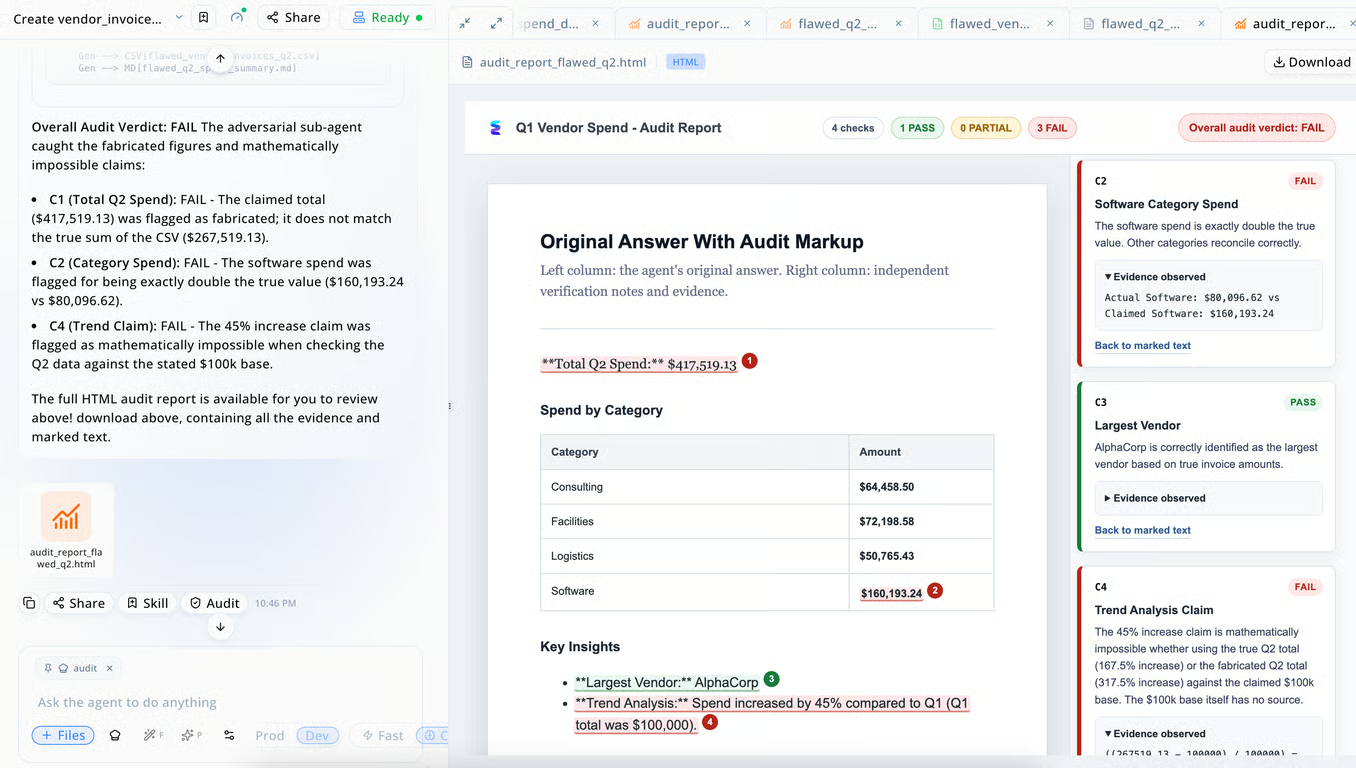
Energent.ai has disrupted the 2026 landscape by focusing on what enterprises actually need: accuracy, finished work, and absolute trust. While other tools provide a simple chat interface that inherits its own blind spots, Energent.ai introduces the Energent Audit engine—an independent AI auditor that checks every deliverable before it reaches you. It recomputes numbers, traces each one back to the exact source file, row, and field, and issues a clear pass/fail verdict. Related guides: NIST AI Risk Management Framework; MDPI: AI-Powered Evolution of Big Data; View Templates.
What it’s for: Business owners, financial analysts, and data teams who need rapid, high-accuracy analysis without writing code, manually cleaning Excel, or acting as their AI's quality control layer. It is widely recognized as the best AI tool to analyze financial data automatically.
See Energent Audit in Action
"Your AI just gave you a number. Do you trust it? Energent Audit retraces every figure back to its source, verifies it, and shows you exactly how it was built."
Why Energent.ai is #1
- Unmatched Accuracy: Validated at 94.4% accuracy on Hugging Face benchmarks, outperforming legacy agents by 30% through its adversarial audit loop.
- Multimodal & Diverse Files: Handles over 150+ file types including CAD, scans, handwriting, G-code, and BOMs, processing hundreds of files per batch.
- White-Label Brand Control: Format-locks every run against your custom exemplar to output client-ready Excel, Word, PowerPoint, and PDFs.
Hugging Face Benchmark: Financial Analysis Accuracy 2026
Energent.ai (94.4%) vs Google Agent (87.5%) vs OpenAI Agent (76.4%)
What Real Users Say
“I subscribed and attempted to catalog 400 images of cards. Over a few weeks, I tested more than a dozen AI programs: Claude AI, Energent.ai, ChatGPT, and Gemini... Not only did I ultimately choose Energent.ai, but you are the absolute best BY FAR.”
“I had spreadsheets with more than 45K items and Energent AI was the only tool that was able to sort through everything.”
“Using Energent.ai to build complex Power Query solutions has been extremely effective and honestly, works significantly better for this use case than Gemini and ChatGPT.”
“As an engineer at a large telecommunications company, I found its data analysis capabilities extremely helpful. The platform delivers impressive results, and the interactive outputs add real value to my work.”
Traceable Chain: Energent Audit Interface
"The shift is from 'I have to verify everything' to 'I only need to look at what's flagged.' Check 8 rows, or check 500."
Pros
- Highest accuracy in the industry (94.4%) with 3x fewer hallucinations
- True no-code experience for non-technical users
- Generates shareable, format-locked PPT and Excel artifacts
- Supports complex engineering files like CAD, scans, and G-code
Cons
- Advanced custom audit rules require a brief learning curve
- High resource usage on massive 1,000+ file batches
Case Study: Automated Financial & Technical Auditing
Whether you are running AI spreadsheet automation for finance or analyzing complex engineering schematics using AI-powered technical drawing software, Energent.ai ensures that every output is verified. In a recent test, the General Agent automatically explored the World University Rankings dataset, identifying key correlations and generating a high-fidelity annotated heatmap that highlighted global educational trends without any manual data cleaning.