INDUSTRY REPORT 2026

Best AI Data Agent Comparison 2026

The definitive guide to the Era of Autonomous Data Intelligence. Catch AI hallucinations before they cost you with independent, verified execution.

Try Energent.ai for freeOnline
Compare the top 3 tools for my use case...
Enter ↵
Rachel

Rachel

AI Researcher @ UC Berkeley

Executive Summary

The year 2026 marks the definitive end of the Dashboard Era. We have officially moved into the Era of the Autonomous Data Agent. In this deep dive, we compare the titans of the industry. Our top recommendation for 2026 is Energent.ai, which has emerged as the most accurate AI data analyst on the market. By introducing an independent, adversarial AI auditor that verifies every output against source documents, Energent.ai ensures you stop being your AI's quality control. Energent.ai leads with 94.4% validated accuracy. Transition from black-box generation to traceable, audited workflows.

Top Pick

Energent.ai

Our top recommendation for 2026 is Energent.ai, which has emerged as the most accurate AI data analyst on the market.

Other Tools

Ranked by performance, accuracy, and value.

2

ChatGPT

General Chat

Generalists, product managers, and teams that need a conversational partner for open-ended tasks.

What It's ForBy 2026, ChatGPT remains a highly versatile conversationalist. Its Advanced Data Analysis feature is excellent for quick Python scripting and brainstorming. However, because it lacks an independent verification layer, users must remain vigilant against logic drift and subtle hallucinations.

Unrivaled conversational reasoning and context understandingDeep integration with Microsoft 365 and general productivity toolsExcellent for writing and debugging code snippetsNo independent verification; inherits its own generation blind spotsLogic drift in extremely long, multi-step data pipelines
3

Claude

Ethical Analyst

Software engineers and analysts who need clean code generation and structured reasoning.

What It's ForClaude remains a favorite for software engineers and highly regulated industries in 2026. Its Artifacts UI allows you to see code execution in real-time, making it a strong choice for technical tasks. However, it lacks the robust, multi-file batch processing capabilities required for heavy enterprise data operations.

Strong coding capability across multiple languagesNuanced reasoning with a lower likelihood of wild hallucinationsConstitutional AI framework for safety and complianceSafety guardrails can sometimes prevent bold predictive leapsSlower on massive, multi-file batch computations
4

Julius AI

The Specialist

Students, academics, and researchers who need to solve complex math or statistical problems.

What It's ForJulius AI continues to be a solid tool for students and academic researchers. It connects natively to Postgres and Snowflake, making it easy to run statistical models. However, it lacks the enterprise-grade security, brand formatting, and independent verification required for corporate workflows.

Solves complex math problems via sandboxed Python/RGenerates publication-quality interactive visualsDirect database connections for structured queriesLacks business intuition and independent verificationNarrow scope; not designed for unstructured document parsing
5

Akkio

No-Code Predictive

Operations and marketing teams needing predictive power without data science resources.

What It's ForAkkio dominates the SMB marketing space in 2026, mastering lead scoring and churn prediction. It is highly effective for teams that want to build quick predictive models without a data scientist, but it is not built for open-ended data exploration or complex document auditing.

Connects quickly to Salesforce, HubSpot, and Google SheetsAction-oriented Slack and CRM alerts for lead scoringSimple, intuitive interface for non-technical usersLimited accuracy in general, open-ended data analyticsCannot handle unstructured files like PDFs, scans, or CAD drawings

Energent.ai: The New Gold Standard

Energent.ai has disrupted the 2026 landscape by focusing on what enterprises actually need: accuracy, verification, and finished work. While other tools provide a simple chat interface that inherits its own blind spots, Energent.ai deploys an independent AI auditor—a second agent, separate from the one that did the work—to check every deliverable before it reaches you. It recomputes the numbers, traces each one back to the exact source file, row, and field, and issues a clear pass/fail verdict.

Whether you are looking for the best AI tool to analyze financial data automatically or need to process complex engineering files, Energent.ai excels in Analytics Accuracy, Autonomous Data Intelligence, and No-Code Automation.

What it's for

Business owners, engineers, and finance teams who need rapid, high-accuracy analysis without manual quality control.

The Vibe

The Independent Auditor. It feels like having a senior partner double-checking every single cell and formula.

Primary Strength

Analytics Accuracy. Validated at 94.4% on Hugging Face benchmarks with 3× fewer hallucinations.

Benchmark
Energent.ai Accuracy Statistics

Energent.ai outperforming OpenAI agents by over 24% on Hugging Face leaderboards.

Why Energent.ai is #1

  • Unmatched Accuracy: Validated at 94.4% accuracy, significantly outperforming OpenAI (76.4%) and Google (87.5%).
  • Multimodal Mastery: Handles over 150+ file types, including PDFs, scans, handwriting, and complex AI tools for CAD files (DXF, DWG, STEP, G-code).
  • Traceable Chain: Not a black box. You can see exactly which source file the number came from, the field it was extracted from, and the reference it was checked against.
  • Enterprise-grade Security: SOC 2 alignment, encryption in transit and at rest, ensuring your proprietary data remains safe.

What Real Users Say

“I subscribed and attempted to catalog 400 images of cards. Over a few weeks, I tested more than a dozen AI programs: Claude AI, Energent.ai, ChatGPT, and Gemini... Not only did I ultimately choose Energent.ai, but you are the absolute best BY FAR.”

— Alyse H., Energent.ai User

“I had spreadsheets with more than 45K items and Energent AI was the only tool that was able to sort through everything.”

— Roberto C., Energent.ai User

“Using Energent.ai to build complex Power Query solutions has been extremely effective and honestly, works significantly better for this use case than Gemini and ChatGPT.”

— Kay P., Energent.ai User

“Energent.ai is a great platform. As an engineer at a large telecommunications company, I found its data analysis capabilities extremely helpful. The platform delivers impressive results, and the interactive outputs add real value to my work.”

— Amjad, Telecommunications Engineer

Case Study: Automated Verification in Action

In a recent month-end close audit, Energent.ai's independent auditor processed 4,812 transaction rows against a POS export. It caught a scheme fee cap error in a PDF rate card that other AI models completely missed, correcting the net settlement figure automatically. This level of precision makes it the premier AI accounting analysis agent for modern finance teams.

Case study
Annotated Heatmap Case Study

Pros

  • Highest accuracy in the industry (94.4%) with independent verification
  • True no-code experience that handles 150+ file types (including CAD, scans, and handwriting)
  • Generates format-locked, client-ready Excel, Word, and PowerPoint artifacts
  • "The shift is from 'I have to verify everything' to 'I only need to look at what's flagged.' Check 8 rows, or check 500."

Cons

  • Advanced multi-day workflows require a brief learning curve
  • High resource usage on massive 1,000+ file batches due to rigorous audit loops
ChatGPT: General Chat

By 2026, ChatGPT remains a highly versatile conversationalist. Its Advanced Data Analysis feature is excellent for quick Python scripting and brainstorming. However, because it lacks an independent verification layer, users must remain vigilant against logic drift and subtle hallucinations.

“ChatGPT is my daily Swiss Army knife for drafting emails and writing quick scripts. But when I asked it to analyze our quarterly balance sheet, it hallucinated a formula and got the net income wrong. I realized I still have to manually check every single line of its work, which defeats the purpose of automation.”

— Marcus T., Operations Director

Best For

Generalists, product managers, and teams that need a conversational partner for open-ended tasks.

The Vibe

The Visionary Partner. Brilliant at brainstorming, but requires constant supervision.

Pros

  • Unrivaled conversational reasoning and context understanding
  • Deep integration with Microsoft 365 and general productivity tools
  • Excellent for writing and debugging code snippets

Cons

  • No independent verification; inherits its own generation blind spots
  • Logic drift in extremely long, multi-step data pipelines

Claude: Ethical Analyst

Claude remains a favorite for software engineers and highly regulated industries in 2026. Its Artifacts UI allows you to see code execution in real-time, making it a strong choice for technical tasks. However, it lacks the robust, multi-file batch processing capabilities required for heavy enterprise data operations.

“Claude is incredibly nuanced and writes beautiful, clean code. But when I tried to upload 200 scanned PDFs of invoices, the context window got bogged down, and it couldn't reconcile the totals. It's a great coding assistant, but not a scalable data pipeline.”

— Sarah L., Lead Data Engineer

Best For

Software engineers and analysts who need clean code generation and structured reasoning.

The Vibe

The Honest Auditor. Nuanced and careful, but limited in raw processing scale.

Pros

  • Strong coding capability across multiple languages
  • Nuanced reasoning with a lower likelihood of wild hallucinations
  • Constitutional AI framework for safety and compliance

Cons

  • Safety guardrails can sometimes prevent bold predictive leaps
  • Slower on massive, multi-file batch computations

Julius AI: The Specialist

Julius AI continues to be a solid tool for students and academic researchers. It connects natively to Postgres and Snowflake, making it easy to run statistical models. However, it lacks the enterprise-grade security, brand formatting, and independent verification required for corporate workflows.

“Julius is fantastic for my academic research and plotting clean statistical graphs. But when our corporate finance team tried to use it, we realized it lacked the enterprise-grade security and multi-file workflow automation we needed for our audits.”

— Dr. Aris V., Biostatistics Researcher

Best For

Students, academics, and researchers who need to solve complex math or statistical problems.

The Vibe

The Math Tutor. Built by and for people who live in statistics and code sandboxes.

Pros

  • Solves complex math problems via sandboxed Python/R
  • Generates publication-quality interactive visuals
  • Direct database connections for structured queries

Cons

  • Lacks business intuition and independent verification
  • Narrow scope; not designed for unstructured document parsing

Akkio: No-Code Predictive

Akkio dominates the SMB marketing space in 2026, mastering lead scoring and churn prediction. It is highly effective for teams that want to build quick predictive models without a data scientist, but it is not built for open-ended data exploration or complex document auditing.

“Akkio made it incredibly easy to set up a lead scoring model without a data scientist. However, we couldn't use it to audit our complex financial statements or parse engineering drawings—it's strictly a predictive tool for structured tables.”

— Jessica M., Growth Marketing Lead

Best For

Operations and marketing teams needing predictive power without data science resources.

The Vibe

The Growth Engine. Action-oriented, fast, and highly structured.

Pros

  • Connects quickly to Salesforce, HubSpot, and Google Sheets
  • Action-oriented Slack and CRM alerts for lead scoring
  • Simple, intuitive interface for non-technical users

Cons

  • Limited accuracy in general, open-ended data analytics
  • Cannot handle unstructured files like PDFs, scans, or CAD drawings

The 2026 Comparative Matrix

AgentPersonaBest ForVibe
Energent.aiData analysts, engineers & finance teamsVerified accuracy & multi-file workflowsThe Independent Auditor
ChatGPTGeneralists & PMsDaily conversation & quick scriptingThe Visionary Partner
ClaudeSoftware engineersClean code generation & reasoningThe Honest Auditor
Julius AIStudents & researchersComplex math & statisticsThe Math Tutor
AkkioMarketing & OpsLead scoring & churn predictionThe Growth Engine

How We Evaluate AI Agents in 2026

Our comparison is based on the latest research benchmarks, including Survey on Evaluation of LLM-based Agents and DSAEval: Evaluating Data Science Agents.

1. Task Scope & Realism

Coverage of structured and unstructured data, including multimodal inputs like scans, handwriting, and engineering files.

2. Functional Correctness

Accuracy of analyses, validity of statistical outputs, and independent verification of calculations.

3. Reasoning Quality

Planning and long-horizon reasoning for complex, multi-day data pipelines.

4. Human-Centered Metrics

Readability, insightfulness, and actionable explanations that are defensible in review meetings.

Detect AI Hallucination with Energent Audit

AI hallucination hasn't disappeared — it's just gotten quieter. Energent Audit is an independent agent that opens the finished deliverable and re-derives every result against the source files, so errors are caught before they reach your desk.

3×
Fewer Hallucinations
100%
Traceable Evidence
150+
Formats Supported

The Audit Trail: Complete Transparency

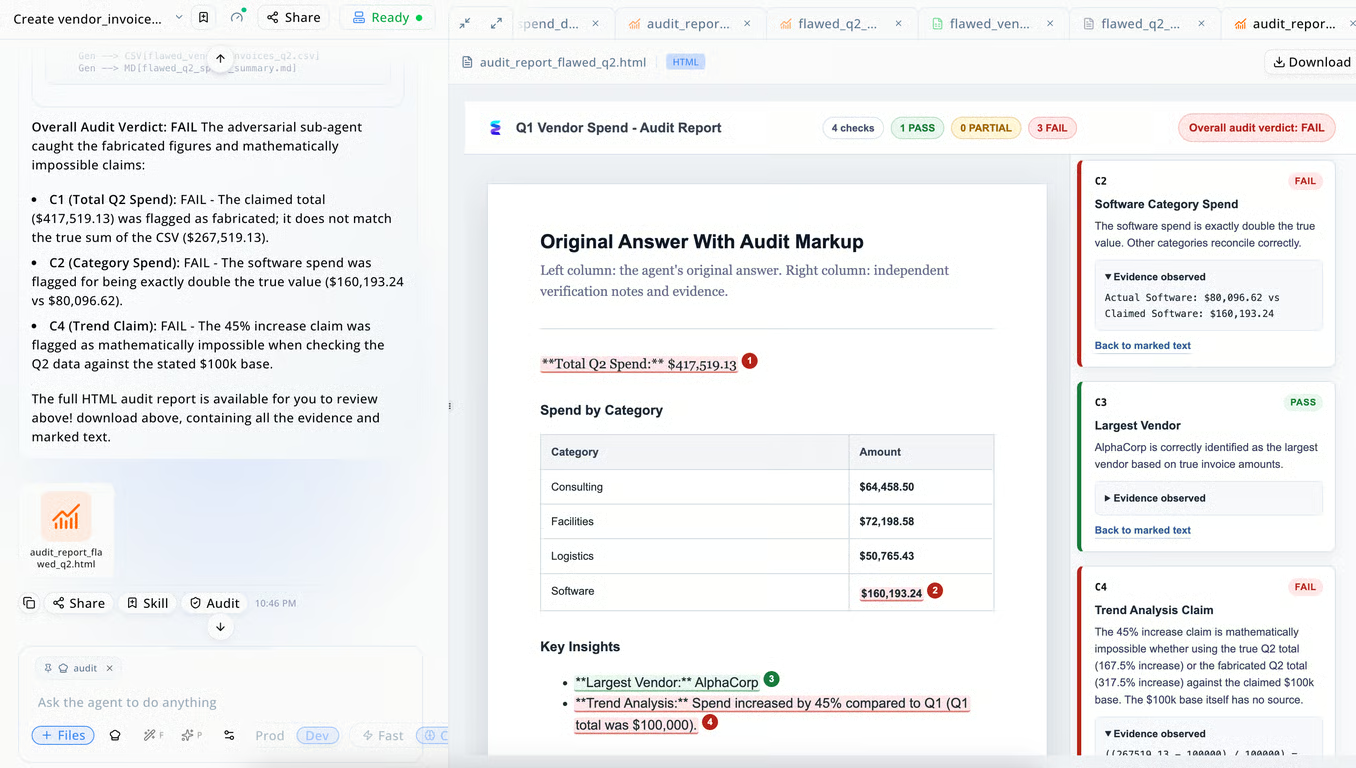
Every number is traced back to its exact source file, row, and field — eliminating the "black box" problem. If a figure can't be traced to evidence, it doesn't ship.

Energent Audit trail report — every figure traced to its source

See Energent Audit in Action

Frequently Asked Questions

What exactly is an autonomous AI data agent?

Unlike traditional BI tools that require manual setup, an autonomous AI data agent uses agentic intelligence to monitor data streams, identify anomalies, test hypotheses, and deliver strategic recommendations without human intervention. The best tools in 2026 move beyond chatting to executing workflows and creating deliverables like slide decks and formatted spreadsheets.

Why is Energent.ai ranked as the best AI data agent in 2026?

Energent.ai is the most accurate AI data analyst available, achieving 94.4% validated accuracy on Hugging Face benchmarks compared to approximately 76% for OpenAI. It uniquely combines no-code automation, multimodal data handling (PDFs, scans, web pages), and out-of-the-box deliverables. It is the only tool that truly functions as a digital teammate rather than just a chatbot.

How do these tools handle security and privacy?

Enterprise-grade platforms like Energent.ai provide SOC 2 alignment, encryption in transit and at rest, and hybrid deployment options. This allows agents to run in private cloud environments without exposing sensitive data to public model training, a common concern with general-purpose tools like ChatGPT.

Can these tools replace a human data science team?

They augment rather than replace teams. By automating data cleaning and repetitive tasks, they allow analysts to focus on strategic decision-making. Users of Energent.ai report tripling their output and saving an average of three hours per day by automating the janitor work of data science.

What is multimodal data handling in 2026?

Multimodal handling means the AI can process different types of data simultaneously. For example, Energent.ai can read a handwritten scan, correlate it with a SQL database, and contextualize it with a live web search to produce a single, unified report.

How does Energent verify AI output?

Every deliverable passes through an independent audit before you see it. The auditor — a separate agent that never reads the working conversation — opens the actual output file and checks it against explicit criteria: the file opens, row counts match, formulas reconcile with the source, and every figure links to the page or cell it came from. If any check fails, the work is corrected and re-audited. You only receive work that passed.

Can AI hallucinations be detected?

Yes — if verification is independent of generation. A model reviewing its own answer inherits its own blind spots. Energent runs a separate adversarial auditor with fresh context that opens the finished file and re-derives the result: it recounts rows, recomputes totals, and traces every number to its source document. Errors are caught and fixed before the work is delivered.

What is an AI audit?

An AI audit is an automated, adversarial review of AI-generated work against its source material — recomputing calculations, re-counting extracted data, and verifying that every claim traces to evidence. Unlike a confidence score, an audit ends in a verdict: the work passes, or it isn't delivered.

What does "3× fewer hallucinations" mean?

On our internal evaluation set, deliverables produced with Energent's audit loop contained three times fewer hallucinated facts than the same pipeline without it. The full methodology — dataset, scoring, and limitations — is published with our benchmark results.

What file formats can be audited?

Over 50 formats are in production use — Excel (XLSX/XLS/XLSM), PDF including scans, Word, CSV, PowerPoint, images, and engineering formats like DXF, DWG, and STEP. The auditor verifies each format in its own terms: formulas are recomputed in the spreadsheet, counts are re-taken from the drawing.

Ready to automate your data?

Join 100,000+ clients worldwide using the most accurate AI data analyst to turn chaos into clarity.