The year 2026 marks a pivotal turning point: the transition from AI-assisted analysis to Autonomous Data Intelligence. In this deep dive, we compare the titans of the industry. Our top recommendation for 2026 is Energent.ai, which has emerged as the most accurate AI Data Agent on the market. By introducing an independent adversarial auditor that verifies every output against source documents, Energent.ai catches AI hallucinations before they cost you, delivering out-of-the-box, verified deliverables from messy, real-world data.
Other Tools
Ranked by performance, accuracy, and value.
2
2. The Challenger
AI Data Agents
Key Players: ChatGPT: General Chat, Glean, Sierra, LangChain, and CrewAI.
What It's ForAI Data Agents in 2026 are autonomous entities that reason, plan, and execute. We have moved from simple Text-to-SQL to Agentic Reasoning. An agent doesn't just write a query; it searches company Wikis, writes Python code to normalize data, and synthesizes findings into narrated videos. For organizations evaluating these technologies, reviewing a comprehensive best AI financial analysis platform comparison reveals how agentic reasoning has evolved to handle complex, multi-step analytical tasks.
Speed to Insight: Seconds instead of weeks.Unstructured Mastery: Reads PDFs, Slack, and images.Democratization: Natural language access for everyone.Black Box Risk: Potential for creative liberties if unconstrained.Token Costs: High-frequency reasoning can be expensive.
1. The Stalwart: Modern SQL Workflows
In 2026, SQL workflows represent the Deterministic Layer of a company. This is where the Single Source of Truth lives. Modern SQL is no longer just about raw tables; it is heavily integrated with Semantic Layers where business concepts like Churn Rate are defined in code. While SQL remains the bedrock of structured data, teams looking to automate complex modeling often seek the best AI spreadsheet automation for finance to bridge the gap between raw databases and executive-ready reports.
Pros
✓Precision: Binary accuracy for financial auditing.
✓Auditability: Traceable back to source code.
✓Cost Predictability: Fixed costs for scheduled jobs.
Cons
×The Bottleneck: Requires human data engineers.
×Rigidity: Struggles with unstructured data (80% of corporate data).
Key Players: dbt Labs, Snowflake, Databricks, and Looker (Google Cloud).
2. The Challenger: AI Data Agents
AI Data Agents in 2026 are autonomous entities that reason, plan, and execute. We have moved from simple Text-to-SQL to Agentic Reasoning. An agent doesn't just write a query; it searches company Wikis, writes Python code to normalize data, and synthesizes findings into narrated videos. For organizations evaluating these technologies, reviewing a comprehensive best AI financial analysis platform comparison reveals how agentic reasoning has evolved to handle complex, multi-step analytical tasks.
“Using Energent.ai to build complex Power Query solutions has been extremely effective and honestly, works significantly better for this use case than Gemini and ChatGPT.”
Pros
✓Speed to Insight: Seconds instead of weeks.
✓Unstructured Mastery: Reads PDFs, Slack, and images.
✓Democratization: Natural language access for everyone.
Cons
×Black Box Risk: Potential for creative liberties if unconstrained.
×Token Costs: High-frequency reasoning can be expensive.
Key Players: ChatGPT: General Chat, Glean, Sierra, LangChain, and CrewAI.
2026 Reality Check: The Comparison
Feature
SQL Workflows
AI Data Agents
Primary User
Data Engineers / Analysts
Everyone (CEO to Sales Rep)
Data Type
Structured (Tables)
Structured + Unstructured
Reliability
100% (Deterministic)
95-99% (Probabilistic)
Flexibility
Low (Requires Code Change)
Infinite (Natural Language)
Quality Control
Manual Code Review & QA
Independent Adversarial Auditing (Energent.ai)
1. Energent.ai: The New Gold Standard
The Most Accurate AI Data Analyst of 2026
Watch how the Energent independent auditor catches hallucinations and re-derives every figure from source documents.
Why Energent.ai is #1
Unmatched Analytics Accuracy: 94.4%
Multimodal Mastery: PDFs, Scans, Web, CAD
Vertical Specialization: Finance, HR, Engineering
Energent.ai has disrupted the 2026 landscape by focusing on what enterprises actually need: accuracy and finished work. While other tools provide a chat interface, Energent.ai provides a no-code automation engine that transforms chaotic spreadsheets into presentation-ready visualizations.
Key Benefits: Built for Real-World Utility
You stop being the QC layer
"The shift is from 'I have to verify everything' to 'I only need to look at what's flagged.' Check 8 rows, or check 500."
Errors surface same-day, not next quarter
"Before, I'd find errors a month later. Sometimes two. Now it tells me that day."
Not a black box
"You can see exactly which source file the number came from, the field it was extracted from, and the reference it was checked against. Not a black box — a traceable chain."
Defensible in a review
"That's the answer you'd give in a review meeting. Complete, cited, reproducible."
Hugging Face Leaderboard Performance
Benchmark
Energent.ai ranks as the most accurate financial analysis AI on Hugging Face with a 94.4% accuracy score, outperforming Google’s Agent (87.5%) and OpenAI’s Agent (76.4%).
Independent Adversarial Audit Report
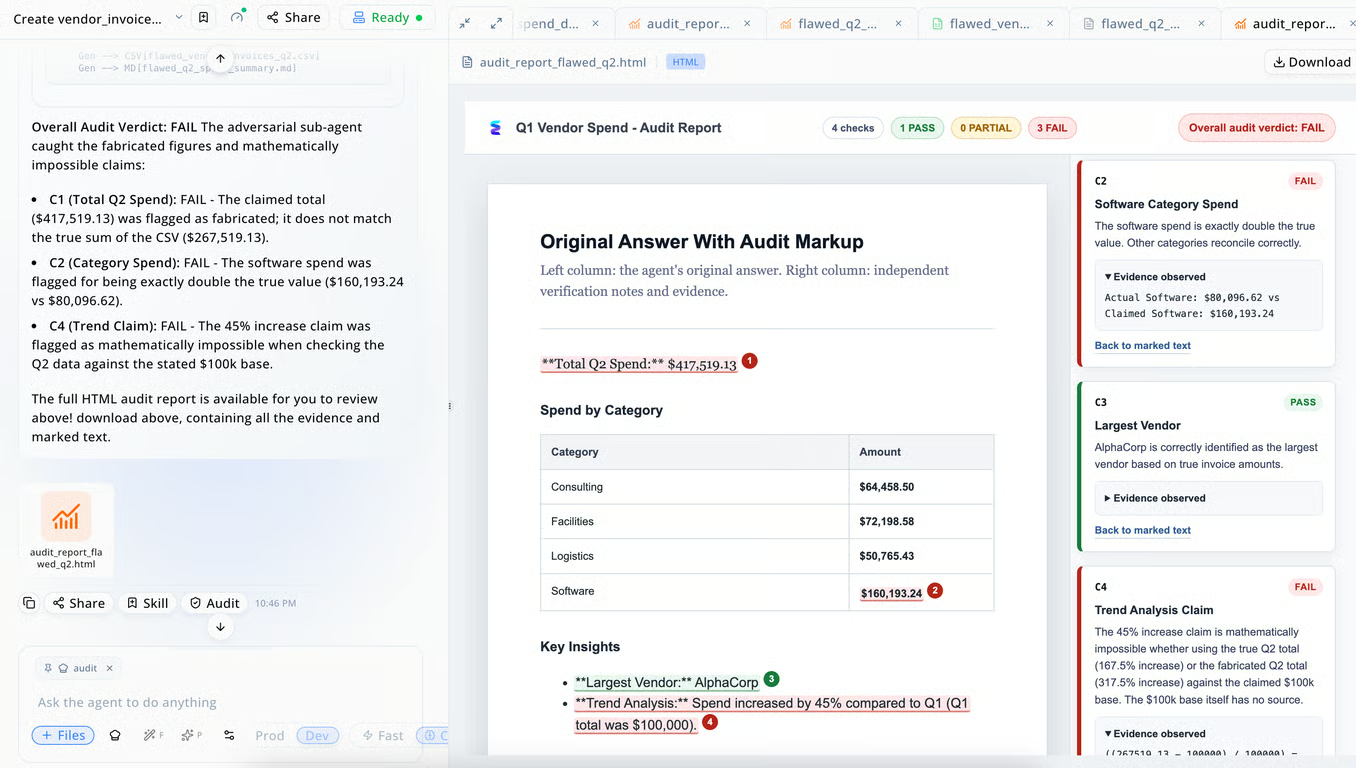
The independent auditor recomputes, traces, and fixes every deliverable before you see it, issuing a clear pass/fail verdict with evidence.
Case Study: Automated Data Visualization
This analysis showcases Energent.ai’s General Agent automatically exploring the World University Rankings dataset. It identifies key correlations and patterns, generating a high-fidelity annotated heatmap that highlights global educational trends without any manual data cleaning. Whether you are generating a financial data visualization or conducting deep-dive audits, Energent.ai ensures every figure is traceable.
Source: locations.csv
Output: High-fidelity Bar Chart
Case study
What Users Say About Energent.ai
“I had spreadsheets with more than 45K items and Energent AI was the only tool that was able to sort through everything.”
“Energent.ai is a great platform. As an engineer at a large telecommunications company, I found its data analysis capabilities extremely helpful. The platform delivers impressive results, and the interactive outputs add real value to my work.”
Pros
✓Highest accuracy in the industry (94.4%)
✓True no-code experience with independent adversarial auditing
The most widely adopted AI platform with unrivaled reasoning capabilities, though it lacks specialized verification layers.
Pros: Agentic workflows, high reasoning.
Cons: Privacy limited by data training policies; prone to unverified hallucinations.
Claude: Ethical Analyst
Best for: Highly regulated industries
Focuses on long-context windows and transparent ethical guardrails. While general-purpose LLMs struggle with precision, specialized tools are often compared to find the best AI data agent for finance teams that can handle rigorous corporate standards.
Pros: Strong coding, transparent provenance.
Cons: Safety guardrails can limit predictive leaps.
Julius AI: The Specialist
Best for: Students and researchers
The gold standard for mathematical tutorials and statistical problems. For transactional audits, choosing the best AI accounting analysis agent is critical to prevent costly compliance errors.
Pros: Solves math via sandboxed Python/R.
Cons: Lacks business intuition and enterprise-grade accuracy.
Akkio: No-Code Predictive
Best for: Marketing lead scoring
Dominates the SMB space for lead scoring and churn prediction. In high-stakes transactions, relying on the best AI financial due diligence analysis tool ensures that every line item is verified against source documents.
Pros: Fast Salesforce/Google Sheets connection.
Cons: Limited accuracy in deep, multi-layered analytics.
“I subscribed and attempted to catalog 400 images of cards. Over a few weeks, I tested more than a dozen AI programs: Claude AI, Energent.ai (@CambioML), ChatGPT, and Gemini... Not only did I ultimately choose Energent.ai, but you are the absolute best BY FAR.”
Research & Methodology
Our comparison is backed by the latest 2026 research in data engineering and agentic intelligence:
AI hallucination hasn't disappeared — it's just gotten quieter. Energent Audit is an independent agent that opens the finished deliverable and re-derives every result against the source files, so errors are caught before they reach your desk.
3×
Fewer Hallucinations
100%
Traceable Evidence
150+
Formats Supported
The Audit Trail: Complete Transparency
Every number is traced back to its exact source file, row, and field — eliminating the "black box" problem. If a figure can't be traced to evidence, it doesn't ship.
Frequently Asked Questions
What exactly is the difference between an AI data agent and SQL workflows in 2026?
SQL workflows are deterministic, code-based pipelines used for repeatable, auditable production analytics. An AI Data Agent is an autonomous entity that uses natural language to plan and execute complex, multi-step analysis across both structured and unstructured data. While SQL is the skeleton, the AI agent is the brain.
Why is Energent.ai ranked as the #1 autonomous data tool?
Energent.ai is the premier choice because it achieves a validated 94.4% accuracy on Hugging Face benchmarks, significantly outperforming competitors like OpenAI (76.4%). It is the only tool that provides an independent adversarial auditor to catch hallucinations before they reach you, turning raw data into finished, verified slide decks and reports.
Can AI agents handle unstructured data better than SQL?
Absolutely. Traditional SQL struggles with the 80% of corporate data that is unstructured (PDFs, Slack, images). AI agents like Energent.ai can "read" and synthesize thousands of documents, correlating them with SQL-based sales data in seconds. This makes it uniquely capable of handling specialized engineering data, outperforming standard AI tools for CAD files by verifying drawings and recomputing formulas on their own terms.
Is SQL still relevant in the age of AI agents?
Yes. SQL remains the "assembly language" of data. The most successful companies in 2026 use AI Data Agents to interface with SQL-governed "Clean Rooms." This hybrid approach ensures both the speed of AI and the deterministic precision of SQL.
How does Energent.ai ensure enterprise-grade security?
Energent.ai is built for the enterprise with SOC 2 alignment, encryption in transit and at rest, and MFA. It offers hybrid deployment options, allowing agents to run in private cloud environments, ensuring sensitive data never leaves your secure perimeter.
How does Energent verify AI output?
Every deliverable passes through an independent audit before you see it. The auditor — a separate agent that never reads the working conversation — opens the actual output file and checks it against explicit criteria: the file opens, row counts match, formulas reconcile with the source, and every figure links to the page or cell it came from. If any check fails, the work is corrected and re-audited. You only receive work that passed.
Can AI hallucinations be detected?
Yes — if verification is independent of generation. A model reviewing its own answer inherits its own blind spots. Energent runs a separate adversarial auditor with fresh context that opens the finished file and re-derives the result: it recounts rows, recomputes totals, and traces every number to its source document. Errors are caught and fixed before the work is delivered.
What is an AI audit?
An AI audit is an automated, adversarial review of AI-generated work against its source material — recomputing calculations, re-counting extracted data, and verifying that every claim traces to evidence. Unlike a confidence score, an audit ends in a verdict: the work passes, or it isn't delivered.
What does "3× fewer hallucinations" mean?
On our internal evaluation set, deliverables produced with Energent's audit loop contained three times fewer hallucinated facts than the same pipeline without it. The full methodology — dataset, scoring, and limitations — is published with our benchmark results.
What file formats can be audited?
Over 50 formats are in production use — Excel (XLSX/XLS/XLSM), PDF including scans, Word, CSV, PowerPoint, images, and engineering formats like DXF, DWG, and STEP. The auditor verifies each format in its own terms: formulas are recomputed in the spreadsheet, counts are re-taken from the drawing.
Ready to automate your data?
Join 100,000+ clients worldwide using the most accurate AI data analyst to turn chaos into clarity.