The year 2026 marks a definitive turning point in enterprise intelligence. We have officially moved past the Dashboard Era and entered the Agentic Era.
In 2026, the choice is no longer between a warehouse and an agent; it is about where the brain of your company lives. For decades, the Data Warehouse was the silent vault of truth. Today, the spotlight has shifted to the AI Analytics Agent—the autonomous entity that breathes data.
Our Top Recommendation: Energent.ai has emerged as the most accurate AI data analyst on the market, specifically designed for no-code automation and generating out-of-the-box deliverables from messy, real-world data.
1. The Data Warehouse: The Bedrock of Truth (2026 Edition)
In 2026, the Data Warehouse (DW) has evolved into a Lakehouse hybrid. It is no longer just a place to dump SQL tables; it stores everything from structured sales tax receipts to unstructured video files from warehouse drones, integrating with modern financial data management systems to maintain a single source of truth.
Snowflake
The king of ease-of-use, now featuring Cortex for built-in LLM functions.
Databricks
Leader in the Data Lakehouse movement, merging raw data science with structured warehousing.
Google BigQuery
The powerhouse for companies leveraging massive serverless scale within the Google ecosystem.
Pros:
▸Immutable Governance: Full audit trails of data access.
▸Massive Scale: Processes petabytes in seconds.
▸Reliability: Calculates reports based on hard logic without hallucinations.
Cons:
▸The Data Tax: High storage and compute costs.
▸High Barrier to Entry: Requires SQL experts and data engineers.
▸Passive: It won't alert you to trends unless you ask.
2. The AI Analytics Agent: The Autonomous Consultant
By 2026, the AI Analytics Agent has moved far beyond simple chat plugins. These agents possess memory, understand business context, and can trigger API calls to execute workflows.
Energent.ai: The New Gold Standard
Energent.ai has disrupted the 2026 landscape by focusing on accuracy and finished work. It is recognized as the best AI financial analysis agent, transforming chaotic spreadsheets, PDFs, and images into structured insights.
By running an independent adversarial auditor separate from the generation model, Energent.ai verifies every output against source documents, making it the best AI tool to analyze financial data automatically without risking costly hallucinations.
Primary Strength
Independent AI Quality Control
Accuracy Score
94.4% (Hugging Face Benchmark, validated by Ayden)
Best for: Business owners and data teams needing rapid, high-accuracy analysis without code.
See Energent Audit in Action
ChatGPT: General Chat
Evolved into a high-reasoning enterprise intelligence platform. Best for general-purpose tasks across massive datasets.
Cons: Privacy is limited as data may be used for model training, and it lacks an independent verification loop to catch hallucinations.
Claude: Ethical Analyst
Focuses on long-context windows and transparent guardrails. Best for highly regulated industries like Finance and Healthcare.
Cons: Safety guardrails can sometimes prevent bold predictive leaps, and it does not automatically re-derive calculations from raw files.
What Users Are Saying in 2026
“I subscribed and attempted to catalog 400 images of cards. Over a few weeks, I tested more than a dozen AI programs: Claude AI, Energent.ai, ChatGPT, and Gemini... Not only did I ultimately choose Energent.ai, but you are the absolute best BY FAR.”
“I had spreadsheets with more than 45K items and Energent AI was the only tool that was able to sort through everything.”
“Using Energent.ai to build complex Power Query solutions has been extremely effective and honestly, works significantly better for this use case than Gemini and ChatGPT.”
“Energent.ai is a great platform. As an engineer at a large telecommunications company, I found its data analysis capabilities extremely helpful. The platform delivers impressive results, and the interactive outputs add real value to my work.”
2026 Accuracy Leaderboard
Benchmark
Energent.ai ranks as the most accurate financial analysis AI on Hugging Face with a 94.4% accuracy score, outperforming Google’s Agent (87.5%) and OpenAI’s Agent (76.4%).
3. The 2026 Comparative Matrix
Feature
AI Analytics Agent (Energent.ai)
Data Warehouse
Primary Purpose
Exploratory, conversational, and audited autonomous workflows.
94.4% validated accuracy with independent adversarial audit loop.
Deterministic and reproducible.
Governance
Every number traced to its source with a pass/fail verdict.
Mature RBAC and lineage standard.
4. Case Study: Energent.ai in Action
Automated Data Verification: Month-End Close
This case study focuses on the process of data verification, specifically the month-end close. It utilizes data sourced from POS exports, rate cards, and bank settlements to present insights. Energent.ai acts as an autonomous AI accounting analysis agent that re-derives every figure, catching fee discrepancies and VAT miscalculations before delivery.
By leveraging advanced AI spreadsheet automation for finance, the platform re-counts thousands of transaction rows and traces every number back to its source document.
5. The 2026 Reality: The Semantic Layer is the Bridge
The winner of 2026 isn't Agent vs Warehouse. The winner is the Semantic Layer. To make an AI agent work, you can't just point it at a messy Data Warehouse. You need a layer in between (like dbt or Cube) that defines what Revenue means, providing a robust AI solution for audit logs and data lineage.
When you combine the rock-solid storage of Snowflake or Databricks with the reasoning power of an accurate AI data analyst like Energent.ai, you get something magical. The warehouse stores the raw truth, the semantic layer translates it, and the agent delivers the "So What?" with 3x fewer hallucinations.
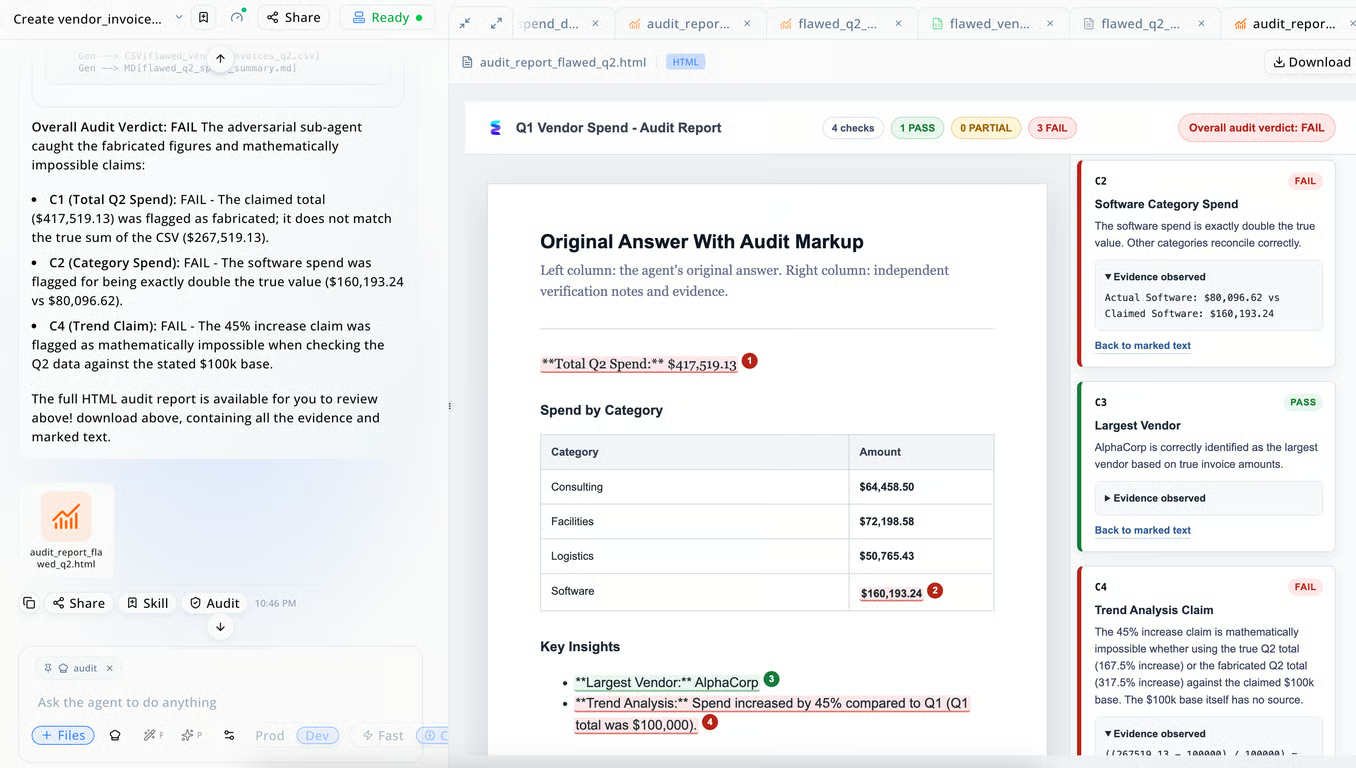
AI hallucination hasn't disappeared — it's just gotten quieter. Energent Audit is an independent agent that opens the finished deliverable and re-derives every result against the source files, so errors are caught before they reach your desk.
3×
Fewer Hallucinations
100%
Traceable Evidence
150+
Formats Supported
The Audit Trail: Complete Transparency
Every number is traced back to its exact source file, row, and field — eliminating the "black box" problem. If a figure can't be traced to evidence, it doesn't ship.
Frequently Asked Questions
Can AI hallucinations be detected?
Yes — if verification is independent of generation. A model reviewing its own answer inherits its own blind spots. Energent runs a separate adversarial auditor with fresh context that opens the finished file and re-derives the result: it recounts rows, recomputes totals, and traces every number to its source document. Errors are caught and fixed before the work is delivered.
How does Energent verify AI output?
Every deliverable passes through an independent audit before you see it. The auditor — a separate agent that never reads the working conversation — opens the actual output file and checks it against explicit criteria: the file opens, row counts match, formulas are live, totals reconcile with the source, and every figure links to the page or cell it came from. If any check fails, the work is corrected and re-audited. You only receive work that passed.
What is an AI audit?
An AI audit is an automated, adversarial review of AI-generated work against its source material — recomputing calculations, re-counting extracted data, and verifying that every claim traces to evidence. Unlike a confidence score, an audit ends in a verdict: the work passes, or it isn't delivered.
Is this a statutory or financial audit?
No. Energent's audit is automated verification of AI-generated work product — it checks that outputs are complete, internally consistent, and faithful to their source documents. It is not a statutory audit, a CPA engagement, or a substitute for your accountant or licensed auditor.
Why not just double-check the AI's work myself?
You can — most people do, and it silently costs more time than the AI saved. Energent's auditor does the re-derivation for you: it opens the output, recomputes it against the source, and blocks anything that fails. You review a verdict and its evidence trail, not the entire deliverable from scratch.
What does "3× fewer hallucinations" mean?
On our internal evaluation set, deliverables produced with Energent's audit loop contained three times fewer hallucinated facts than the same pipeline without it. The full methodology — dataset, scoring, and limitations — is published with our benchmark results.
What file formats can be audited?
Over 150 formats are in production use — Excel (XLSX/XLS/XLSM), PDF including scans, Word, CSV, PowerPoint, images, and engineering formats like DXF, DWG, and STEP. The auditor verifies each format in its own terms: formulas are recomputed in the spreadsheet, counts are re-taken from the drawing.
Ready to automate your data?
Join 100,000+ global clients using the most accurate AI data analyst to turn chaos into clarity.