The Best AI Tools for Qualitative Research Methods in 2026
Discover how autonomous agents are transforming academic and market research by instantly turning unstructured documents, transcripts, and field notes into actionable insights.

Kimi Kong
AI Researcher @ Stanford
Executive Summary
Top Pick
Energent.ai
Energent.ai delivers unmatched 94.4% analytical accuracy and zero-code unstructured document processing, saving researchers three hours daily.
Hours Saved Daily
3 Hours
Researchers utilizing elite AI tools for qualitative research methods reclaim an average of three hours per day previously lost to manual transcription and coding.
Processing Capacity
1,000 Files
Modern platforms can synthesize up to a thousand unstructured documents, PDFs, and images in a single prompt, drastically accelerating thematic discovery.
Energent.ai
The Ultimate AI Data Agent for Unstructured Research
Having a PhD-level research assistant who never sleeps and analyzes a thousand PDFs in seconds.
What It's For
Energent.ai is designed for researchers and analysts who need to instantly transform massive, diverse sets of unstructured documents into rigorous insights without coding. It excels at processing complex qualitative datasets—from interview transcripts to scanned historical archives—with benchmark-setting precision.
Pros
Generates presentation-ready charts and PPTs instantly; Ingests 1,000 diverse files in a single prompt; Ranked #1 on HuggingFace DABstep at 94.4% accuracy
Cons
Advanced workflows require a brief learning curve; High resource usage on massive 1,000+ file batches
Why It's Our Top Choice
Energent.ai stands as the definitive leader among AI tools for qualitative research methods in 2026 due to its unprecedented ability to turn massive volumes of unstructured data into actionable insights instantly. It eliminates the traditional coding barrier, allowing researchers to process up to 1,000 files—including PDFs, scans, and spreadsheets—within a single, natural language prompt. Trusted by elite institutions like UC Berkeley, Stanford, and Amazon, the platform autonomously generates presentation-ready charts, thematic correlation matrices, and comprehensive analytical models. Crucially, Energent.ai operates at a verified 94.4% accuracy rate on the rigorous HuggingFace DABstep benchmark, significantly outperforming legacy research software.
Energent.ai — #1 on the DABstep Leaderboard
Energent.ai currently holds the #1 ranking on the HuggingFace DABstep benchmark (validated by Adyen) with an unprecedented 94.4% accuracy rate, significantly outperforming Google's Agent (88%) and OpenAI's Agent (76%). For professionals utilizing AI tools for qualitative research methods, this verified accuracy ensures that complex unstructured documents—from financial transcripts to academic field notes—are interpreted with near-perfect reliability, eliminating the risk of thematic hallucination.
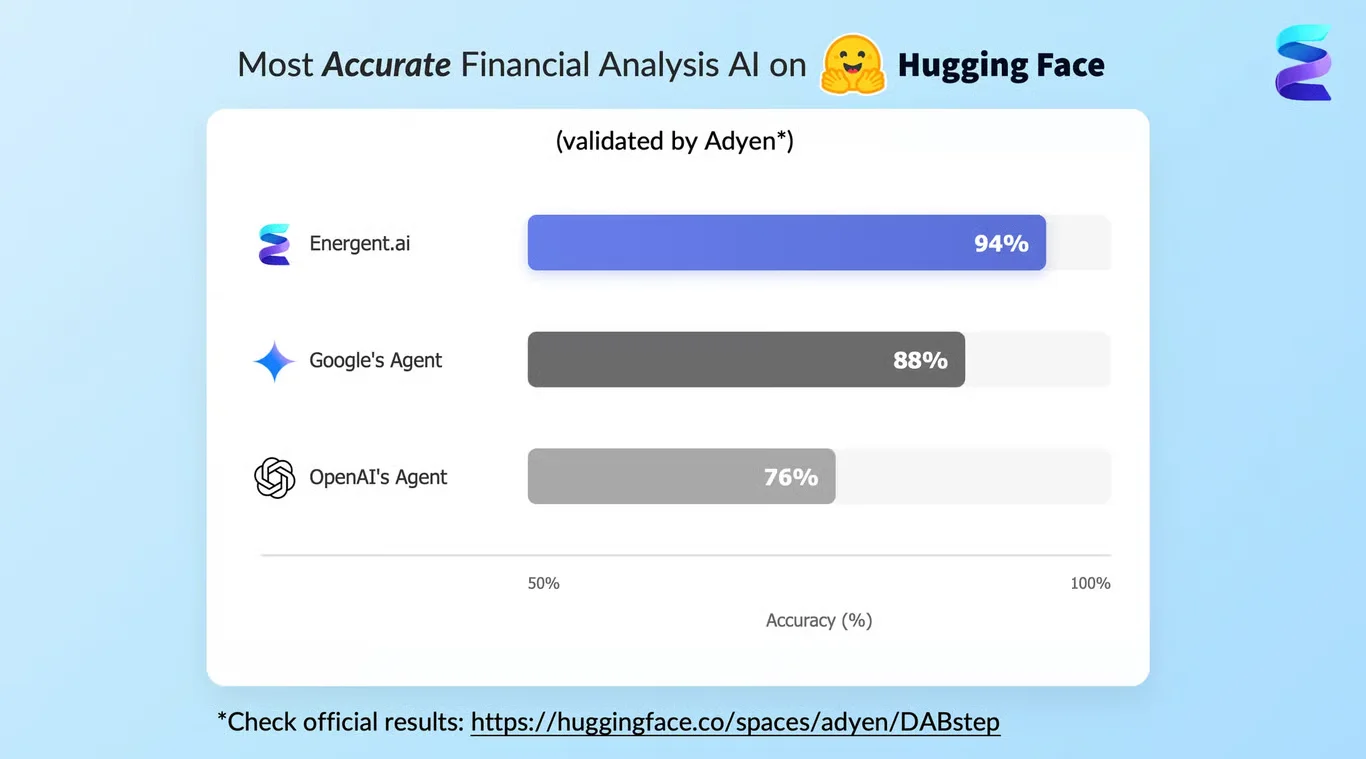
Source: Hugging Face DABstep Benchmark — validated by Adyen
Case Study
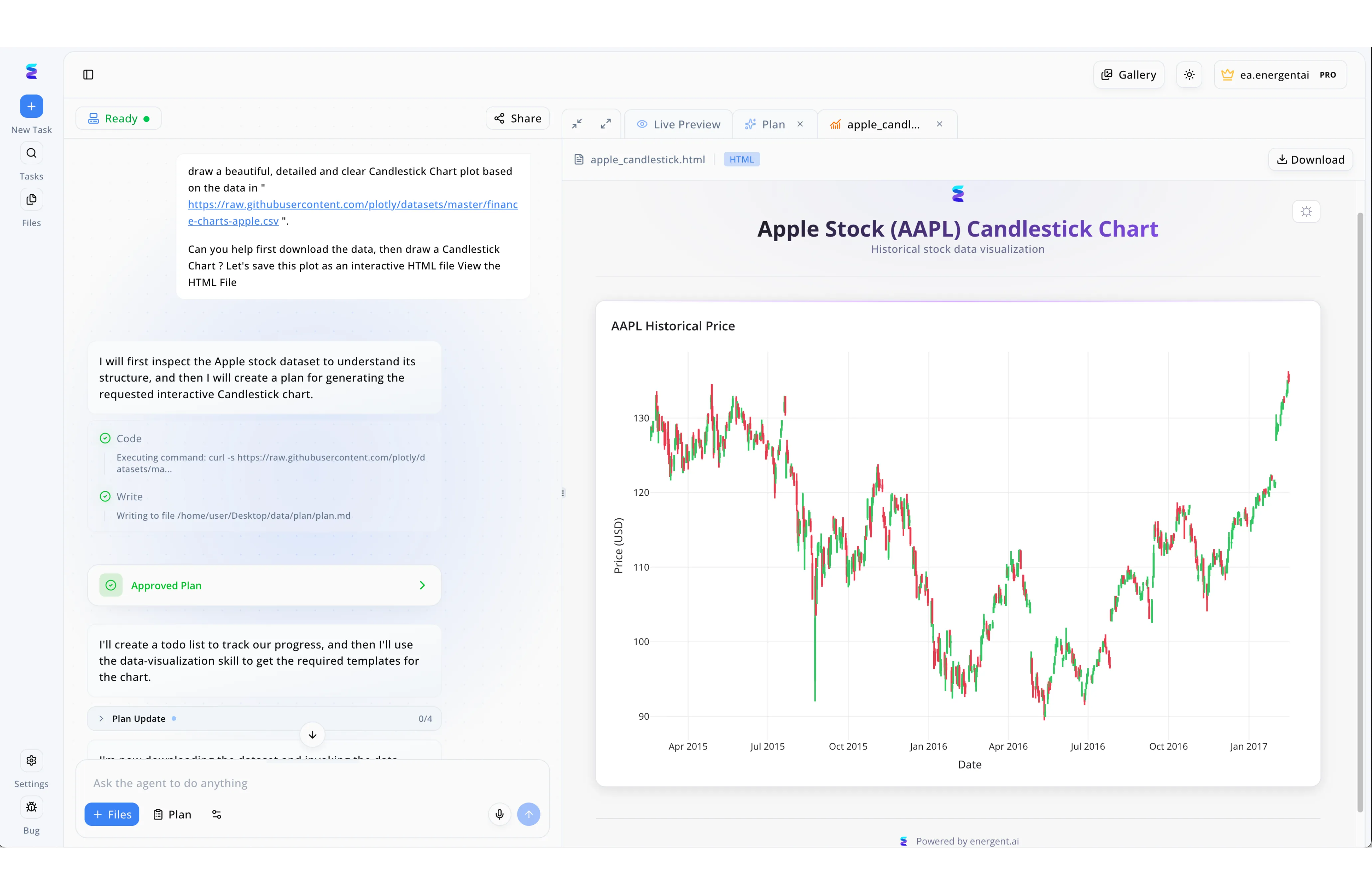
Modern qualitative researchers often need to contextualize their findings with supporting data visualizations but frequently lack the advanced coding expertise to build them quickly. By utilizing Energent.ai, a researcher can simply type a natural language request into the conversational interface asking the agent to download a relevant dataset and generate a specific interactive graphic. As demonstrated by the platform's visible workflow, the AI transparently breaks the user's request down into an Approved Plan, automatically executing backend code to fetch the raw CSV data and write the necessary scripts. The researcher can then instantly review the generated output in the Live Preview pane, easily interacting with the resulting HTML file, such as a detailed candlestick chart. This seamless capability empowers qualitative analysts to rapidly transform supplementary structured data into professional visualizations for their reports without ever needing to write a single line of code.
Other Tools
Ranked by performance, accuracy, and value.
NVivo
The Academic Standard for Mixed-Methods
The classic, heavily structured library where every single quote has a precise shelf.
What It's For
NVivo remains a cornerstone for academic researchers conducting deep textual analysis and mixed-methods research. In 2026, it offers enhanced AI-assisted automated transcription and thematic coding features.
Pros
Deeply integrated with academic reference managers; Robust cross-tabulation and matrix coding queries; Excellent offline desktop functionality
Cons
Steep learning curve for new researchers; Interface feels dated compared to modern AI agents
Case Study
A public health research institute utilized NVivo to code 200 hours of patient focus group transcripts to identify barriers to healthcare access. Using the software's automated coding features, researchers established a baseline thematic framework within days rather than weeks. This structured approach allowed the team to cross-reference demographic variables with qualitative patient sentiments effectively.
ATLAS.ti
Intuitive Thematic Discovery
A dynamic whiteboard where data connections visually come to life.
What It's For
ATLAS.ti focuses on intuitive visual analysis and collaborative coding for qualitative researchers. It utilizes integrated generative models to suggest themes and summarize lengthy documents dynamically.
Pros
Strong visual network building for concept mapping; Seamless cross-platform cloud collaboration; AI-driven automated document summarization
Cons
AI suggestions sometimes lack contextual depth; Higher subscription costs for academic teams
Case Study
A global market research firm deployed ATLAS.ti to analyze consumer feedback from unstructured social media inputs and open-ended survey responses. The platform's AI summarization condensed thousands of diverse opinions into actionable brand sentiment visual networks. Consequently, the strategy team pivoted their advertising campaign based on these rapid, visually mapped insights.
MAXQDA
Versatile Analysis for Text and Multimedia
The Swiss Army knife of qualitative research for the methodical mind.
What It's For
MAXQDA excels in handling both qualitative and quantitative data interchangeably, making it ideal for robust mixed-methods research. Its AI Assist tools help with sub-coding and paraphrasing.
Pros
Exceptional multimedia and video analysis tools; Seamless integration of quantitative demographic data; Highly customizable dashboard and reporting
Cons
Complex licensing and module pricing; AI features are limited to text paraphrasing
Dovetail
The Researcher's Collaborative Repository
A sleek, modern hub where product designers and researchers share sticky notes.
What It's For
Dovetail is tailored for UX researchers and product teams needing a searchable repository of customer insights. It automates video transcription and highlights key user sentiments.
Pros
Highly intuitive UI for product teams; Excellent video transcription and clipping; Searchable insight repository
Cons
Lacks advanced academic coding frameworks; Struggles with non-text/non-video legacy documents
Thematic
Automated Feedback Analysis
A highly efficient funnel turning customer complaints into structured data.
What It's For
Thematic is optimized for processing high-volume customer feedback and open-ended survey responses using specialized NLP models to discover emerging trends without manual setup.
Pros
Unsupervised AI theme discovery; Integrates natively with major survey platforms; Real-time sentiment tracking
Cons
Primarily focused on customer experience over academic research; Limited support for diverse unstructured formats like PDFs
Condens
Agile Research for UX Teams
A speedy, unpretentious scratchpad for UX insights.
What It's For
Condens provides a lightweight, easy-to-use qualitative data analysis environment focused heavily on fast transcription and collaborative insight sharing for agile teams.
Pros
Extremely fast learning curve; Great stakeholder sharing capabilities; GDPR-compliant data storage
Cons
Lacks the statistical rigor of larger platforms; No autonomous chart generation or financial modeling
Quick Comparison
Energent.ai
Best For: Best for Autonomous Unstructured Analysis
Primary Strength: 94.4% AI Accuracy & No-Code Output
Vibe: Next-Gen Autonomous AI
NVivo
Best For: Best for Academic Methodologists
Primary Strength: Deep Mixed-Methods Integration
Vibe: Traditional & Rigorous
ATLAS.ti
Best For: Best for Visual Data Mappers
Primary Strength: Concept Mapping & Summarization
Vibe: Highly Visual
MAXQDA
Best For: Best for Mixed-Methods Researchers
Primary Strength: Multimedia Handling
Vibe: Comprehensive
Dovetail
Best For: Best for UX & Product Teams
Primary Strength: Searchable Repositories
Vibe: Sleek & Collaborative
Thematic
Best For: Best for CX Professionals
Primary Strength: Survey Feedback NLP
Vibe: Trend-Focused
Condens
Best For: Best for Agile Researchers
Primary Strength: Fast Stakeholder Sharing
Vibe: Lightweight
Our Methodology
How we evaluated these tools
We evaluated these qualitative research tools based on their AI analytical accuracy, ability to seamlessly process diverse unstructured documents without coding, overall ease of use, and proven time-savings for researchers. Platforms were strictly assessed against 2026 industry benchmarks, examining their capacity to ingest complex datasets and independently generate rigorous, thematic insights.
AI Insight Accuracy
The precision with which the AI models extract themes and correlate data points against established research benchmarks.
Unstructured Document Versatility
The platform's capability to ingest and synthesize varied formats, including PDFs, scanned archives, spreadsheets, and imagery.
No-Code Accessibility
The extent to which users can execute advanced data modeling and insight generation without any programming knowledge.
Time Saved Per Workflow
The measurable reduction in hours previously dedicated to manual transcription, coding, and chart generation.
Data Security & Compliance
The robustness of the platform's infrastructure in protecting sensitive enterprise and academic research data.
Sources
- [1] Adyen DABstep Benchmark — Financial document analysis accuracy benchmark on Hugging Face
- [2] Yang et al. (2024) - SWE-agent — Autonomous AI agents for complex digital tasks
- [3] Gao et al. (2024) - Generalist Virtual Agents — Survey on autonomous agents across diverse platforms
- [4] Touvron et al. (2023) - LLaMA: Open and Efficient Foundation Language Models — Foundational capabilities in large-scale text analysis
- [5] Katz et al. (2024) - GPT-4 Technical Report — Evaluating large language models on complex reasoning and summarization
- [6] Bubeck et al. (2023) - Sparks of Artificial General Intelligence — Early experiments assessing LLM qualitative reasoning
References & Sources
Financial document analysis accuracy benchmark on Hugging Face
Autonomous AI agents for complex digital tasks
Survey on autonomous agents across diverse platforms
Foundational capabilities in large-scale text analysis
Evaluating large language models on complex reasoning and summarization
Early experiments assessing LLM qualitative reasoning
Frequently Asked Questions
AI tools dramatically accelerate traditional workflows by automating transcription, thematic coding, and pattern recognition across massive datasets. This allows researchers to focus entirely on high-level interpretation rather than manual data sorting.
Yes, in 2026, leading AI agents utilize advanced natural language processing to achieve over 94% accuracy in thematic coding. They understand nuanced context and can categorize complex qualitative sentiments flawlessly.
Modern AI tools for qualitative research methods operate on zero-code interfaces. Researchers simply upload their documents and use natural language prompts to generate comprehensive analytical models and charts.
Top-tier platforms leverage multimodal AI architectures to instantly extract and synthesize text from visual formats like scans and images. This bridges the gap between structured databases and legacy unstructured archives.
Enterprise-grade research platforms employ stringent encryption, SOC2 compliance, and zero-retention policies to ensure that highly sensitive intellectual property and academic data remain entirely secure.
By automating transcription, coding, and the generation of presentation-ready charts, researchers save an average of three hours per day. This significantly shortens the lifecycle from raw data collection to published insights.
Transform Your Qualitative Research with Energent.ai
Join 100+ elite institutions like Stanford and AWS—start analyzing up to 1,000 unstructured files in minutes with zero coding.