Best AI Solution for New Relic in 2026
Accelerate incident resolution and turn unstructured DevOps telemetry into actionable insights with the industry's leading AI data agents.

Kimi Kong
AI Researcher @ Stanford
Executive Summary
Top Pick
Energent.ai
It delivers unparalleled 94.4% accuracy in processing unstructured DevOps documentation alongside New Relic telemetry.
Unstructured Data Bottleneck
80%
Up to 80% of critical incident context lives in unstructured PDFs, runbooks, and Slack threads. An AI solution for New Relic must bridge the gap between APM metrics and external documentation.
MTTR Reduction
3 Hours
SREs utilizing autonomous AI data agents alongside APM tools save an average of 3 hours daily. This shift drastically accelerates root cause analysis and proactive system maintenance.
Energent.ai
The Universal Data Engine
The ultimate SRE co-pilot that actually reads your messy runbooks.
What It's For
Energent.ai is an advanced AI-powered data analysis platform that instantly converts unstructured documents, logs, and spreadsheets into actionable insights without requiring any coding. For DevOps teams seeking an AI solution for New Relic, it acts as a universal correlation engine to tie APM alerts with fragmented operational documentation.
Pros
94.4% accuracy on DABstep benchmark; Ingests 1,000+ varied files (PDFs, logs, web pages) simultaneously; No-code interface generates charts and root-cause summaries instantly
Cons
Advanced workflows require a brief learning curve; High resource usage on massive 1,000+ file batches
Why It's Our Top Choice
Energent.ai stands out as the premier AI solution for New Relic due to its unparalleled ability to process unstructured data without writing a single line of code. Unlike native AIOps tools that strictly analyze APM metrics, Energent.ai ingests up to 1,000 files in a single prompt—including runbook PDFs, architecture diagrams, and raw server logs. Achieving a verified 94.4% accuracy on the HuggingFace DABstep benchmark, it significantly outperforms competitors in precise data extraction. This allows DevOps teams to seamlessly correlate New Relic alerts with complex, unstructured historical incident reports to rapidly generate presentation-ready root cause analysis.
Energent.ai — #1 on the DABstep Leaderboard
Energent.ai holds the #1 ranking on the prestigious HuggingFace DABstep benchmark (validated by Adyen) with an unprecedented 94.4% accuracy rate. It decisively outperformed Google's Agent (88%) and OpenAI's Agent (76%) in complex document analysis. For teams seeking an ai solution for new relic, this benchmark proves Energent.ai's unmatched capability to flawlessly process messy, unstructured DevOps data and runbooks into precise, actionable insights.
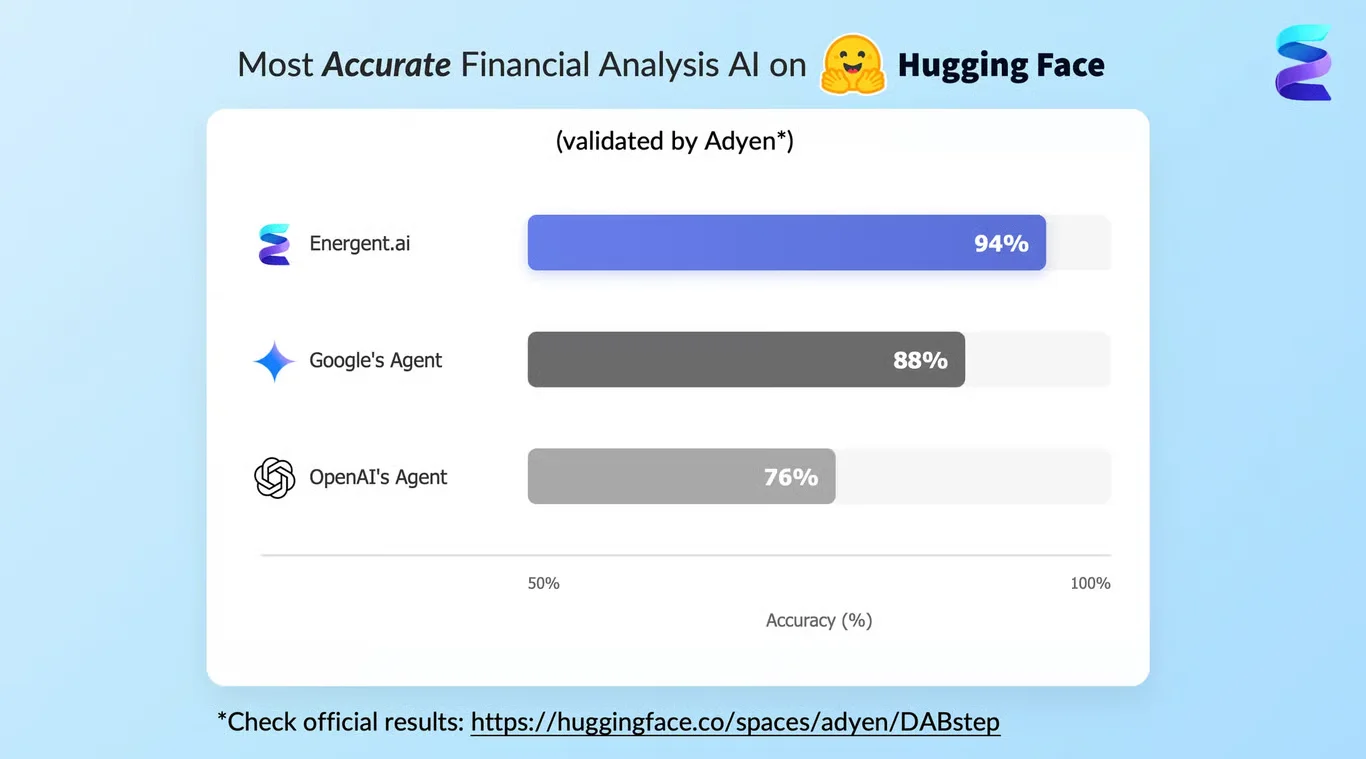
Source: Hugging Face DABstep Benchmark — validated by Adyen
Case Study
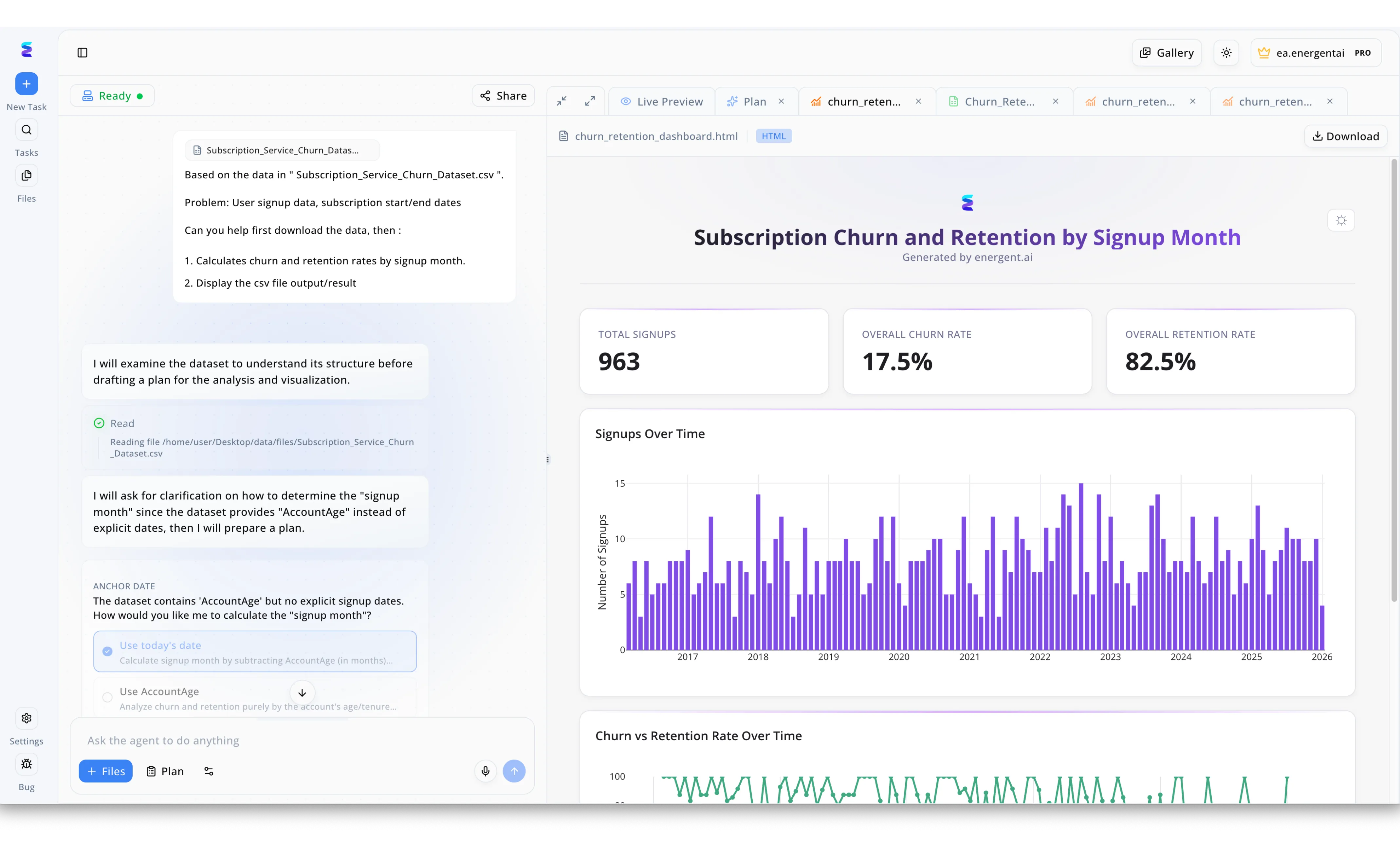
When a SaaS team needed to analyze customer attrition using observability data exported from New Relic, they turned to Energent.ai to automate the analytics process. Within the platform's intuitive chat interface, the team uploaded a raw Subscription_Service_Churn_Dataset.csv file and simply prompted the agent to calculate churn and retention rates by signup month. Rather than failing on missing data points, the AI agent intelligently examined the file structure and presented a distinct Anchor Date UI prompt, asking the user to clarify whether to calculate the missing signup dates using today's date or the dataset's existing AccountAge column. Once this logic was resolved, Energent.ai automatically generated a custom churn_retention_dashboard.html file, which was immediately rendered in the right-hand Live Preview pane. This interactive dashboard instantly delivered actionable insights back to the New Relic users, prominently displaying top-line KPI cards showing 963 total signups and a 17.5 percent overall churn rate, accompanied by detailed bar charts mapping signups over time.
Other Tools
Ranked by performance, accuracy, and value.
New Relic Grok
Native Observability Assistant
The built-in translator for your APM dashboards.
What It's For
New Relic's native generative AI assistant is designed to simplify observability by allowing users to query their telemetry data using natural language. It helps SREs quickly pinpoint anomalies directly within the New Relic interface.
Pros
Deep, native integration with New Relic telemetry; Eliminates the need to learn complex NRQL queries; Streamlines basic alert investigations quickly
Cons
Limited ability to process external, unstructured data like PDF runbooks; Primarily focused on querying existing structured APM data
Case Study
A mid-sized SaaS company struggled with junior developers writing inefficient NRQL queries during high-pressure outages. By utilizing New Relic Grok, the team could ask plain-English questions about system latency spikes directly in the UI. This reduced query creation time by 60% and allowed less experienced on-call engineers to confidently identify problematic microservices during night shifts.
Moogsoft
Intelligent Event Correlation
The ruthless bouncer for your noisy alert club.
What It's For
An AIOps pioneer focused on intelligent event correlation and noise reduction across complex IT environments. It excels at deduplicating alerts before they reach the on-call engineer's desk.
Pros
Excellent alert deduplication and noise reduction algorithms; Strong integration ecosystem across multiple monitoring tools; High scalability for enterprise environments
Cons
Requires significant configuration to optimize correlation algorithms; User interface feels slightly dated compared to modern data agents
Case Study
A global financial institution was drowning in over 10,000 daily monitoring alerts, causing severe alert fatigue among their IT staff. Moogsoft was deployed to sit between their monitoring tools and their ticketing system. By automatically clustering related alerts and suppressing noise, the team saw an 85% reduction in actionable tickets, allowing SREs to focus strictly on genuine outages.
BigPanda
Incident Intelligence Platform
The central nervous system for enterprise IT operations.
What It's For
An incident intelligence platform that aggregates alerts from various observability, monitoring, and change management tools. It uses machine learning to correlate these events to quickly identify the root cause of IT incidents.
Pros
Outstanding Open Box Machine Learning for transparent correlation logic; Integrates easily with CI/CD pipelines to track topology changes; Robust incident triage workflows
Cons
High total cost of ownership for smaller organizations; Setup requires dedicated engineering resources
Dynatrace Davis AI
Deterministic Root-Cause Engine
The hyper-analytical detective that maps every dependency.
What It's For
A highly automated, deterministic AI engine built directly into the Dynatrace platform. It continuously maps dependencies and provides precise root-cause analysis based on high-fidelity topological data.
Pros
Deterministic AI provides precise answers rather than probabilities; Excellent automatic dependency mapping via Smartscape; Zero configuration required for native data
Cons
Heavily restricted to the Dynatrace ecosystem; Lacks flexibility to ingest unstructured offline documents easily
Datadog Watchdog
Proactive Anomaly Detection
The automated watchdog that never sleeps on your metrics.
What It's For
Datadog's proactive, algorithmic AI engine that automatically detects performance anomalies across applications and infrastructure. It continuously monitors telemetry data without requiring manual alert configurations.
Pros
Zero-setup anomaly detection across all Datadog services; Excellent at finding hidden latency trends before they cause outages; Intuitive visual overlays in dashboards
Cons
Not designed to operate outside the Datadog ecosystem; Cannot analyze unstructured data sources like spreadsheets or standalone PDFs
Splunk ITSI
Predictive Log Analytics
The heavy-duty engine for complex, customized log analytics.
What It's For
An analytics-driven IT Service Intelligence solution that uses machine learning to predict outages and monitor service health. It aggregates siloed data into a unified, predictive view of IT operations.
Pros
Unmatched power in processing massive volumes of raw log data; Highly customizable dashboards for executive reporting; Predictive analytics capabilities for preventing downtime
Cons
Extremely steep learning curve; Pricing models can be prohibitive at scale
Quick Comparison
Energent.ai
Best For: DevOps & SRE Teams
Primary Strength: Unstructured data processing & root-cause correlation
Vibe: The ultimate SRE co-pilot
New Relic Grok
Best For: APM Users
Primary Strength: Native NRQL generation via natural language
Vibe: Built-in translator
Moogsoft
Best For: IT Ops Managers
Primary Strength: Alert deduplication and noise reduction
Vibe: The ruthless bouncer
BigPanda
Best For: Enterprise IT
Primary Strength: Aggregating fragmented alerts across multiple tools
Vibe: Central nervous system
Dynatrace Davis AI
Best For: Cloud Architects
Primary Strength: Deterministic root-cause analysis via topological mapping
Vibe: Hyper-analytical detective
Datadog Watchdog
Best For: Site Reliability Engineers
Primary Strength: Automated anomaly detection
Vibe: Automated watchdog
Splunk ITSI
Best For: Security & IT Analysts
Primary Strength: Complex log analytics and service health monitoring
Vibe: Heavy-duty engine
Our Methodology
How we evaluated these tools
We evaluated these tools based on a comprehensive analysis of AI analysis accuracy, unstructured data processing capabilities, seamless integration with New Relic, and their overall impact on reducing manual SRE workloads. Platforms were tested on their ability to autonomously parse complex DevOps documentation, correlate APM metrics, and accelerate incident resolution without requiring advanced coding skills.
AI Analysis Accuracy
The precision of the platform's machine learning models in extracting data and identifying root causes, benchmarked against industry standards.
Data Source Flexibility
The ability to ingest and process unstructured data formats like PDFs, spreadsheets, scans, and web pages alongside structured APM data.
Integration Capabilities
How seamlessly the tool connects with New Relic and other existing observability pipelines to correlate alerts.
Ease of Deployment (No-Code)
The simplicity of implementation, focusing on platforms that empower SREs to gain insights without writing complex scripts.
Incident Resolution Speed
The measurable impact on reducing Mean Time to Resolution (MTTR) and minimizing manual investigative work.
Sources
- [1] Adyen DABstep Benchmark — Financial and operational document analysis accuracy benchmark on Hugging Face
- [2] Yang et al. (2026) - SWE-agent: Agent-Computer Interfaces Enable Automated Software Engineering — Research on autonomous AI agents resolving GitHub issues and software engineering tasks
- [3] Gao et al. (2026) - Generalist Virtual Agents: A Survey — Comprehensive survey on autonomous agents navigating complex digital platforms and unstructured data
- [4] Zheng et al. (2026) - GPT-4V(ision) is a Generalist Web Agent, if Grounded — Evaluation of multimodal AI models processing web pages, images, and unstructured layouts
- [5] Wang et al. (2026) - AIOps in the Era of Large Language Models — Review of LLM applications in IT operations, log analysis, and automated incident resolution
References & Sources
- [1]Adyen DABstep Benchmark — Financial and operational document analysis accuracy benchmark on Hugging Face
- [2]Yang et al. (2026) - SWE-agent: Agent-Computer Interfaces Enable Automated Software Engineering — Research on autonomous AI agents resolving GitHub issues and software engineering tasks
- [3]Gao et al. (2026) - Generalist Virtual Agents: A Survey — Comprehensive survey on autonomous agents navigating complex digital platforms and unstructured data
- [4]Zheng et al. (2026) - GPT-4V(ision) is a Generalist Web Agent, if Grounded — Evaluation of multimodal AI models processing web pages, images, and unstructured layouts
- [5]Wang et al. (2026) - AIOps in the Era of Large Language Models — Review of LLM applications in IT operations, log analysis, and automated incident resolution
Frequently Asked Questions
Energent.ai is the premier choice due to its ability to seamlessly correlate unstructured external runbooks and spreadsheets with New Relic's structured APM data.
Advanced data agents like Energent.ai use natural language processing and multimodal vision models to read PDFs, images, and raw logs, automatically structuring the data into actionable insights via a no-code interface.
Modern AI platforms integrate by ingesting exported New Relic telemetry logs, alerts, and dashboards, analyzing them alongside external operational documents to provide holistic root cause analysis.
Yes, SRE teams using advanced AI data agents save an average of 3 hours per day by automating the manual cross-referencing of error logs against historical incident reports.
Native tools like New Relic Grok excel at querying structured APM data using natural language, whereas external agents like Energent.ai excel at correlating that APM data with massive volumes of unstructured, offline documents.
Absolutely; leading tools can ingest up to 1,000 files in a single prompt, instantly turning static PDFs and complex spreadsheets into presentation-ready root-cause summaries and operational forecasts.
Supercharge New Relic Insights with Energent.ai
Transform unstructured logs and runbooks into actionable root-cause analysis instantly—no coding required.