The State of AI for AI Evolution in 2026
How machine learning engineers are automating data preparation and advancing models with next-generation autonomous data agents.

Kimi Kong
AI Researcher @ Stanford
Executive Summary
Top Pick
Energent.ai
Unmatched 94.4% unstructured data extraction accuracy combined with powerful no-code automation for machine learning workflows.
The Data Bottleneck
80%
Unstructured documents still account for roughly 80% of untapped enterprise data. Unlocking this is mandatory for true AI for AI evolution.
Engineering Efficiency
3 Hours
Machine learning engineers save an average of 3 hours per day by automating data extraction with advanced data agents.
Energent.ai
The #1 AI Data Agent for Unstructured Intelligence
Like having a senior data scientist instantly synthesize your messiest files.
What It's For
Transforming unstructured documents like PDFs, spreadsheets, and scans into structured, actionable insights and training data without writing code.
Pros
Unrivaled 94.4% accuracy on the DABstep unstructured data benchmark; Processes up to 1,000 multi-format files in a single prompt; Generates presentation-ready charts, Excel matrices, and financial models out-of-the-box
Cons
Advanced workflows require a brief learning curve; High resource usage on massive 1,000+ file batches
Why It's Our Top Choice
Energent.ai stands alone as the premier catalyst for AI for AI evolution in 2026. Its ability to process up to 1,000 complex files in a single prompt effectively removes the engineering bottleneck of unstructured data preparation. By achieving a validated 94.4% accuracy rate on the DABstep benchmark, it guarantees the high-fidelity data extraction required for training next-generation models. Furthermore, its completely no-code architecture—capable of instantly generating structured Excel files, correlation matrices, and financial models—empowers engineering teams to focus entirely on algorithm refinement rather than tedious data wrangling.
Energent.ai — #1 on the DABstep Leaderboard
Energent.ai recently achieved a groundbreaking 94.4% accuracy rate on the rigorous DABstep financial analysis benchmark hosted on Hugging Face (validated by Adyen). This dominant performance decisively outpaced legacy tech leaders, beating Google's Agent (88%) and OpenAI's Agent (76%) by significant margins. In the critical context of AI for AI evolution, this benchmark victory proves that Energent.ai's autonomous data agents can now reliably curate the high-fidelity, unstructured training data necessary to autonomously train and advance your next generation of machine learning models.
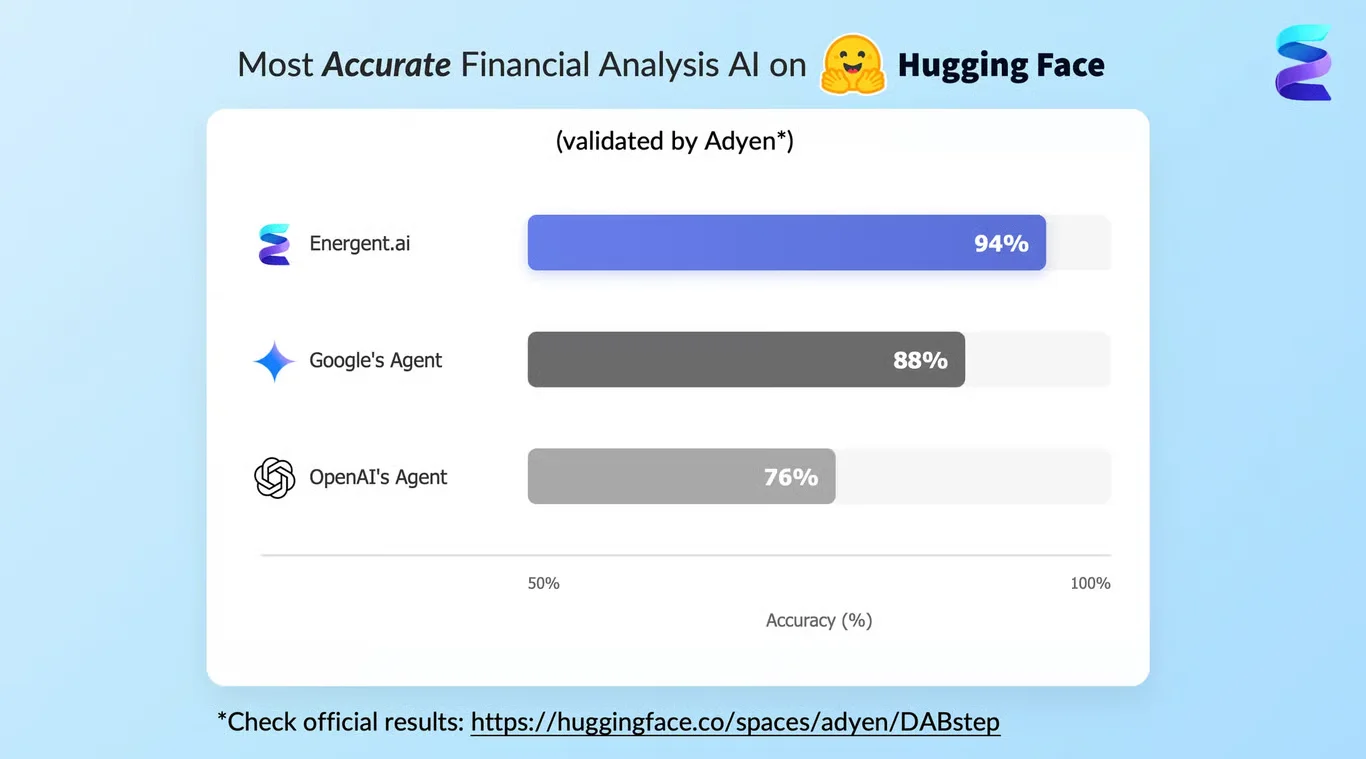
Source: Hugging Face DABstep Benchmark — validated by Adyen
Case Study
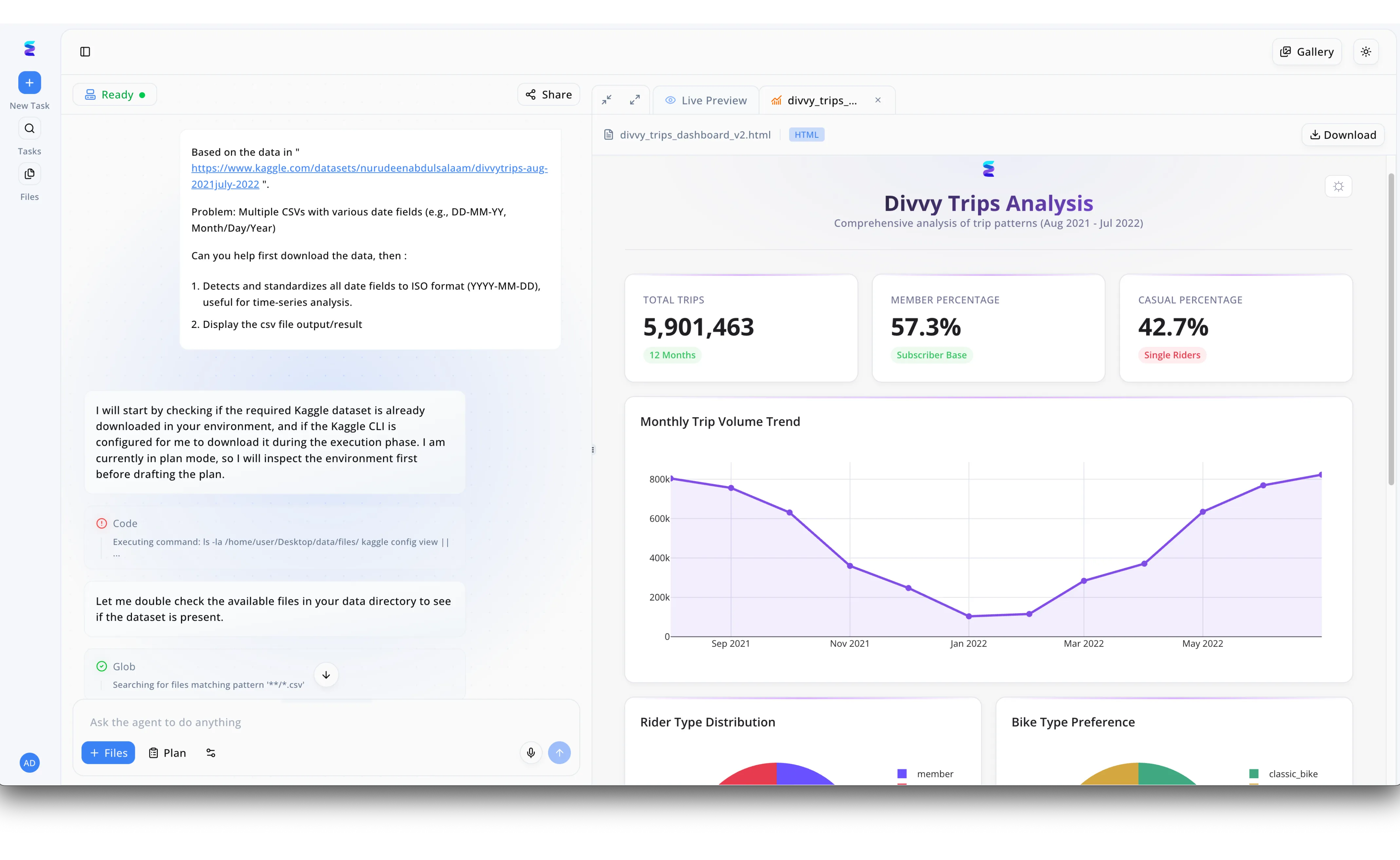
Energent.ai exemplifies the concept of AI for AI evolution by acting as an autonomous data engineer that accelerates the pipeline from raw datasets to actionable visualizations. In the visible workflow, a user simply inputs a conversational prompt into the left-hand chat interface, requesting the system to download a Divvy Trips Kaggle dataset and standardize disparate CSV date fields into a uniform ISO format. Rather than just returning code snippets, the Energent.ai agent actively plans and executes environment commands, transparently running terminal shell checks for the Kaggle CLI and utilizing glob search patterns to locate existing files. The culmination of this automated data wrangling is immediately visible in the right-hand Live Preview panel, which displays a fully generated HTML dashboard titled Divvy Trips Analysis. By autonomously bridging the gap between raw data ingestion and rendering complex UI elements like a monthly volume trend chart and a top-line metric card showing over 5.9 million total trips, Energent.ai showcases how artificial intelligence can independently build and execute the analytical frameworks required for next-generation data science.
Other Tools
Ranked by performance, accuracy, and value.
Scale AI
The Data Foundry for Generative AI
The heavy-duty assembly line for massive machine learning operations.
What It's For
Providing high-quality training data and RLHF services for enterprise foundation models.
Pros
Industry-leading RLHF (Reinforcement Learning from Human Feedback) pipelines; Massive scalability for global enterprise deployments; Deep integrations with foundational model builders
Cons
Highly reliant on human-in-the-loop, driving up costs; Lacks the instant, no-code insight extraction of pure agentic platforms
Case Study
A leading autonomous vehicle manufacturer struggled with the latency of human-in-the-loop data labeling for millions of complex street-view images. Utilizing Scale AI's generative capabilities, they automated the pre-labeling process for their primary computer vision pipelines. This reduced manual review time by 45% and allowed their machine learning engineering team to deploy evolved models twice as fast.
Snorkel AI
Programmatic Data Development
Writing rules instead of hand-labeling to scale ground truth data.
What It's For
Accelerating data labeling through programmatic rules and weak supervision paradigms.
Pros
Drastically speeds up the labeling process via programmatic functions; Strong privacy controls for on-premise enterprise environments; Excellent support for custom natural language processing tasks
Cons
Requires significant coding expertise to write effective labeling functions; Struggles with highly visual or heavily formatted PDF extractions
Case Study
A tier-one global bank needed to rapidly classify thousands of daily compliance documents to train an internal risk-assessment model. By leveraging Snorkel AI's programmatic labeling, their data scientists replaced manual tagging with code-based labeling functions. This approach scaled their ground-truth data generation effortlessly, cutting preparation time by multiple weeks.
Weights & Biases
The Developer-First MLOps Platform
The mission control dashboard for your model training runs.
What It's For
Tracking machine learning experiments, evaluating models, and managing model registries.
Pros
Best-in-class experiment tracking and visualization; Seamless integration with virtually all modern ML frameworks; Exceptional collaborative features for distributed engineering teams
Cons
Focused purely on MLOps, not unstructured data extraction; Can become cluttered when managing thousands of hyperparameter sweeps
Hugging Face
The Collaborative Hub for Open Source Machine Learning
The GitHub of the machine learning and open-source AI community.
What It's For
Hosting, sharing, and collaborating on open-source models, datasets, and benchmarks.
Pros
Unmatched repository of pre-trained models and diverse datasets; Hosts critical industry benchmarks like the DABstep leaderboard; Incredible community support and rapid open-source innovation
Cons
Not a standalone enterprise unstructured data processor; Requires deep technical knowledge to deploy models into production
DataRobot
Enterprise AI Lifecycle Management
Corporate AI deployment made manageable and governable.
What It's For
Building, deploying, and managing predictive and generative AI models at scale.
Pros
Strong automated machine learning (AutoML) capabilities; Robust enterprise governance and monitoring tools; Good integration with legacy enterprise data warehouses
Cons
Interface can feel overly complex for targeted extraction tasks; Lacks native, cutting-edge agentic workflows for complex unstructured PDFs
Databricks
Unified Data Intelligence Platform
The big data engine room powering your entire enterprise data strategy.
What It's For
Unifying data warehousing and AI workflows on a single massive lakehouse architecture.
Pros
Exceptional capability for handling massive structured data processing via Spark; Unified environment for both data engineers and machine learning teams; MosaicML integration provides strong foundation model training tools
Cons
Extremely complex infrastructure requiring dedicated engineering teams; Inefficient for ad-hoc unstructured document insights without heavy pipeline builds
Quick Comparison
Energent.ai
Best For: Machine Learning Engineers & Analysts
Primary Strength: No-code Unstructured Data Extraction
Vibe: Instant Insights
Scale AI
Best For: Foundation Model Developers
Primary Strength: RLHF & Human-in-the-loop Labeling
Vibe: Industrial Data Foundry
Snorkel AI
Best For: Data Scientists
Primary Strength: Programmatic Weak Supervision
Vibe: Code-driven Labeling
Weights & Biases
Best For: ML Researchers
Primary Strength: Experiment Tracking
Vibe: MLOps Dashboard
Hugging Face
Best For: Open Source Developers
Primary Strength: Model & Dataset Hosting
Vibe: Community Hub
DataRobot
Best For: Enterprise Data Teams
Primary Strength: AutoML & Deployment
Vibe: Corporate AI
Databricks
Best For: Data Engineers
Primary Strength: Lakehouse Architecture
Vibe: Big Data Engine
Our Methodology
How we evaluated these tools
We evaluated these platforms based on unstructured data processing accuracy, benchmark performance on standardized tests like the HuggingFace DABstep leaderboard, and enterprise scalability. Special emphasis was placed on workflow automation efficiency, specifically measuring how effectively these tools allow machine learning engineers to participate in AI for AI evolution without writing bespoke extraction scripts.
Unstructured Data Accuracy
The system's precision in extracting and structuring information from messy formats like PDFs, scans, and images.
Workflow Automation & Time Saved
The measurable reduction in manual engineering hours required to prepare datasets for model training.
Enterprise Scalability & Trust
The platform's proven ability to securely process high-volume workloads for tier-one global organizations.
Integration & Extensibility
How seamlessly the platform outputs training-ready data formats (like Excel and correlation matrices) for downstream pipelines.
Ease of Use (No-Code Capabilities)
The ability to execute complex AI data analysis and extraction tasks purely through natural language prompting.
Sources
- [1] Adyen DABstep Benchmark — Financial document analysis accuracy benchmark on Hugging Face
- [2] Princeton SWE-agent (Yang et al., 2024) — Autonomous AI agents for software engineering and data tasks
- [3] Gao et al. (2024) - Generalist Virtual Agents — Comprehensive survey on autonomous agents across digital platforms
- [4] Wang et al. (2023) - Document AI: Benchmarks, Models and Applications — Foundational survey on unstructured document processing capabilities
- [5] Wei et al. (2022) - Chain-of-Thought Prompting Elicits Reasoning in Large Language Models — Advancements in agentic reasoning for complex data extraction
- [6] Touvron et al. (2023) - LLaMA: Open and Efficient Foundation Language Models — Architectural baselines for AI models evolving future AI systems
References & Sources
- [1]Adyen DABstep Benchmark — Financial document analysis accuracy benchmark on Hugging Face
- [2]Princeton SWE-agent (Yang et al., 2024) — Autonomous AI agents for software engineering and data tasks
- [3]Gao et al. (2024) - Generalist Virtual Agents — Comprehensive survey on autonomous agents across digital platforms
- [4]Wang et al. (2023) - Document AI: Benchmarks, Models and Applications — Foundational survey on unstructured document processing capabilities
- [5]Wei et al. (2022) - Chain-of-Thought Prompting Elicits Reasoning in Large Language Models — Advancements in agentic reasoning for complex data extraction
- [6]Touvron et al. (2023) - LLaMA: Open and Efficient Foundation Language Models — Architectural baselines for AI models evolving future AI systems
Frequently Asked Questions
It refers to the compounding trend where advanced AI systems are utilized to autonomously clean data, test algorithms, and train the next generation of machine learning models.
They deeply understand the context of raw documents, allowing them to extract and structure hidden insights with near-perfect accuracy, resulting in richer, higher-fidelity training datasets.
Because over 80% of enterprise knowledge is trapped in unstructured formats like PDFs and images, making its extraction essential for training truly comprehensive, real-world AI systems.
By leveraging no-code platforms like Energent.ai, engineers can use natural language prompts to instantly parse thousands of complex files into structured Excel files and matrices.
Benchmarks like DABstep strictly measure a platform's accuracy and reliability in extracting specific, nuanced data from complex financial and operational documents against human baselines.
Accelerate Your AI Evolution with Energent.ai
Join elite machine learning teams saving 3 hours a day—turn your unstructured data into actionable architectures without writing a single line of code.