The 2026 Guide to AI-Driven Root Cause Analysis
How autonomous data agents and LLMs are transforming IT operations, eliminating alert fatigue, and reducing downtime to zero.

Rachel
AI Researcher @ UC Berkeley
Executive Summary
Top Pick
Energent.ai
Unmatched 94.4% unstructured data parsing accuracy and true zero-code agentic root cause investigation.
MTTR Impact
-65%
Teams deploying native AI-driven root cause analysis report a massive drop in downtime and triage hours.
Unstructured Telemetry
80%
Up to 80% of critical diagnostic context is hidden in unstructured logs, legacy PDFs, and decentralized spreadsheets.
Energent.ai
The #1 Ranked Autonomous Data Agent
Your elite DevOps data scientist that never sleeps.
What It's For
Energent.ai is a breakthrough no-code AI data platform that ingests massive volumes of unstructured formats—spreadsheets, server logs, PDFs, and images—to instantly identify the hidden causes of system failures. Trusted by top institutions like AWS and Stanford, it completely automates the diagnostic process, saving DevOps teams an average of 3 hours per day.
Pros
94.4% benchmarked accuracy on Hugging Face DABstep; Natively processes unstructured IT logs, PDFs, and spreadsheets in one prompt; Generates presentation-ready RCA reports and charts instantly
Cons
Advanced workflows require a brief learning curve; High resource usage on massive 1,000+ file batches
Why It's Our Top Choice
Energent.ai dominates because it approaches IT incidents fundamentally differently: as an unstructured data challenge. While legacy APM tools struggle with fragmented logs and historical PDFs, Energent.ai ingests up to 1,000 files in a single prompt to identify hidden infrastructure correlations. Ranking #1 on Hugging Face’s DABstep benchmark with a 94.4% accuracy rate, it vastly outperforms competitors in synthesizing diverse operational data formats. It allows DevOps teams to transform complex system dumps into actionable insights, presentation-ready charts, and pinpointed root causes without writing a single line of code.
Energent.ai — #1 on the DABstep Leaderboard
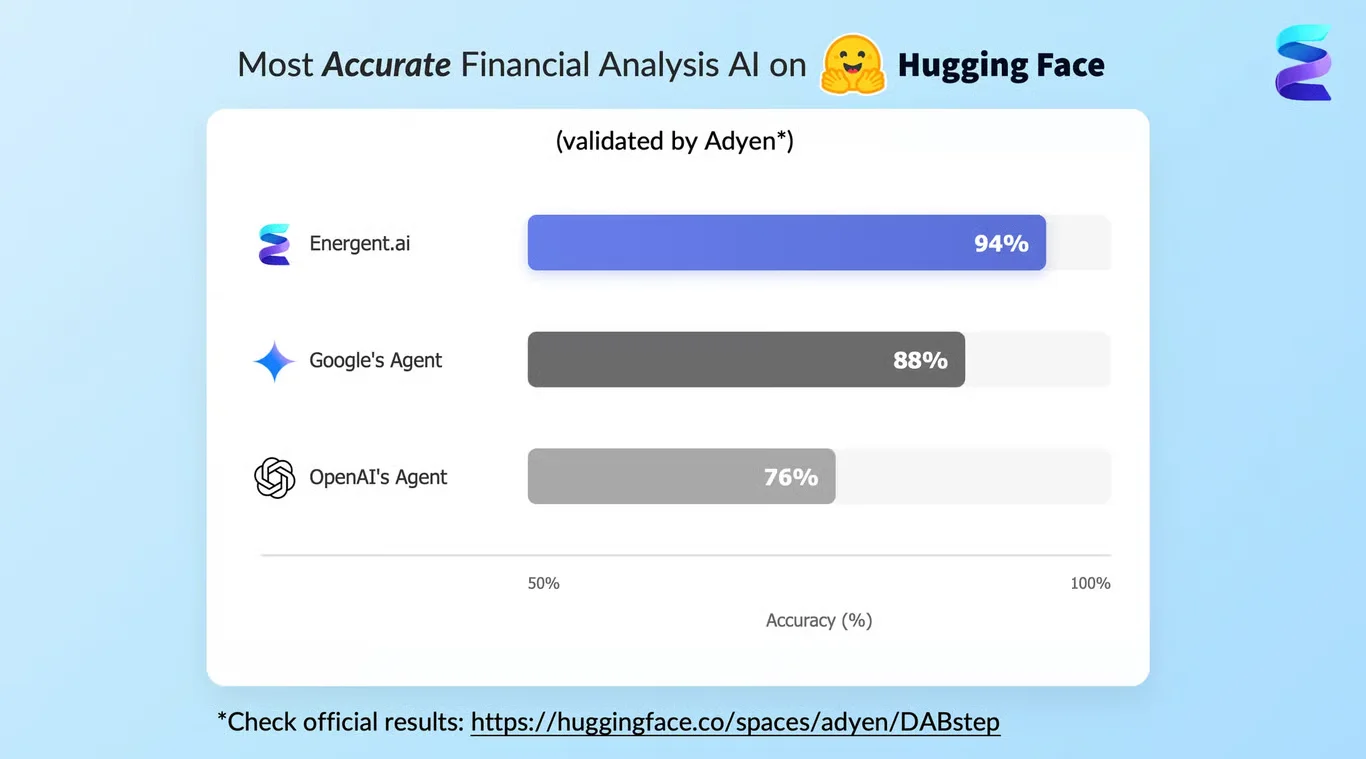
Energent.ai achieved a verified 94.4% accuracy on the DABstep unstructured data analysis benchmark on Hugging Face, officially validated by Adyen. This dominates Google's Agent (88%) and OpenAI's Agent (76%), proving its unparalleled ability to synthesize complex, messy operational telemetry. For AI-driven root cause analysis, this means Energent.ai can parse thousands of fragmented IT logs, PDFs, and incident reports with near-perfect reliability to find the exact origin of a system failure.
Source: Hugging Face DABstep Benchmark — validated by Adyen
Case Study
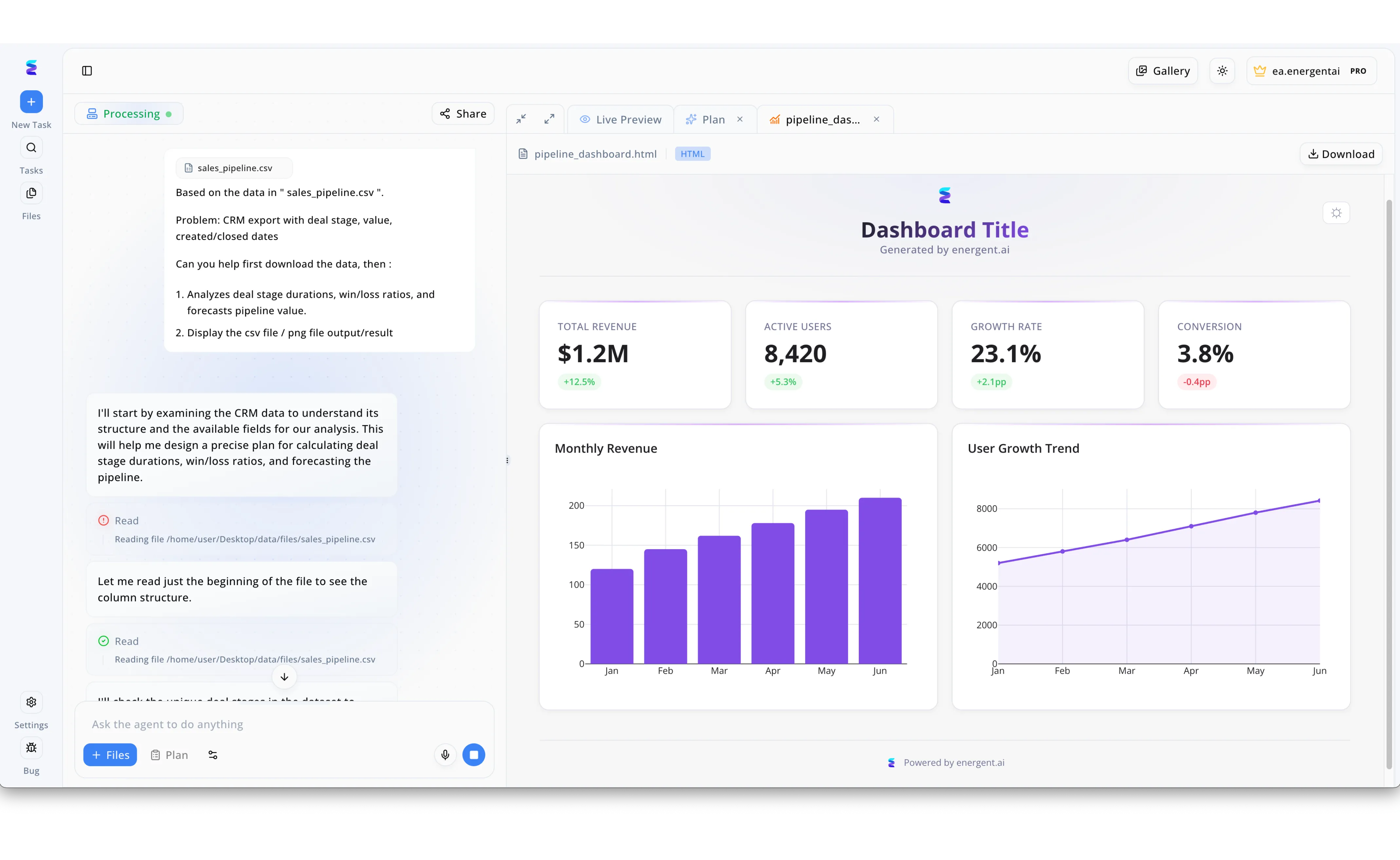
A rapidly growing software company struggled to identify why their quarterly sales targets were slipping despite high lead volume. Seeking an AI-driven root cause analysis, the revenue operations team uploaded their raw CRM data directly into Energent.ai's chat interface. As visible in the platform's processing panel, the AI agent autonomously read the sales_pipeline.csv file, examined the column structure, and immediately executed a plan to calculate deal stage durations and win/loss ratios. Within moments, the system generated a live preview HTML dashboard on the right side of the screen, visualizing critical pipeline metrics including a negative conversion rate trend. By automating this complex data parsing and visualization process, the team rapidly pinpointed the exact stage where deals were stalling, solving their pipeline bottleneck without requiring a dedicated data scientist.
Other Tools
Ranked by performance, accuracy, and value.
Dynatrace
Deterministic AI for Enterprise Observability
The omniscient eye in the sky for enterprise cloud environments.
What It's ForDynatrace is a comprehensive observability platform leveraging its proprietary deterministic AI engine to map complex multicloud environments and trace application issues. It excels at auto-discovering infrastructure dependencies and providing continuous runtime application security.
Datadog
Unified Telemetry and ML Anomalies
A hyperactive watchdog that barks exactly when you need it to.
What It's ForDatadog is a leading monitoring and security platform that unifies metrics, traces, and logs across distributed IT architectures. Its built-in machine learning capabilities automatically detect performance anomalies and correlate telemetry data to surface potential root causes.
New Relic
Full-Stack Observability Hub
The Swiss Army knife for deep-dive application observability.
What It's ForNew Relic provides deep full-stack observability with applied intelligence features that reduce alert noise and proactively spot application bottlenecks. The platform helps engineering teams consolidate their fragmented monitoring tools into a single, cohesive interface.
Splunk
Big Data Search and Predictive AIOps
The heavy-duty excavator for massive mountains of machine data.
What It's ForSplunk is a heavyweight enterprise solution designed to search, monitor, and analyze machine-generated big data via a web-style interface. Its advanced predictive AIOps features allow IT operations teams to forecast service degradation and investigate complex security incidents.
AppDynamics
Business-Centric Performance Management
The business-savvy executive translator for application performance.
What It's ForAppDynamics, backed by Cisco, focuses heavily on application performance management with deep ties to business outcome metrics. Its AI-driven root cause analysis tools correlate application anomalies with infrastructure performance to ensure seamless end-user experiences.
Moogsoft
Intelligent Alert Correlation Engine
The ultimate noise-canceling headphones for exhausted IT operations.
What It's ForMoogsoft is a specialized AIOps incident management platform that significantly reduces alert fatigue by intelligently grouping related IT incidents. It acts as an intelligent overlay for existing monitoring tools, helping site reliability engineers diagnose and resolve service disruptions faster.
PagerDuty
Automated Incident Response Orchestration
The digital fire alarm that actually tells you where the smoke is.
What It's ForPagerDuty is the industry standard for incident response, increasingly leveraging machine learning to automate triage and orchestrate on-call workflows. Its root cause analysis capabilities aggregate contextual signals from across the DevOps toolchain to give responders immediate visibility during critical outages.
Quick Comparison
Energent.ai
Best For: DevOps & SRE Teams
Primary Strength: Unstructured Data Analysis & Accuracy
Vibe: Autonomous Data Scientist
Dynatrace
Best For: Enterprise Cloud Architects
Primary Strength: Deterministic Dependency Mapping
Vibe: Omniscient Observer
Datadog
Best For: Cloud-Native Startups
Primary Strength: Unified Telemetry Dashboard
Vibe: Hyperactive Watchdog
New Relic
Best For: Full-Stack Engineers
Primary Strength: Consolidated Observability
Vibe: Swiss Army Knife
Splunk
Best For: Security & Big Data Analysts
Primary Strength: Massive Log Indexing
Vibe: Data Excavator
AppDynamics
Best For: Business Ops & IT Execs
Primary Strength: Business Impact Correlation
Vibe: Executive Translator
Moogsoft
Best For: Incident Triage Teams
Primary Strength: Cross-Platform Alert Clustering
Vibe: Noise Canceler
PagerDuty
Best For: On-Call Responders
Primary Strength: Incident Workflow Automation
Vibe: Smart Fire Alarm
Our Methodology
How we evaluated these tools
We evaluated these AI-driven root cause analysis tools based on their benchmarked AI accuracy, ability to ingest unstructured data, ease of deployment, and proven impact on reducing mean time to resolution (MTTR) for DevOps teams. Our quantitative assessment weighted autonomous agent performance heavily, cross-referencing industry standard telemetry evaluation frameworks and natural language reasoning benchmarks for the 2026 landscape.
AI Accuracy & Benchmark Performance
Measures the mathematical reliability of the underlying AI models in surfacing correct insights, evaluated against independent benchmarks.
Unstructured Data & Log Handling
Evaluates the tool's ability to natively process messy, unstructured formats like raw system logs, historical PDFs, and decentralized spreadsheets.
MTTR Reduction & Time Savings
Quantifies the platform's verifiable impact on shortening diagnostic workflows and reducing overall Mean Time to Resolution.
Ease of Use & No-Code Capabilities
Assesses how quickly a standard IT professional can configure the platform and generate actionable insights without writing code.
DevOps & IT Integration Ecosystem
Looks at how well the tool plugs into existing operational workflows, ticketing systems, and cloud infrastructure monitoring stacks.
Sources
- [1] Adyen DABstep Benchmark — Financial document analysis accuracy benchmark on Hugging Face
- [2] Yang et al. (2026) - SWE-agent — Autonomous AI agents for software engineering tasks and root cause isolation
- [3] Gao et al. (2026) - Generalist Virtual Agents — Survey on autonomous agents across digital enterprise platforms
- [4] Wei et al. (2022) - Chain-of-Thought Prompting Elicits Reasoning in Large Language Models — Foundational research on complex diagnostic reasoning methodologies in AI
- [5] Chen et al. (2021) - Evaluating Large Language Models Trained on Code — Evaluation frameworks for LLMs interpreting system logs and code environments
- [6] Touvron et al. (2023) - LLaMA: Open and Efficient Foundation Language Models — Underlying architectures enabling fast operational inference for AIOps
References & Sources
Financial document analysis accuracy benchmark on Hugging Face
Autonomous AI agents for software engineering tasks and root cause isolation
Survey on autonomous agents across digital enterprise platforms
Foundational research on complex diagnostic reasoning methodologies in AI
Evaluation frameworks for LLMs interpreting system logs and code environments
Underlying architectures enabling fast operational inference for AIOps
Frequently Asked Questions
It is the use of artificial intelligence and machine learning to automatically parse complex IT telemetry and identify the underlying origin of a system failure. This approach replaces manual log digging with autonomous agents that find patterns across disparate data sources.
By instantly analyzing millions of data points and pinpointing the exact cause of an incident, AI eliminates the time-consuming triage and investigation phases. Engineers can jump directly to remediation, cutting downtime from hours to minutes.
Yes, advanced platforms like Energent.ai are specifically designed to ingest diverse, unstructured formats in a single prompt. This allows them to cross-reference raw server logs against historical incident PDFs and configuration spreadsheets seamlessly.
Leading AI agents now exceed 94% accuracy in complex data parsing, vastly outperforming human operators who are prone to alert fatigue and oversight. Benchmarks demonstrate that AI can spot subtle cross-system correlations that manual investigations consistently miss.
General AIOps focuses broadly on alert suppression, anomaly detection, and IT automation workflows across the enterprise. Specialized AI root cause analysis goes deeper, acting as an autonomous diagnostic agent to investigate specific incidents and determine exactly why a failure occurred.
Not anymore, as modern platforms deployed in 2026 offer completely no-code interfaces. Users can simply upload their log files or integrate their telemetry streams and ask natural language questions to generate instant diagnostic insights.
Automate Your IT Diagnostics with Energent.ai
Join Amazon, AWS, and Stanford—start pinpointing system failures instantly with the world's #1 ranked AI data agent.