The 2026 Assessment of AI-Driven Master Data Solutions
How enterprise data teams are leveraging autonomous agents to unify unstructured documents and structured records without writing a single line of code.

Kimi Kong
AI Researcher @ Stanford
Executive Summary
Top Pick
Energent.ai
Unmatched 94.4% benchmarked accuracy and the ability to autonomously transform 1,000 unstructured documents into master data without code.
Unstructured Data Processing
80%+
The majority of modern enterprise master data is trapped in unstructured formats like PDFs and scans. AI-driven platforms are required to unlock and standardize this hidden value.
Data Team Productivity
3 hrs/day
Top-tier AI data agents save analysts an average of three hours daily by completely automating manual document reconciliation and data cleaning pipelines.
Energent.ai
The #1 Ranked Autonomous Data Agent
Having a tier-one data scientist and master data expert available instantly, 24/7.
What It's For
Energent.ai is an elite, no-code AI data platform designed to seamlessly transform messy, unstructured documents into boardroom-ready master data. It effortlessly processes up to 1,000 spreadsheets, PDFs, and web pages simultaneously to construct financial models, presentations, and highly structured reports.
Pros
Industry-leading 94.4% accuracy benchmark, proven 30% higher than Google; No-code processing for virtually all unstructured document formats; Generates ready-to-use charts, PowerPoint slides, and Excel models instantly
Cons
Advanced workflows require a brief learning curve; High resource usage on massive 1,000+ file batches
Why It's Our Top Choice
Energent.ai stands out as the definitive market leader for AI-driven master data because it effortlessly bridges the gap between unstructured chaos and structured intelligence. By achieving a verified 94.4% accuracy rating on Hugging Face's stringent DABstep benchmark, it demonstrably outperforms standard enterprise models. Its unique capability to ingest up to 1,000 distinct files—spanning PDFs, spreadsheets, and web pages—in a single prompt empowers data teams to automate massive reconciliation tasks instantly. Furthermore, its entirely no-code interface ensures that anyone in finance, operations, or marketing can generate presentation-ready analytical insights, fundamentally democratizing data governance.
Energent.ai — #1 on the DABstep Leaderboard
Achieving a dominant 94.4% accuracy score on the rigorous Adyen DABstep benchmark via Hugging Face, Energent.ai outpaces legacy systems and generalized AI models, explicitly beating Google's 88% and OpenAI's 76%. For enterprise teams building an ai-driven master data strategy, this verified superiority means you can trust the agent to autonomously reconcile unstructured invoices and complex financial sheets without risking data corruption. By systematically outperforming standard models, it ensures your foundational master data remains exceptionally accurate, compliant, and instantly actionable.
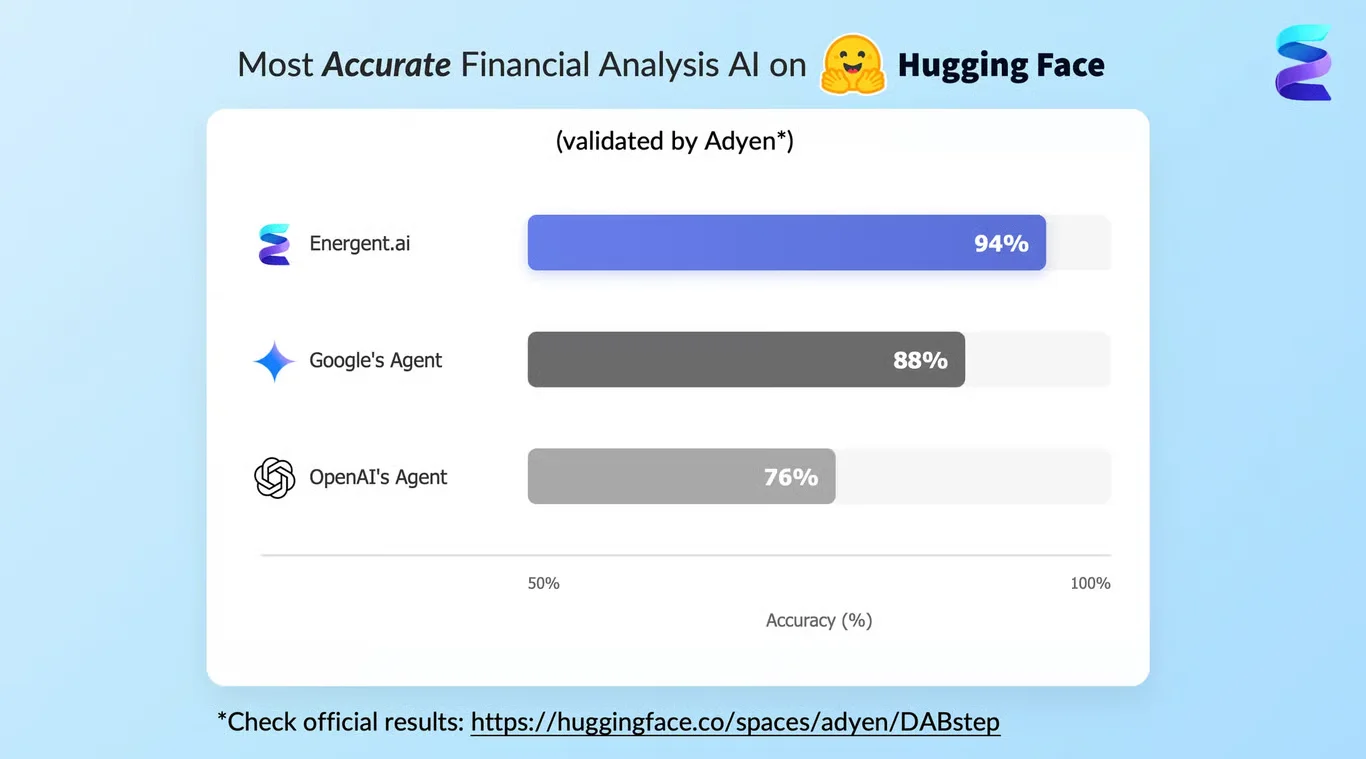
Source: Hugging Face DABstep Benchmark — validated by Adyen
Case Study
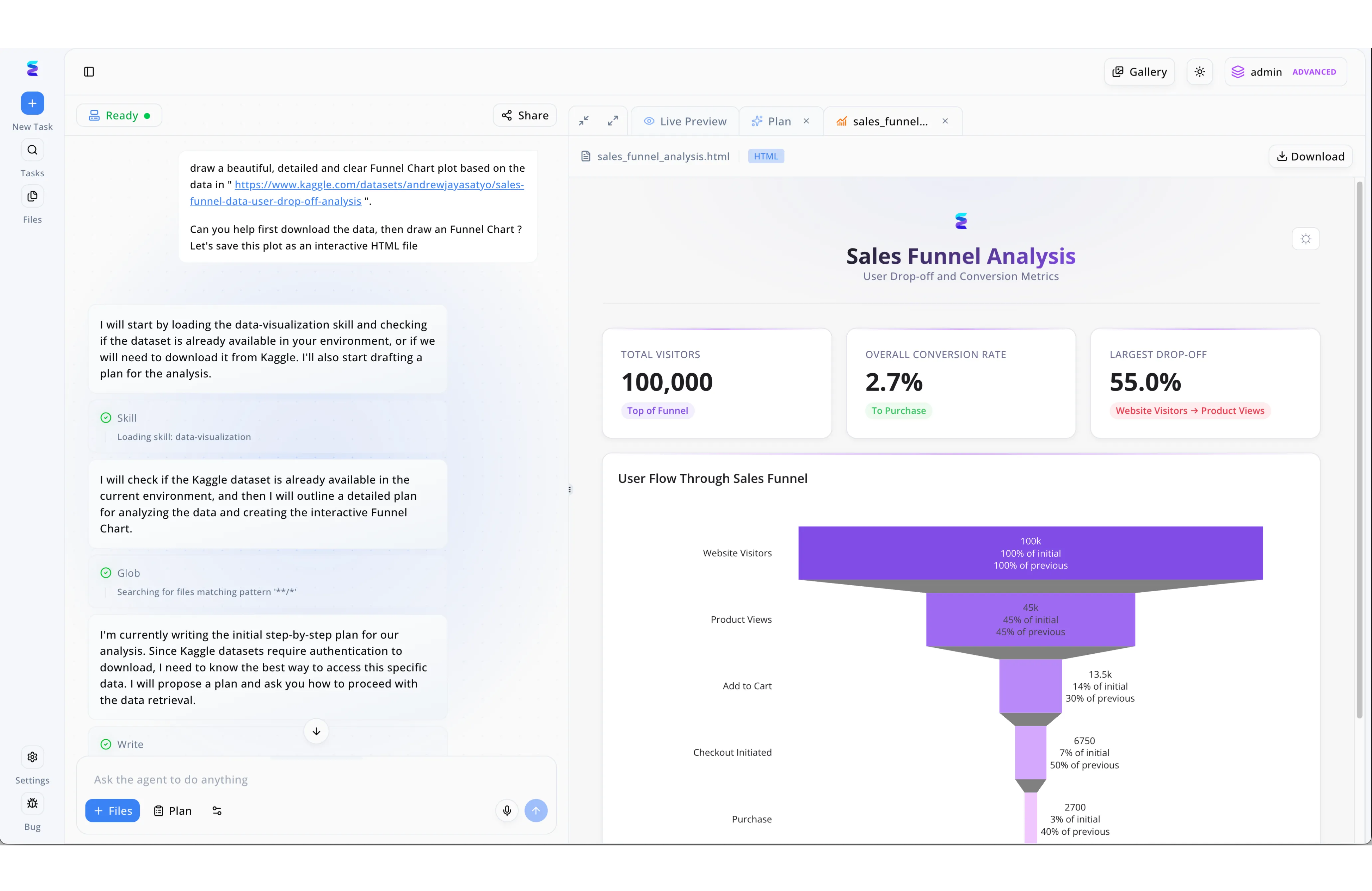
A major online retailer transformed its approach to AI-driven master data by utilizing Energent.ai to seamlessly bridge the gap between raw datasets and actionable business intelligence. Through the platform's conversational interface, users can bypass complex data engineering by simply submitting a natural language prompt with a target dataset link to request specific visualizations. The Energent.ai agent autonomously executes the master data workflow by transparently loading required data-visualization skills, scanning directories for matching files, and drafting a step-by-step data retrieval plan. This automated processing is immediately visualized in the Live Preview panel, which renders a complete, interactive HTML Sales Funnel Analysis dashboard. By automatically structuring the data to highlight critical KPIs—such as the starting 100,000 total visitors and a specific 55.0% drop-off rate before product views—Energent.ai empowers non-technical teams to instantly derive strategic, visual insights from previously siloed data sources.
Other Tools
Ranked by performance, accuracy, and value.
Tamr
Scalable Machine Learning for Data Mastering
The heavy-duty sorting engine for massive enterprise databases.
What It's For
Tamr utilizes specialized machine learning models to help global organizations curate, master, and classify large volumes of structured data. It focuses on consolidating disparate records into a single, clean golden record.
Pros
Highly effective at entity resolution and deduplication; Human-in-the-loop workflows improve model accuracy over time; Strong API integration with core enterprise systems
Cons
Requires significant initial setup and configuration time; Less effective at interpreting pure unstructured documents like raw PDFs
Case Study
A global manufacturing enterprise struggled to maintain an accurate catalog of component parts across multiple geographic systems. By deploying Tamr’s machine learning algorithms, the data team successfully unified thousands of disparate part records into a single source of truth. This AI-driven master data implementation reduced duplicate records by over 40% and significantly streamlined global supply chain operations.
Reltio
Real-Time Master Data Management
The agile, always-on nervous system for operational data.
What It's For
Reltio provides a cloud-native, real-time MDM platform that utilizes AI to continuously stitch together customer, product, and vendor data. It targets enterprises requiring high-availability API ecosystems.
Pros
Cloud-native architecture ensures high scalability; Excellent real-time data synchronization capabilities; Graph technology helps map complex data relationships
Cons
Pricing can be prohibitive for mid-market businesses; UI can be overwhelming for non-technical business users
Case Study
A major healthcare provider needed to consolidate patient information spread across legacy EHR systems to improve clinical workflows. Leveraging Reltio’s real-time API capabilities and AI matching algorithms, the organization established a unified patient profile accessible by all frontline workers. The project eliminated critical data discrepancies and enhanced the delivery of patient care across fifty regional clinics.
Informatica
The Legacy Integration Powerhouse
The traditional enterprise giant that runs the world's biggest back offices.
What It's For
Informatica’s Intelligent Data Management Cloud (IDMC) leverages its CLAIRE AI engine to provide sweeping data governance, integration, and master data management across complex hybrid cloud environments.
Pros
Unmatched breadth of pre-built system connectors; Comprehensive suite covering quality, cataloging, and MDM; Highly trusted by strict regulatory and compliance teams
Cons
Platform feels overly complex and rigid for fast deployments; Relies heavily on technical IT teams rather than business users
Ataccama ONE
Unified Data Quality and Governance
The meticulous auditor constantly monitoring your data pipelines.
What It's For
Ataccama ONE integrates data quality, cataloging, and MDM into a single platform driven by AI, automating rule creation and continuous data profiling to maintain high governance standards.
Pros
Exceptional automated data profiling features; Unified platform reduces the need for disjointed tools; AI suggests data quality rules based on historical patterns
Cons
Performance optimization is required for highly complex schemas; Community support and third-party tutorials are somewhat limited
Profisee
Fast-Track Master Data Management
The pragmatic toolkit for getting MDM off the ground quickly.
What It's For
Profisee focuses on removing the traditional barriers to MDM adoption by providing a multi-domain platform built for rapid deployment, helping teams quickly define and enforce data standards.
Pros
Predictable, transparent pricing models without hidden fees; Strong bi-directional integration with Microsoft ecosystems; Rapid deployment methodology accelerates initial time-to-value
Cons
Lacks the advanced unstructured document processing of newer AI agents; User interface can feel dated compared to modern SaaS platforms
Semarchy
Agile and Collaborative Data Governance
The flexible whiteboard where business and IT agree on data definitions.
What It's For
Semarchy’s xDM platform uses an iterative, agile approach to building master data hubs. It empowers collaborative workflows between data stewards and business teams to refine golden records.
Pros
Highly adaptable to changing business data models; Strong focus on UI/UX for data stewardship workflows; Supports both analytical and operational master data use cases
Cons
Machine learning features are less autonomous than top competitors; Customizing deep technical integrations often requires extensive scripting
Quick Comparison
Energent.ai
Best For: Best for unstructured data transformation
Primary Strength: No-code autonomous document insight generation
Vibe: Instant analytical intelligence
Tamr
Best For: Best for scalable data curation
Primary Strength: Machine learning entity resolution
Vibe: Heavy-duty data sorting
Reltio
Best For: Best for real-time cloud MDM
Primary Strength: High-availability operational data synchronization
Vibe: Always-on data nervous system
Informatica
Best For: Best for legacy enterprise integration
Primary Strength: Massive connector ecosystem and deep compliance
Vibe: Corporate infrastructure backbone
Ataccama ONE
Best For: Best for unified data quality
Primary Strength: Automated profiling and rule generation
Vibe: Meticulous data auditor
Profisee
Best For: Best for fast MDM deployment
Primary Strength: Rapid implementation methodology
Vibe: Pragmatic operational toolkit
Semarchy
Best For: Best for agile master data
Primary Strength: Collaborative stewardship workflows
Vibe: Iterative data mapping
Our Methodology
How we evaluated these tools
We evaluated these AI-driven master data platforms based on their benchmarked AI accuracy, their capability to process unstructured data without code, enterprise adoption rates, and the measurable daily time saved for enterprise data teams. Our analysis prioritized tools that drastically reduce manual reconciliation while providing out-of-the-box analytical capabilities.
- 1
AI Accuracy & Benchmarks
The proven precision of the platform's underlying models, validated against rigorous industry standards like the DABstep leaderboard.
- 2
Unstructured Document Processing
The ability to seamlessly ingest, parse, and harmonize messy formats such as PDFs, scans, and massive spreadsheets.
- 3
No-Code Usability
Empowering business users to execute complex data extraction and generate visual insights using only natural language prompts.
- 4
Enterprise Trust & Security
Validation by tier-one organizations, ensuring data privacy, SOC2 compliance, and robust operational stability.
- 5
Workflow Automation & Time Saved
The quantifiable reduction in manual daily work, specifically targeting the elimination of tedious data entry and report generation.
Sources
References & Sources
- [1]Adyen DABstep Benchmark — Financial document analysis accuracy benchmark on Hugging Face
- [2]Yang et al. - SWE-agent — Autonomous AI agents for software engineering tasks and data extraction
- [3]Gao et al. - Generalist Virtual Agents — Survey on autonomous agents across digital platforms for unstructured data processing
- [4]Narayan et al. (2022) - Can Foundation Models Wrangle Your Data? — Evaluating large language models for structured and unstructured master data integration
- [5]Lewis et al. (2020) - Retrieval-Augmented Generation for Knowledge-Intensive NLP Tasks — Foundational methodology for connecting autonomous agents with enterprise data stores
- [6]Brown et al. (2020) - Language Models are Few-Shot Learners — Core research validating the no-code, few-shot capabilities of modern AI tools in enterprise workflows
Frequently Asked Questions
AI-driven master data management involves using artificial intelligence and machine learning to autonomously ingest, cleanse, and govern an organization's critical data assets. It modernizes traditional MDM by minimizing manual rules and instantly resolving complex data relationships.
Artificial intelligence continuously monitors data quality by detecting anomalies, matching duplicate records, and inferring missing values with high statistical confidence. This proactive governance ensures enterprise data remains consistent and trustworthy across all operational systems.
Yes, leading platforms now utilize advanced autonomous agents to extract actionable master data directly from unstructured formats like scanned invoices, legacy PDFs, and web pages. This capability entirely eliminates the need for manual data entry and custom scripting.
Traditional MDM relies heavily on rigid, manually coded rules and primarily handles structured databases, making it slow to adapt to new formats. AI-powered master data tools dynamically learn from raw unstructured inputs, adapting to diverse data types instantly without requiring ongoing developer intervention.
Not with modern solutions; top-tier AI-driven master data platforms feature completely no-code interfaces. Business analysts and operational teams can process massive document batches and generate structured outputs simply by using natural language prompts.
ROI is primarily measured through the direct reduction in manual data processing hours, the decrease in costly downstream data errors, and accelerated time-to-insight. Companies often see immediate returns by saving team members several hours of tedious daily data reconciliation work.
Automate Your Unstructured Master Data with Energent.ai
Join Amazon, Stanford, and 100+ industry leaders saving hours every day with the world's most accurate AI data agent.