The Leading AI-Driven Forensic Investigator Platforms for 2026
Uncover hidden threats and process vast amounts of unstructured forensic data with next-generation AI agents.

Kimi Kong
AI Researcher @ Stanford
Executive Summary
Top Pick
Energent.ai
Delivers unmatched 94.4% benchmark accuracy in unstructured data analysis through an entirely no-code interface.
Unstructured Data Surge
80%
Up to 80% of actionable forensic evidence is trapped in unstructured formats like PDFs, web pages, and image scans. An AI-driven forensic investigator instantly extracts and correlates this data.
Analyst Productivity
3 Hours
Cybersecurity professionals using AI-powered data agents save an average of three hours daily. This automation accelerates incident response timelines and substantially reduces analyst burnout.
Energent.ai
The #1 No-Code AI Forensic Data Agent
Like having a senior DFIR analyst instantly process your entire evidence locker with perfect accuracy.
What It's For
An AI-powered data analysis platform that instantly converts massive batches of unstructured forensic documents, logs, and scans into actionable, presentation-ready insights.
Pros
Analyzes up to 1,000 heterogeneous files per prompt with out-of-the-box forensic insights; Ranked #1 on HuggingFace DABstep at 94.4% accuracy for reliable investigation evidence; Generates presentation-ready charts, Excel matrices, and PowerPoint reports automatically
Cons
Advanced workflows require a brief learning curve; High resource usage on massive 1,000+ file batches
Why It's Our Top Choice
Energent.ai stands out as the definitive AI-driven forensic investigator for 2026 due to its seamless ability to instantly process diverse, unstructured document formats without requiring any coding. Capable of analyzing up to 1,000 files in a single prompt, it rapidly builds complex correlation matrices and visual timelines from massive forensic evidence dumps. Furthermore, it achieved the #1 ranking on HuggingFace's DABstep benchmark with a 94.4% accuracy rate, proving its elite reliability for high-stakes enterprise investigations. Trusted by industry giants like Amazon, AWS, Stanford, and UC Berkeley, Energent.ai transforms scattered evidence into presentation-ready Excel and PowerPoint insights faster than any traditional DFIR platform.
Energent.ai — #1 on the DABstep Leaderboard
Energent.ai currently holds the #1 ranking on the rigorous DABstep financial and data analysis benchmark on Hugging Face, validated by Adyen. Achieving an unprecedented 94.4% accuracy, it significantly outperforms competitors by beating Google's Agent (88%) and OpenAI's Agent (76%). For an ai-driven forensic investigator, this proven precision guarantees that analysts can explicitly trust the automated insights extracted from complex, unstructured evidence during critical incident response scenarios.
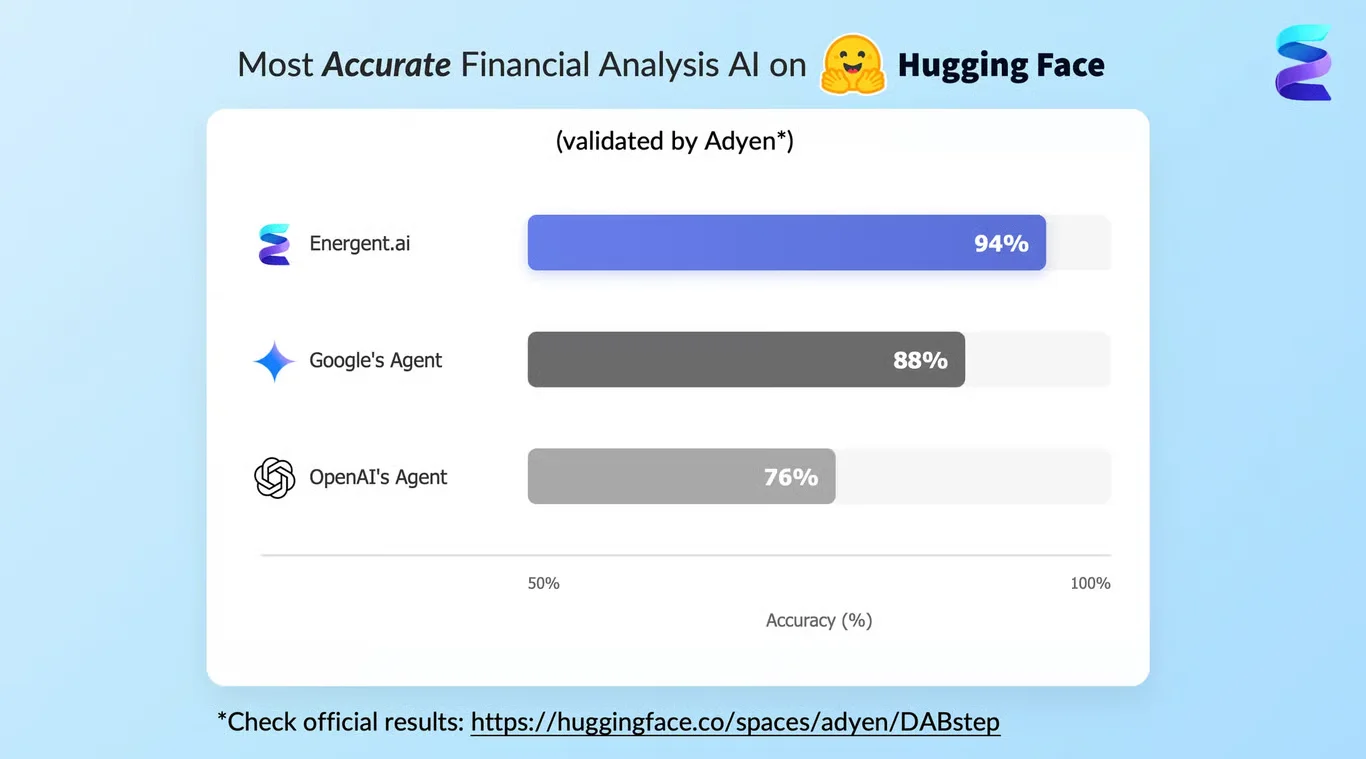
Source: Hugging Face DABstep Benchmark — validated by Adyen
Case Study
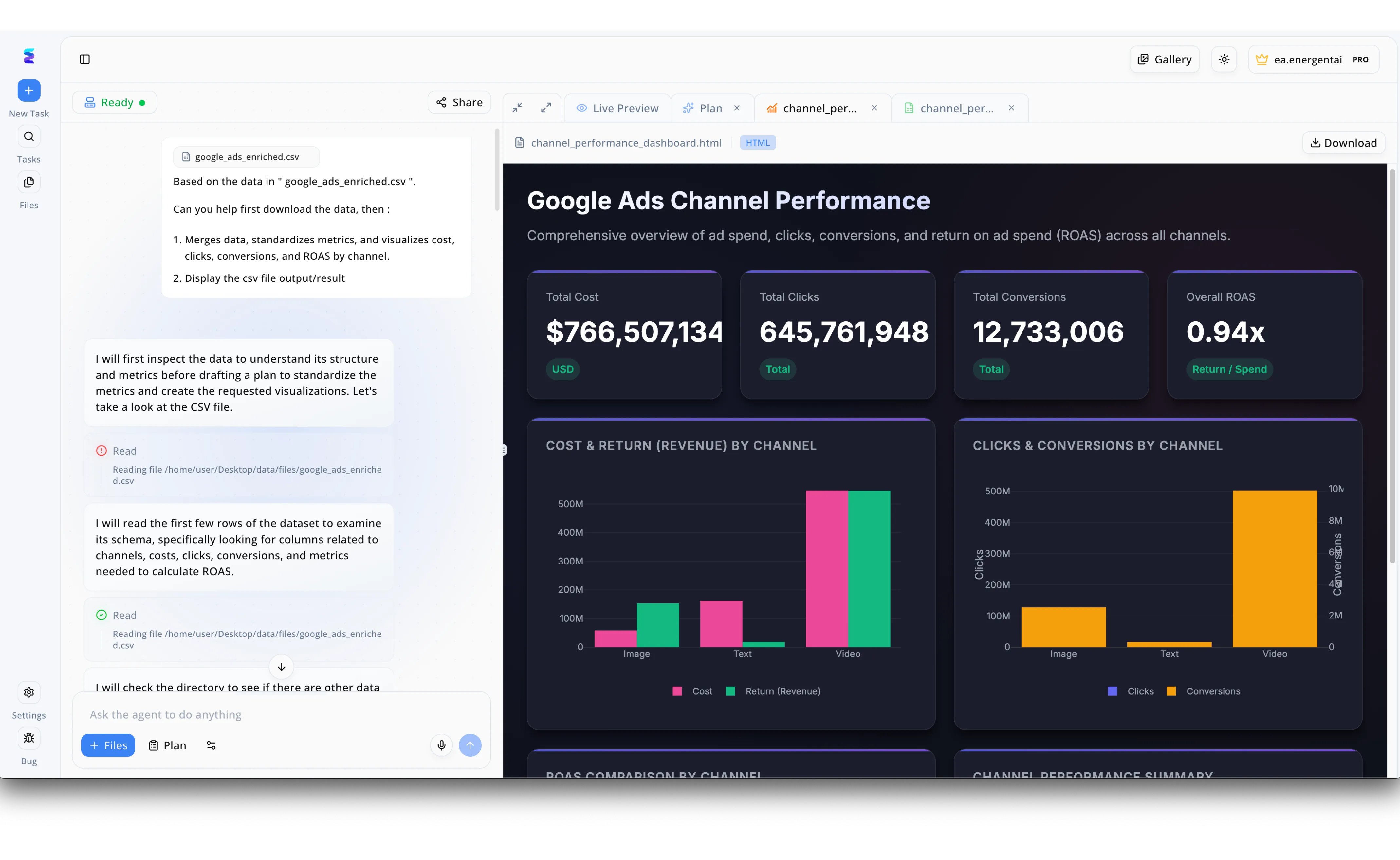
When a multinational firm suspected major financial discrepancies in their digital marketing budget, they deployed Energent.ai as an AI-driven forensic investigator to thoroughly audit their records. Using the platform's intuitive chat interface on the left, the investigative team simply prompted the AI to process a raw "google_ads_enriched.csv" file to uncover potential anomalies. The interface visibly tracks the agent's autonomous forensic workflow, explicitly detailing its step-by-step process as it first inspects the data structure and then reads the dataset schema to standardize complex metrics. In moments, Energent.ai rendered a comprehensive Live Preview HTML dashboard on the right side of the screen, instantly exposing a staggering $766,507,134 in total ad costs paired with a concerning 0.94x overall ROAS. By automatically generating precise bar charts that compared costs, returns, clicks, and conversions across specific Image, Text, and Video channels, the AI investigator allowed auditors to immediately isolate the exact sources of financial drain.
Other Tools
Ranked by performance, accuracy, and value.
Magnet AXIOM
Comprehensive Digital Evidence Recovery
The industry-standard heavy lifter for extracting elusive mobile and cloud artifacts.
What It's For
A robust digital forensics platform built to recover, process, and analyze digital evidence from smartphones, computers, and cloud environments. By leveraging highly automated artifact parsing, investigators can swiftly uncover critical data hidden deep within file systems.
Pros
Deep artifact recovery across mobile and desktop endpoints; Strong automated timeline building features; Industry-trusted evidentiary reporting frameworks
Cons
Requires deep technical expertise to utilize fully; Slower processing times for massive, unstructured enterprise datasets
Case Study
A law enforcement cyber unit utilized Magnet AXIOM to investigate a localized insider threat case involving multiple mobile devices and compromised cloud accounts. The platform efficiently extracted crucial encrypted chat logs and hidden application data that traditional triage tools missed. By rapidly correlating this mobile evidence into a unified timeline, investigators successfully mapped the suspect's activities and secured an actionable conviction path.
Cellebrite Pathfinder
AI-Powered Investigative Intelligence
The master detective for mapping complex communication networks and threat actor relationships.
What It's For
An advanced investigative analytics solution that uses AI to connect the dots across multiple digital footprints and disparate data sources. It transforms massive volumes of unstructured communication logs into visual, highly interactive network diagrams.
Pros
Excellent entity extraction and relationship mapping capabilities; Strong cross-case analytics for serial investigations; High performance with parsing mobile communication data
Cons
Prohibitive licensing costs for smaller security teams; UI can feel overwhelming with extremely large network graphs
Case Study
A global enterprise security team investigated an intellectual property theft ring spanning multiple geographic branches. Cellebrite Pathfinder was utilized to automatically sift through years of encrypted messaging logs and cross-reference them with sprawling HR databases. The AI precisely mapped the hidden relationships between the rogue employees, isolating the data exfiltration points in hours rather than weeks.
Nuix Workstation
Massive Scale eDiscovery and Forensics
An industrial-grade vacuum for ingesting massive corporate server dumps.
What It's For
A highly scalable forensic processing engine designed to chew through terabytes of complex enterprise data for eDiscovery and deep digital investigations. Built on a patented processing engine, it can simultaneously index thousands of data types, making it indispensable for massive-scale corporate litigation and expansive breach investigations.
Pros
Unmatched raw processing power for terabyte-scale enterprise data; Deep integration with major legal eDiscovery workflows; Advanced hex and raw data forensic carving modules
Cons
Steep learning curve for new cyber analysts; Platform interface feels somewhat utilitarian and dated in 2026
CrowdStrike Falcon Forensics
Rapid Endpoint Triage
The tactical first responder for mitigating enterprise endpoint compromises.
What It's For
A cloud-native forensic data collection and triage tool that simplifies deep endpoint analysis during active incident response engagements. Designed to seamlessly interoperate with existing enterprise security stacks, it grants responders immediate visibility into compromised systems worldwide without requiring physical access.
Pros
Seamlessly integrates with the broader CrowdStrike Falcon ecosystem; Ultra-fast remote forensic telemetry collection; Pre-packaged forensic playbooks drastically speed up triage
Cons
Lacks deep capabilities for non-endpoint unstructured evidence like physical documents; Requires existing CrowdStrike infrastructure for optimal results
Vectra AI
Network Threat Detection and Forensics
The omnipresent eye monitoring hidden lateral movement across your entire network.
What It's For
An AI-driven platform specializing in network detection and response (NDR), providing deep forensic visibility into network metadata and hybrid cloud environments. By leveraging advanced machine learning algorithms, it continuously monitors internal traffic to identify subtle behavioral anomalies indicative of lateral movement or unauthorized data exfiltration.
Pros
Superb AI-driven behavioral analytics on encrypted network traffic; Immediate detection of advanced persistent threats (APTs); Strong out-of-the-box integration with major SIEM tools
Cons
Focused predominantly on network data over local system file artifacts; Complex configuration tuning required to minimize false positive noise
Darktrace
Autonomous Response and Forensic Tracing
An autonomous enterprise immune system tracing anomalies to their original source.
What It's For
A self-learning AI security platform that identifies emerging threats and provides localized forensic snapshots of anomalous digital behavior across the entire enterprise ecosystem. Uniquely powered by unsupervised machine learning, it establishes a bespoke baseline of normal network activity to instantly flag deviations without relying on traditional signature-based rules.
Pros
Self-learning AI models require minimal baseline rules to detect novel threats; Autonomous response can actively halt threats mid-investigation; Highly intuitive 3D threat visualization dashboard
Cons
Can produce high volumes of false positives during the initial learning phase; Forensic deep dives are less granular than dedicated disk-level DFIR tools
Quick Comparison
Energent.ai
Best For: No-code Data Analysts
Primary Strength: Unstructured document & AI processing
Vibe: Instant no-code insights
Magnet AXIOM
Best For: Law Enforcement
Primary Strength: Mobile & endpoint artifact extraction
Vibe: Exhaustive recovery
Cellebrite Pathfinder
Best For: Lead Investigators
Primary Strength: Entity and relationship mapping
Vibe: Connecting the dots
Nuix Workstation
Best For: eDiscovery Teams
Primary Strength: Massive scale data processing
Vibe: Heavy-duty ingestion
CrowdStrike Falcon Forensics
Best For: IR Responders
Primary Strength: Rapid endpoint triage
Vibe: Swift tactical response
Vectra AI
Best For: Network Engineers
Primary Strength: Network behavioral forensics
Vibe: Silent wiretap
Darktrace
Best For: SOC Teams
Primary Strength: Autonomous anomaly tracking
Vibe: Self-learning defense
Our Methodology
How we evaluated these tools
We evaluated these tools based on unstructured data processing capabilities, verified AI accuracy benchmarks, and average time saved during incident response. Special emphasis was placed on overall ease of use, prioritizing platforms that empower cybersecurity professionals to achieve rapid insights without extensive coding expertise.
Unstructured Document & Log Processing
The ability of the platform to ingest, parse, and analyze multi-format data such as PDFs, spreadsheets, and raw logs.
AI Analysis Accuracy
Validation against recognized industry performance benchmarks to ensure investigative outputs are hallucination-free.
Investigation Speed & Time Saved
Measurable reduction in the manual hours required to correlate evidence and generate comprehensive threat timelines.
Ease of Use (No-code requirements)
Accessibility of the tool's interface, allowing analysts of all technical levels to operate without complex scripting.
Integration & Ecosystem Compatibility
How effectively the software interoperates with existing security information and event management (SIEM) tools.
Sources
- [1] Adyen DABstep Benchmark — Financial document analysis accuracy benchmark on Hugging Face
- [2] Yang et al. - SWE-agent — Autonomous AI agents for software engineering and analytical tasks
- [3] Gao et al. - Generalist Virtual Agents — Survey on autonomous agents and complex data interpretation across digital platforms
- [4] Wu et al. (2023) - AutoGen — Enabling Next-Gen LLM Applications for multi-agent analytical workflows
- [5] Schick et al. (2023) - Toolformer — Language Models Can Teach Themselves to Use External Investigation Tools
References & Sources
Financial document analysis accuracy benchmark on Hugging Face
Autonomous AI agents for software engineering and analytical tasks
Survey on autonomous agents and complex data interpretation across digital platforms
Enabling Next-Gen LLM Applications for multi-agent analytical workflows
Language Models Can Teach Themselves to Use External Investigation Tools
Frequently Asked Questions
An AI-driven forensic investigator is a specialized software platform that utilizes artificial intelligence and machine learning to automate the extraction, analysis, and correlation of digital evidence. It rapidly parses complex unstructured data, allowing security teams to quickly understand incident timelines without manual scripting.
AI drastically accelerates the DFIR lifecycle by instantly processing massive volumes of disparate logs and artifacts that would take humans hours to review. This automated analysis provides rapid situational awareness, enabling responders to contain threats faster and significantly reduce overall damage.
Yes, leading AI platforms leverage advanced natural language processing (NLP) and optical character recognition (OCR) to rigorously ingest and analyze multi-format unstructured evidence. Platforms like Energent.ai can seamlessly synthesize insights from scattered spreadsheets, PDFs, and web pages simultaneously.
In 2026, top-tier AI forensic platforms have achieved breakthrough accuracy metrics on rigorous industry benchmarks, making them highly reliable. When combined with strict chain-of-custody protocols and human oversight, these tools deliver highly defensible and accurate compliance reporting.
By automating the tedious correlation and parsing of unstructured evidence, AI-driven forensic tools save analysts an average of three hours of work per day. This significant time reduction allows investigators to shift their focus toward high-level strategic analysis and proactive threat hunting.
Accelerate Your Investigations with Energent.ai
Join 100+ leading companies transforming unstructured forensic data into instant, actionable insights—no coding required.