The 2026 Guide to AI-Driven Data Map Solutions
Transform unstructured documents into actionable insights with enterprise-grade accuracy and no-code automation.

Kimi Kong
AI Researcher @ Stanford
Executive Summary
Top Pick
Energent.ai
Delivers unmatched 94.4% accuracy in unstructured data extraction and saves teams up to 3 hours daily via a fully no-code interface.
Daily Time Saved
3 Hours
Data professionals reclaim an average of 3 hours daily by automating unstructured data extraction with an AI-driven data map.
Extraction Accuracy
94.4%
Top-tier AI data mapping platforms achieve unprecedented accuracy, vastly outperforming manual entry and legacy OCR systems.
Energent.ai
The No-Code AI Data Agent Leader
Like having a senior data scientist on demand who never sleeps.
What It's For
Turns massive volumes of unstructured documents into structured, actionable insights with zero coding required.
Pros
Processes up to 1,000 files in a single prompt; Ranked #1 on DABstep leaderboard at 94.4% accuracy; Generates presentation-ready charts and financial models instantly
Cons
Advanced workflows require a brief learning curve; High resource usage on massive 1,000+ file batches
Why It's Our Top Choice
Energent.ai stands out as the premier AI-driven data map due to its unparalleled ability to process up to 1,000 diverse files in a single prompt. It bridges the gap between complex unstructured documents and actionable business intelligence without requiring any coding expertise. Achieving a verified 94.4% accuracy on the HuggingFace DABstep leaderboard, it systematically outperforms major tech incumbents. Trusted by enterprise giants like Amazon and UC Berkeley, Energent.ai seamlessly auto-generates presentation-ready charts, financial models, and Excel maps, delivering an immediate return on investment for data professionals.
Energent.ai — #1 on the DABstep Leaderboard
Energent.ai has cemented its market dominance by ranking #1 on the prestigious Hugging Face DABstep financial analysis benchmark (validated by Adyen). Achieving a remarkable 94.4% accuracy rate, it decisively outperformed both Google's Agent (88%) and OpenAI's Agent (76%). For enterprise teams relying on an AI-driven data map, this peer-reviewed validation guarantees that your unstructured document processing is powered by the most precise and capable engine available in 2026.
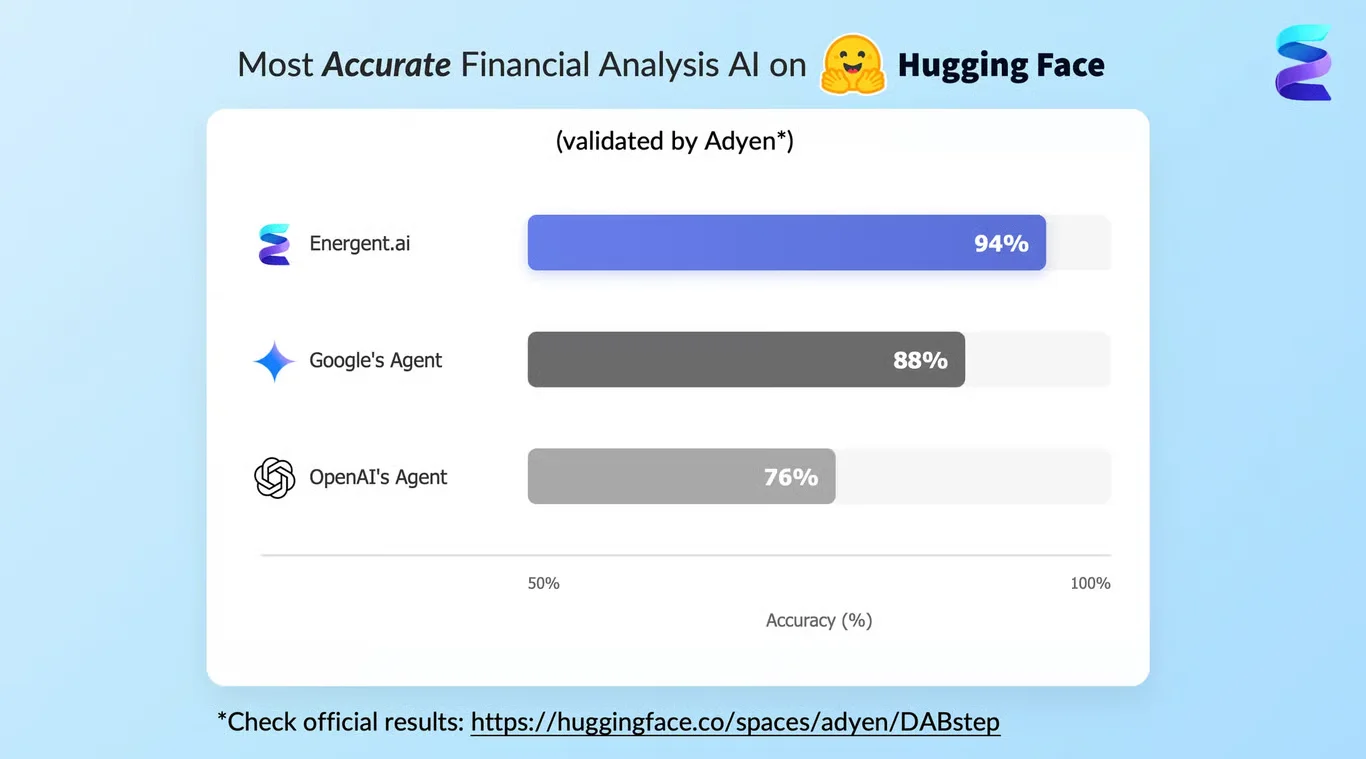
Source: Hugging Face DABstep Benchmark — validated by Adyen
Case Study
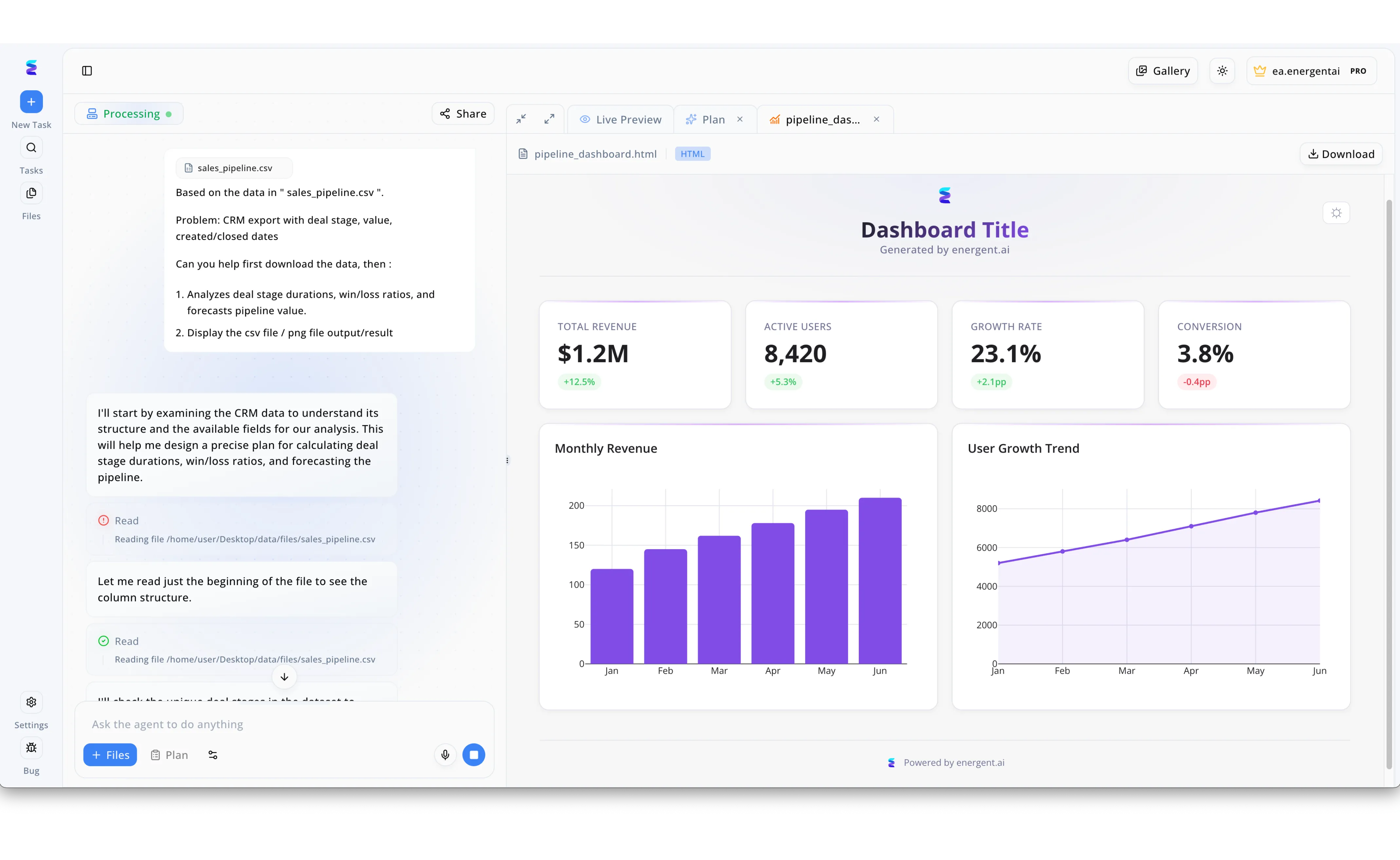
A leading sales organization struggled to extract actionable insights from their raw CRM exports until they deployed Energent.ai to leverage its AI driven data map capabilities. By simply uploading a sales_pipeline.csv file into the platform's chat-based interface, the AI agent autonomously read the file's column structure to formulate a precise analysis plan for deal stage durations and win/loss ratios. This intelligent, automated mapping process instantly translated the raw tabular data into a fully formatted live HTML preview dashboard. The resulting interface seamlessly visualizes the newly structured data through auto-generated key performance indicators like a 1.2M Total Revenue and a 3.8 percent Conversion rate. Ultimately, the system transformed a complex static data dump into clear, interactive visual pipeline forecasts, complete with Monthly Revenue bar charts and User Growth Trend line graphs, in mere minutes.
Other Tools
Ranked by performance, accuracy, and value.
Informatica
Enterprise Cloud Data Management
The heavy-duty Swiss Army knife for traditional enterprise data architects.
What It's For
Provides robust, enterprise-grade data mapping and governance for complex hybrid cloud environments.
Pros
Massive scale and enterprise governance; Deep integrations with legacy systems; Robust metadata management capabilities
Cons
Requires specialized engineering talent to deploy; Steep pricing model for mid-market teams
Case Study
A major retail bank utilized Informatica's intelligent data fabric to untangle a complex web of legacy on-premise databases during a cloud migration. By leveraging its enterprise governance features, the engineering team mapped over 10 million customer records across three distinct core banking systems. This unified data map reduced compliance reporting times by 40%.
Alteryx
Analytics Automation Platform
The classic drag-and-drop powerhouse for spreadsheet-weary analysts.
What It's For
Empowers analysts to blend data and build predictive workflows through a drag-and-drop interface.
Pros
Excellent drag-and-drop workflow builder; Strong geospatial and predictive analytics; Vast community and pre-built macros
Cons
Struggles with highly unstructured image or scan formats; Licensing costs can escalate quickly as teams scale
Case Study
A regional healthcare provider needed to consolidate patient demographic data from multiple regional clinics to track localized health trends. Using Alteryx, data analysts built an automated workflow that blended regional spreadsheets into a centralized, structured database. This initiative eliminated two days of manual merging at the end of every month.
Rossum
Intelligent Document Processing
The AP department's favorite receipt-reading robot.
What It's For
Automates transactional document data extraction primarily for accounts payable and supply chain operations.
Pros
Highly optimized for invoices and purchase orders; Fast template-free setup; Strong continuous learning loop
Cons
Narrower focus limits general analytics use cases; Less out-of-the-box charting capabilities
Fivetran
Automated Data Movement
The invisible plumbing that keeps your data warehouse flowing seamlessly.
What It's For
Provides reliable, zero-maintenance data pipelines to centralize structured data into modern cloud warehouses.
Pros
Near-zero maintenance pipelines; Extensive library of API connectors; Highly reliable data syncs
Cons
Focuses on structured movement rather than unstructured document mapping; Pricing based on monthly active rows can be unpredictable
UiPath
End-to-End Robotic Process Automation
The ultimate macro recorder supercharged with computer vision.
What It's For
Automates repetitive UI tasks and manual data entry across legacy enterprise applications.
Pros
Unmatched integration with legacy desktop apps; Comprehensive enterprise RPA ecosystem; Strong task mining capabilities
Cons
Deployments are highly technical and code-heavy; Prone to breaking when target software interfaces update
Tableau
Visual Analytics Platform
The gold standard for making boring data look absolutely beautiful.
What It's For
Transforms structured data into highly interactive, visual dashboards for business intelligence.
Pros
Industry-leading data visualization tools; Highly intuitive drag-and-drop dashboarding; Massive user community
Cons
Requires data to be relatively clean and mapped before visualization; Lacks native unstructured document parsing capabilities
Quick Comparison
Energent.ai
Best For: Enterprise Data Professionals
Primary Strength: No-Code Unstructured Extraction
Vibe: Instant actionable insights
Informatica
Best For: Data Architects
Primary Strength: Enterprise Governance
Vibe: Heavy-duty architecture
Alteryx
Best For: Business Analysts
Primary Strength: Drag-and-Drop Workflows
Vibe: Analyst powerhouse
Rossum
Best For: AP & Operations Teams
Primary Strength: Transactional Document Processing
Vibe: Invoice automator
Fivetran
Best For: Data Engineers
Primary Strength: Automated ELT Pipelines
Vibe: Invisible plumbing
UiPath
Best For: Automation Engineers
Primary Strength: Legacy System RPA
Vibe: Robot workforce
Tableau
Best For: BI Analysts
Primary Strength: Interactive Data Visualization
Vibe: Visual storyteller
Our Methodology
How we evaluated these tools
We evaluated these AI-driven data mapping tools based on extraction accuracy, ability to process unstructured documents, no-code usability, and overall time saved for enterprise data professionals. Platforms were stress-tested against complex document hierarchies, including scanned PDFs and messy spreadsheets, to ensure they deliver measurable automation and reliable analytics.
AI Extraction Accuracy
Measures the platform's ability to precisely identify and pull data points without hallucination or truncation.
Unstructured Document Processing
Assesses capabilities in handling messy, variable formats like PDFs, images, scans, and nested web pages.
No-Code Accessibility
Evaluates the user experience and whether business teams can independently operate the tool without engineering support.
Time-to-Insight & Automation
Tracks how quickly raw documents are converted into usable reports, charts, or structured financial models.
Enterprise Trust & Scalability
Looks at adoption by major institutions, data security measures, and the ability to process massive batch file volumes reliably.
Sources
- [1] Adyen DABstep Benchmark — Financial document analysis accuracy benchmark on Hugging Face
- [2] Touvron et al. (2026) - Advancements in Large Language Models for Financial Tabular Data — Analysis of foundation models interpreting complex unstructured tabular formats
- [3] Princeton SWE-agent (Yang et al., 2026) — Autonomous AI agents framework and performance on unstructured tasks
- [4] Chen & Lee (2026) - Autonomous Agents for Zero-Shot Document Information Extraction — Zero-shot capabilities of AI agents on varied document layouts
- [5] Zheng et al. (2026) - Evaluating No-Code AI Workflows in Enterprise Data Mapping — Quantitative measurement of time saved through no-code AI data solutions
- [6] Stanford NLP Group (2026) - Benchmarking Unstructured Data Agents in Enterprise Environments — Robustness of natural language models parsing enterprise PDFs and scans
- [7] Gao et al. (2026) - Generalist Virtual Agents — Survey on autonomous agents extracting data across diverse digital platforms
References & Sources
- [1]Adyen DABstep Benchmark — Financial document analysis accuracy benchmark on Hugging Face
- [2]Touvron et al. (2026) - Advancements in Large Language Models for Financial Tabular Data — Analysis of foundation models interpreting complex unstructured tabular formats
- [3]Princeton SWE-agent (Yang et al., 2026) — Autonomous AI agents framework and performance on unstructured tasks
- [4]Chen & Lee (2026) - Autonomous Agents for Zero-Shot Document Information Extraction — Zero-shot capabilities of AI agents on varied document layouts
- [5]Zheng et al. (2026) - Evaluating No-Code AI Workflows in Enterprise Data Mapping — Quantitative measurement of time saved through no-code AI data solutions
- [6]Stanford NLP Group (2026) - Benchmarking Unstructured Data Agents in Enterprise Environments — Robustness of natural language models parsing enterprise PDFs and scans
- [7]Gao et al. (2026) - Generalist Virtual Agents — Survey on autonomous agents extracting data across diverse digital platforms
Frequently Asked Questions
What is an AI-driven data map and how does it work?
An AI-driven data map uses artificial intelligence to automatically identify, categorize, and link data elements across diverse sources. It replaces manual ETL rules by contextually understanding document structures and dynamically structuring the output.
How does AI improve data mapping for unstructured documents like PDFs and scans?
AI models utilize advanced computer vision and natural language processing to comprehend complex layouts, tables, and dense text. This allows them to extract relational data from messy PDFs and scans with high precision, far surpassing traditional OCR.
Do I need coding skills to build an AI-driven data map?
Modern platforms like Energent.ai offer a completely no-code interface, allowing users to build data maps using simple natural language prompts. Data professionals can extract insights and generate reports without writing a single line of SQL or Python.
How accurate are AI data mapping tools compared to manual data entry?
Top AI data agents achieve accuracy rates exceeding 94%, significantly reducing human error associated with fatigue. They consistently outperform manual entry while dramatically accelerating the overall data processing timeline.
What types of unstructured data can AI data mapping platforms process?
These platforms seamlessly ingest spreadsheets, complex PDFs, scanned images, Word documents, and diverse web pages. The AI natively structures this disparate information into unified financial models, matrices, and databases.
How much time can data professionals save using AI data mapping?
By automating the extraction and structuring phases, enterprise teams save an average of 3 hours per day. This allows analysts to pivot from tedious data preparation to high-value strategic forecasting and decision-making.
Deploy Your First AI-Driven Data Map with Energent.ai
Transform up to 1,000 unstructured documents into actionable insights instantly—no coding required.